The experiment every parent runs
You've run it. You explained — clearly, warmly, more than once — that we speak kindly when frustrated. Then the wifi died during the match, or the email arrived at dinner, and you did the other thing. And three days later your child, blocked by a sibling, reproduced your other thing with a precision that felt like surveillance footage.
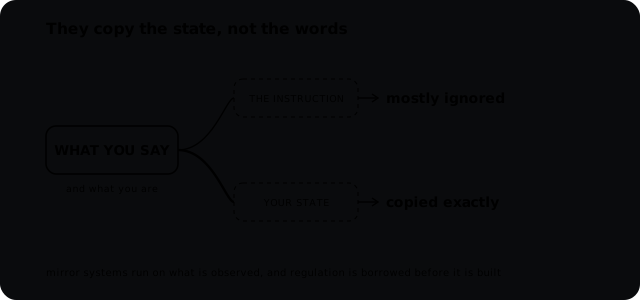
The standard parental conclusion is they don't listen. The developmental science says the opposite: they listen perfectly — just not to the channel you think you're broadcasting on. A child's brain runs two information feeds about how to be human: the explanation feed (your words, low priority, often contradicted) and the demonstration feed (your behavior and state, high priority, never off). When the feeds disagree, the demonstration wins. It has always won. The entire research tradition below is, in a sense, the documentation of that one asymmetry.
The Bobo doll and sixty years of confirmation
In 1961, Albert Bandura sat children in a room where an adult either played calmly or attacked an inflatable clown — the Bobo doll — punching it, hammering it, narrating the aggression. Then the children got the doll. The ones who'd watched aggression reproduced it, often move for move, phrase for phrase — no instruction given, no reward offered. Observation alone installed the behavior.
Six decades of social-learning research refined the picture without overturning it: children learn by watching, they preferentially copy the powerful and the loved (that's you, twice over), and fidelity peaks for emotional behavior — the handling of frustration, conflict, disappointment. Which makes brutal sense from the child's design perspective: the survival-relevant information in any tribe was never the stated policy. It was what the big ones actually did when things went wrong. Your child is not auditing your parenting philosophy. They're recording your Tuesday.
You are not raising a child who listens to you. You are raising a child who watches you — and the footage is always rolling, and the edit is always literal.
The mirror machinery (with honest caveats)
The neural story starts in 1990s Parma: researchers recording macaque motor neurons noticed cells firing both when the monkey grasped a peanut and when it watched a researcher grasp one. Mirror neurons — action machinery that runs partial simulations of observed action. The human work since points to broader "mirror system" activity associated with imitation, action understanding, and plausibly the bodily side of empathy: watching is, neurally, a quiet rehearsal.
The honest scientific caveat, because this concept got inflated into magic on its way through pop culture: exactly how much human social learning the mirror system specifically explains remains debated, and serious researchers have pushed back on its broadest claims. But notice what doesn't depend on the debate: the behavioral facts — children rehearse what they watch, imitation is automatic and early (newborns mimic facial expressions within weeks), and states transmit between bodies. The mirror story gives the phenomenon an address. The phenomenon itself was never in question — every parent's footage archive confirms it.
Stress contagion: the channel under the words
The second channel runs deeper than imitation, and it's the one I'd most want every parent to know about: your nervous system state transmits directly. In the lab, researchers have shown stress contagion concretely — in one well-known design, mothers were stressed (a hostile-audience task), then reunited with their infants: the infants' heart rates rose to track their mothers', catching a stress they never witnessed, through touch, tone, and tension alone.
This is co-regulation's double edge. The same channel through which your calm settles a melting-down four-year-old — the most important channel in early development — also carries your 11pm inbox dread, your Sunday-evening tension, your suppressed argument. Children read state like weather, because for them it is weather: their developing system calibrates against the adult systems around it, thousands of samples a year, and the calibration becomes their baseline. (This is why your own regulation is, without exaggeration, developmental infrastructure — and why the patterns that travel through families travel through behavior and state, not blood. That chain is breakable: the AI-age parenting piece covers where it fits.)
The good news: repair beats perfection
If the science stopped there, it would be a guilt engine — and parenting content has enough of those. So here's the finding that changes the assignment: the developmental literature does not require regulated-always parents. It rewards repairing ones.
Attachment research — Ed Tronick's work on mismatch and repair is the classic — shows that parent-child interaction is normally full of ruptures, and that the repair cycle itself is where children learn the deepest lesson available: connection breaks and gets fixed; storms end; people return. A child who never sees you struggle learns that struggle is shameful and hidden. A child who sees you lose it, name it, breathe, and apologize learns the complete sequence — including the part most adults were never shown. You don't need a perfect record. You need a visible recovery rate.
Stop trying to perform calm for your children — they read through performances; that's their specialty. Instead, let them watch you recover. The exhale they see you take, the apology they hear you make, the do-over they watch you request: that's the curriculum. Not your best moments. Your honest repairs.
The modeling practice
- Repair out loud, every time. "I shouted. That wasn't okay. I'm sorry — let me try that again." Thirty seconds, and it teaches rupture-and-repair, accountability, and that apologies flow downhill too — three lessons no lecture delivers.
- Narrate your regulation, not just your rules. "I'm getting frustrated, so I'm taking three slow breaths before I answer." You're making the invisible machinery visible — which is the only way a child can copy it. (Your own toolkit: the physiological sigh works at any age, witnessed or taught.)
- Close the say-do gaps they can see. The phone rule you break at dinner, the kindness policy that exempts traffic. You don't need zero gaps — you need to close the ones in the footage, or name them honestly when caught. "You're right, I'm on my phone. Closing it." is itself a modeling event.
- Audit what's running in the background. How you talk about your body, money, mistakes, other drivers, your own parents — the ambient commentary becomes their inner voice with startling directness. Pick one background pattern this month; change it where it's witnessed.
- Settle yourself before you settle them. The airline rule, validated by co-regulation science: a dysregulated adult cannot regulate a child — the channel only transmits what's actually in the sender. Your three breaths before entering the meltdown aren't selfish. They're the intervention.
It starts with your own patterns.
Children learn most from what we model. The free Life Audit shows the pattern running your own days in three minutes, with one first move you can start this week.
Take the free Life Audit →Frequently asked questions
Do children really copy their parents' behavior?
It's foundational developmental science: Bandura's Bobo doll studies showed children reproduce observed adult behavior without instruction or reward, and fidelity is highest for emotional behavior — how adults act under pressure.
What are mirror neurons in simple terms?
Neurons that fire both when doing an action and when watching it — observation runs a quiet rehearsal. The system's exact scope in humans is debated; the behavioral fact it points at (children rehearse what they watch) is not.
Why does my child copy my stress and anger?
Two channels: observational learning records your stress behavior as "what one does," and co-regulation transmits your physiological state directly — infant heart rates track their stressed mothers' in lab studies. Their biology synchronizes with yours.
How do I model better behavior for my kids?
Repair out loud when you slip, narrate your regulation so it's copyable, close the visible say-do gaps, and settle yourself before settling them. Witnessed recovery teaches more than performed perfection.