Claude Builds, Grok Bot Repeats: Why Adaptation Just Became the Skill of the Decade
What’s in this article
Anthropic's Claude builds — deep, end-to-end work. On August 11, 2026, xAI's Grok Bot joined from the opposite direction: always-on agents that watch you do a routine once, then run it while you sleep. The repeatable half of work is spoken for, and the leaderboard reshuffles every quarter — which makes adaptation the skill of this decade. It has a biology, and it runs on exactly what the machines just handed back: room in the day.
What happened, with dates
The headlines blur together, so here is the plain version.
Anthropic's Claude builds. Deep, end-to-end work — a single agent that holds a whole project and carries it from idea to shipped. I run my company on it: the site, the systems behind it, the campaigns around it. It's the reason a business our size operates like a much larger one.
And on August 11, 2026, xAI released Grok Bot into public beta, built with Cursor — a different animal entirely. Always-on agents, each with its own cloud computer, that sign into your existing tools with your credentials and keep working after you close the laptop — and they learn a workflow by watching you do it once, which is, quietly, the most radical product decision of the year. Multiple bots coordinate in group chats. In the launch coverage, one designer pointed a bot at his art pipeline and shipped 74 finished game assets in about two hours.
Two labs, opposite designs — one builds deep, one watches and repeats — and both right about their half. Read the launches together and they say one thing.
The half that never needed a human
Every business has a half that never needed a human. It just never had anywhere else to go.
Any working week splits cleanly in two. There's the part that needs a person — the decisions, the conversations, the room that goes differently because someone specific is in it. And there's the part that merely occupies one: the follow-ups, the answering, the reports, the watching. Work that runs the same no matter who does it, and that filled human calendars for one reason only — until now, humans were the only option.
That's what this month ended, from both directions at once. We've watched it happen up close: a client — a health e-commerce business — runs the whole repeatable layer end to end on engines today. Not a pilot, not a demo. The articles publish, the customers get answered, the reorders get chased, the site gets watched — and none of it comes back to a person's evening.
And there's a second fact under the first: the leaderboard reshuffles every quarter. The frontier tools have traded places roughly every three months for two years. Whichever one you commit to expires with the round.
The skill of the decade is adaptation
Put the two facts together — the repeatable half is spoken for, and no tool stays best for longer than a quarter — and the actual skill of this decade comes into focus.
It isn't prompting. It isn't picking the right tool; there is no right tool for longer than a season. It's adaptation — constant change on the outside, constant growth on the inside: re-picking, re-learning, letting a working routine expire without grieving it. The change is what the market demands; the growth is what the change deposits in the person who meets it well. The market restarts quarterly now, and it will keep restarting — the peculiar stability of this era is that the instability is dependable. The people and companies that compound are not the ones who chose best once. They're the ones who can change with the terrain, every time it moves.
We build for this deliberately. Every engine we run is replaceable by design — the workflows are ours, the direction is ours, the model underneath can be swapped without the business noticing. Held that way, each new release lands as a free upgrade instead of a crisis. That is adaptation practiced as an operating principle rather than admired as a slogan.
Even the famous line agrees, in a way nobody intends. "It is not the strongest of the species that survives, but the most adaptable" — everyone pins it on Darwin. It was written by Leon Megginson, a management professor at Louisiana State University, in 1963, paraphrasing Darwin for an audience of businessmen; the Darwin Correspondence Project has confirmed the sentence appears nowhere in Darwin's work. Then the quote did the most darwinian thing on record: it shed its author, attached itself to a bigger name, and survived. The line about adaptation survived by adapting — there is no cleaner demonstration of its own thesis.
But here is what every "skills of the future" list misses: adaptation is not an attitude. It has a biology.
Adaptation has a biology
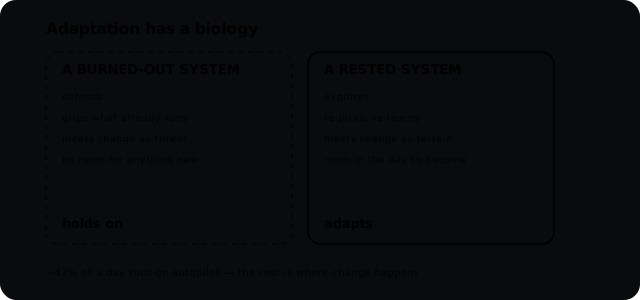
Start with the inertia. Behavioral research puts roughly 43% of daily behavior on autopilot — performed in the same context, at the same time, while attention is elsewhere — repetition without a decision. That's not a flaw. It's what habits are for: they hold yesterday in place so attention can go elsewhere. But it means a life resists change by design — asking a person to adapt is asking them to work against half of their own operating system.
Add the fragmentation tax: attention researchers at UC Irvine found it takes about 23 minutes to fully return to a task after an interruption. A day split across seven threads never fully arrives anywhere — and learning anything new requires arriving.
Then the fuel problem, which decides everything. A burned-out system defends instead of explores. The WHO classifies burnout as an occupational phenomenon — something the job does to a person, not something a person is — and its signature is the exact opposite of adaptability: gripping what already runs, because there's nothing left over for anything new. An exhausted person doesn't adapt. They hold on.
Which exposes the self-defeating loop in the standard corporate response to this era: automate, then refill the freed hours with more work. That spends the biggest labor dividend in a generation on making people less capable of the one skill the era demands.
What my research found
This is where I stop citing launches and start citing my own data.
In my master's study, I set out expecting the body to explain the mind: what adults eat, what they take, how healthy they are — measured against the stress they carried. The supplements predicted nothing. Physical health predicted nothing either: the older group in my sample had more health problems and carried less than the physically healthy younger one. One variable in the model did the predicting, and it wasn't in the body at all: how people read their own life. The ones who read theirs as worth waking up for carried the least — whatever their circumstances.
And change is a circumstance too. A person who reads their life as their own meets a reshuffled market the way they'd meet weather: as terrain, not as threat. That's the difference between the founder who swaps engines mid-race and keeps compounding, and the one who defends last season's stack because too much identity is stored in it.
A decade of studying behavior since — first in consumer research, now in building — has only sharpened the conclusion: what moves a person is what moves a business. The tools change the circumstances. How the life reads is still yours.
What human-first AI is for
Now put the layers in order, because a position falls out of them.
The economics say the repeatable half of work no longer needs a person. The market says no tool stays best for a quarter, so adaptation is the skill that compounds. The behavioral science says adaptation fights the autopilot half of a day and dies in an exhausted system — it needs attention that arrives and a nervous system with room to explore.
Human-first AI is the working order that takes all of it seriously: the machines take the repeatable half — of the business and of the day — and the dividend goes back to the person as room to become. The presence. The evening. The unhurried hour that produces the decision worth more than a week of busywork.
Maslow saw this structure a century ago. He put self-actualization at the top of the hierarchy because it's the need that only gets attention when the lower floors go quiet — and for a hundred years of working life, they never went quiet. The repeatable half of work sat on every calendar like a maintenance floor that never closed. What shipped this month is, in his terms, a quieting of the lower floors at industrial scale. The question of what a person becomes when the maintenance is handled stops being philosophy and becomes a schedule.
It is also why the other half of what we build is human: if engines are how a business adapts, a person needs a practice for the same skill. Rewiring is that practice — re-picking, re-learning, letting a routine expire without grieving it, trained on your own life before the market demands it.
Run in that order, the loop feeds itself: the machines free the person; the freed person adapts; the adapting business banks every release as leverage. Run in the reverse order — output first, person later — and the loop eats itself: the machines free the person, the freed hours get refilled, the exhausted person grips last season's stack, and the next release arrives as a threat.
Free the time. Then live in it
So let the machines take the half that never needed you. Both flavors exist now — the deep builder and the patient repeater — they're real, and refusing them doesn't protect anyone's evenings; it donates them to a competitor who said yes.
Then take the step almost everyone skips: give the freed hours to the half that did need you. Not to a fuller calendar — to the dinner where you're actually there, the walk that isn't between meetings, the hour of thinking, the life around the work. The freed time is not a productivity resource. It's the point — and, as it turns out, it's also the training ground for the one skill the next decade will keep asking of you.
One question, and it outlasts every tool cycle: which parts of your week actually need you — and which just have you? Map the two honestly. Hand the second list to the machines without ceremony. Guard the first with your life.
Free the time. Then live in it. The future of work is more life.
The Life Audit is free and comes back written: where your hours actually go, and what handing the repeatable half over would change.
Get the free Life Audit →Frequently asked questions
What is Grok Bot?
xAI's agent product, released in public beta on August 11, 2026: always-on AI agents that each get their own cloud computer, sign into your existing tools, learn workflows by watching you once, and complete multi-step jobs unsupervised while you're offline.
How is Grok Bot different from Claude?
Opposite designs. Claude is a deep builder — one agent carrying end-to-end work like sites, systems and campaigns. Grok Bot is a patient repeater — persistent bots that learn routines by observation and run them continuously. Together they cover the repeatable half of work from both ends.
Why is adaptation more important than picking the right AI tool?
Because there is no right tool for longer than a quarter — the frontier has reshuffled roughly every three months for two years. A tool choice expires with the round; the capacity to re-pick, re-learn and let routines expire compounds through every round.
What does it mean that adaptation has a biology?
Three measurable constraints: roughly 43% of daily behavior runs on autopilot, so a life resists change by design; interrupted attention takes about 23 minutes to fully return, so fragmented days can't learn; and burnout — an occupational phenomenon per the WHO — flips a person from exploring to gripping. Adaptation needs a rested human with room in the day.
What does human-first AI mean?
A working order: machines take the repeatable half — of the business and of the day — and the dividend goes back to the person as room to become: presence, evenings, unhurried thinking. The reverse order, output first and person later, produces exhausted teams that can't adapt.
Why does how you read your own life matter for adapting?
In the author's master's research, how people read their own life was the variable that predicted the stress they carried — physical health and supplements predicted nothing. Change is a circumstance too: a person who reads their life as their own meets a reshuffled market as terrain, not threat.
Did Darwin really say "it is not the strongest of the species that survives, but the most adaptable"?
No. The line was written in 1963 by Leon Megginson, a management professor at Louisiana State University, as a paraphrase of Darwin for a business audience — the Darwin Correspondence Project has confirmed it appears nowhere in Darwin's writing. Fittingly, the quote survived by adapting: it shed its author and attached itself to a bigger name.