The infrastructure you forgot you built
People who say they're "bad at habits" are running dozens of perfect ones before 9am: the alarm dismissed the same way, the kettle filled, the shower sequence executed in identical order, the keys checked at the same pocket-pat. None of it requires motivation, none of it gets skipped on hard days, and none of it was ever on a goals list. It's automaticity — the brain's compiled code — and you own a library of it.
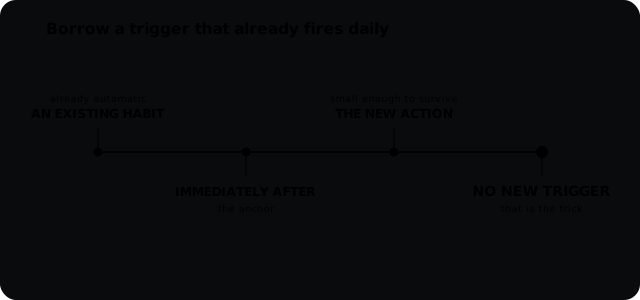
The strategic insight of habit stacking is almost rude in its simplicity: that library has open attachment points. Every existing routine ends somewhere — the coffee finishes pouring, the toothbrush goes back in the cup — and each ending is a precision-timed, daily-firing, zero-maintenance trigger that a new behavior can ride. Instead of asking a new habit to survive on memory and enthusiasm (the plan that has failed you every January), you wire it to machinery with a decade of uptime. The kettle has never once forgotten to boil.
The science: if-then beats someday
Under the friendly branding sits one of the most replicated findings in behavioral science. Peter Gollwitzer's implementation intentions research asked a simple question: what happens when people convert goals ("I'll exercise more") into if-then plans ("If it's Monday at 7am, then I run before showering")? His meta-analysis across roughly 94 studies found the format produced a medium-to-large jump in follow-through — in practical terms, roughly doubling goal completion in many domains, from exercise to screenings to studying.
The mechanism is delegation: an if-then plan hands the decision to the situation. Without it, every performance of the new behavior requires an in-the-moment choice — and in-the-moment choices are made by whoever you are in that moment, frequently tired and lobbied by the couch. With it, the cue fires and the behavior follows with the decision already made, weeks earlier, by calm-you. Habit stacking is simply the implementation intention with the best possible trigger: not a time (which you must notice) or a context (which varies), but an existing habit — a cue your nervous system already executes flawlessly. (And the new behavior, once riding, automates by the standard rules: repetition on a stable cue, ~66 days median.)
Goals run on remembering and wanting — two systems with terrible uptime. Stacks run on triggers that already fire. The kettle doesn't need to feel motivated.
Choosing anchors: the three properties
The stack is only as strong as its anchor, and good anchors share three properties:
- Daily, without fail. The coffee, the teeth, the commute, sitting down at the desk. An anchor that fires five days in seven trains a five-in-seven habit — and the gaps reset progress. (Weekend-different routines are the classic silent saboteur; pick anchors that survive Saturdays.)
- Consistent time and place. The association forms fastest when the cue arrives in the same context — same kitchen, same hour. "After lunch" at a desk Monday, a café Tuesday, and skipped Wednesday is a moving target; consistency is a property of the architecture before it's a property of you.
- A crisp end-moment. The new behavior needs an exact "now": after I put my plate in the dishwasher beats after dinner; after I park and turn off the engine beats after work. Mushy boundaries make the brain renegotiate, and renegotiation is where stacks go to die.
One refinement worth stealing from behavior design (BJ Fogg's version of this is "anchor moments"): match the location and energy of anchor and behavior. Breathing exercises stack beautifully onto coffee (same kitchen, calm register); squats stack onto teeth-brushing (same bathroom, body already standing). A stack that requires changing rooms or moods pays a tax at exactly the moment it can't afford one.
Building the stack
- Inventory your anchors. List your bulletproof daily routines, morning to night — most people find eight to fifteen. This list is your real estate.
- Pick one behavior, sized tiny. Two minutes or less to start: three breaths, three sentences, ten squats, one glass of water. The stack's job is installing the showing up; volume grows later on an automatic foundation. (This is the floor principle wearing its habit clothes.)
- Write the sentence and say it. "After I [anchor], I will [behavior] in [place]." Specific, spoken, ideally posted where the anchor happens — a note on the coffee machine outperforms a goal in an app, because it lives at the trigger.
- Run it for the anchor's next 30–60 firings. Track attendance only. Miss one? Never miss twice — the anchor fires again tomorrow, which is the entire beauty of the method: the trigger forgives, because it never stops arriving.
- Extend only after automation. When the behavior happens before the debate can convene — that's the signal. Then either grow it (three sentences become a paragraph) or stack the next behavior onto a different anchor. Resist the morning-routine-of-twelve fantasy; chains fail at their weakest link, and every link is weakest while new.
Stop asking "how do I remember to do the new thing?" — memory was never going to staff this. Ask instead: "which of my existing routines should this ride on?" You're not building a habit from nothing. You're adding one car to a train that's been running on time for years.
The four failure modes
- Unstable anchor. The behavior was stacked on a routine that itself wobbles. Audit honestly: does the anchor truly fire daily, same time, same place? If not, re-anchor — don't re-resolve.
- Oversized passenger. The 45-minute workout stacked on the coffee pour worked twice, then the anchor started triggering avoidance instead of action — the association forming in reverse. Shrink until the behavior is small enough that skipping feels sillier than doing.
- The mega-chain. Five new behaviors in sequence — one bad morning breaks link two, and links three through five never fire. One stack at a time; the train grows car by car.
- The invisible vague. "After breakfast I'll plan my day" — where? when exactly? with what? Stacks fail in their mushy clauses. Rewrite until a stranger could verify compliance: after I put my plate in the dishwasher, I open the notebook on the counter and write the day's top task. Verifiable is executable.
And the meta-rule under all four: when a stack fails, interrogate the architecture, not your character. A decade of watching people build and break these taught me the failure is in the sentence's design nine times out of ten — and sentences, unlike characters, can be redrafted before lunch.
One stack is a habit. A system is a life.
Seven questions, about a minute. See where your current architecture leaks — and which stack to build first.
Take the Free Assessment →Frequently asked questions
What is habit stacking?
Wiring a new behavior onto an existing daily habit — "after I pour my coffee, I write three sentences" — so the new behavior inherits a trigger that already fires reliably. The science underneath is Gollwitzer's implementation-intentions research.
Why does habit stacking work?
It solves the cue problem (stable trigger, pre-load-tested) and pre-decides (if-then plans move the choice from tired-you to calm-you). If-then formats roughly doubled follow-through across ~94 studies.
What are good habit stacking examples?
After coffee → three breaths or sentences; after teeth → ten squats; after sitting at desk → write the top task; after dinner → ten-minute walk. Anchors must be daily, consistent in time and place, with crisp end-moments.
Why do my habit stacks keep failing?
Unstable anchor, oversized behavior, too-long chain, or mushy phrasing. Fix the architecture — re-anchor, shrink, single-stack, rewrite until verifiable — before doubting your discipline.