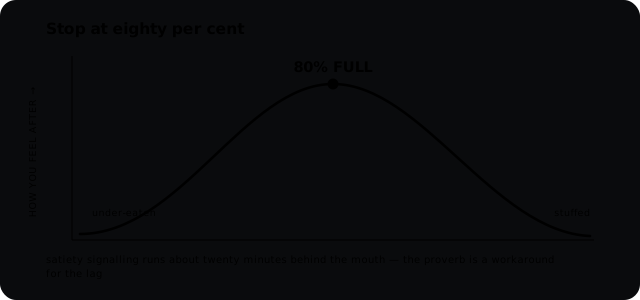
A proverb with a mechanism
Before meals in Okinawa — home to one of the best-documented concentrations of healthy old age on earth — many people still say a small phrase the way others say grace: hara hachi bu. Belly, eight parts of ten. It's eating advice compressed to four syllables: stop before full.
I'm professionally suspicious of longevity folklore — the blue-zone record-keeping has real problems, and proverbs aren't data. But this particular practice earns its place for a reason most folklore doesn't: it encodes a measurable piece of physiology, one that modern eating violates at almost every meal. Strip away the postcard and you're left with an instruction a gastroenterologist could have written.
The 20-minute lag your fork keeps winning
Satiety is not a live feed. When food reaches your stomach, the fullness report travels to the brain through a slow relay — stretch receptors, gut hormones (CCK, GLP-1, PYY) released as food moves along, blood glucose shifting. The whole broadcast takes roughly twenty minutes to arrive in consciousness as "I've had enough."
Now put that lag against a modern meal: soft, calorie-dense, engineered-to-be-eaten-fast food, consumed in ten minutes over a screen. The race is over before the referee arrives. You eat to a felt 100% — which, twenty minutes later, settles in as a stuffed 120% — and the discomfort after every big meal is just the late report finally landing. Repeat at two meals a day for a decade and the lag alone, no gluttony required, quietly finances the weight gain that no diet seems to touch.
Hara hachi bu is simply eating with the lag priced in. Stop at a felt 80%, and when the broadcast arrives, you're at a true, comfortable 100%. The Okinawans didn't know the hormone names. They knew the feeling — and built a sentence to catch it.
You're not overeating because you're undisciplined. You're overeating because your fork is faster than your hormones — at every single meal.
What the evidence says about eating less
The deeper claim under the practice — that habitually eating somewhat less extends healthspan — has more laboratory support than almost anything else in longevity science. Caloric restriction without malnutrition extends lifespan across nearly every organism tested: yeast, worms, flies, rodents. In humans, the landmark CALERIE trial couldn't measure lifespan (no 80-year trials exist), but two years of mild restriction — participants achieved about 12% below baseline — improved cardiometabolic markers and slowed measures of biological aging.
Hold that 12% next to the proverb: stopping at 80% of fullness, in practice, lands within range of exactly that kind of mild, sustainable reduction — achieved without weighing, logging, or thinking about food more than you already do. Historical Okinawan caloric intake ran meaningfully below the mainland's, with the practice as one plausible contributor.
The honest boundaries: severe chronic restriction has real costs (muscle, bone, hormones, life enjoyment) and is not the recommendation; aging adults in particular need protein protected. The defensible claim is narrower and still powerful: chronic caloric excess is the metabolic default of modern life, and the 80% rule removes it gently.
Why this survives where diets die
Every diet you've watched fail — your own or anyone's — died of one of two wounds, and hara hachi bu carries neither:
- It bans nothing. Restriction psychology is well-documented: forbid a food and you've assigned it a spotlight, scheduled the craving, and pre-written the binge that follows the first slip. The 80% rule never triggers the loop because the menu is untouched. Pasta, dessert, your grandmother's everything — all permitted. Only the stopping point moves.
- It has no app to abandon. Counting works while you count; the research on diet adherence shows most people stop within months, and the weight returns with interest. A calibrated sense of "eight parts full" can't be uninstalled. It walks into every restaurant, wedding, and decade with you — which is why a slightly imprecise rule you run for thirty years beats a precise one you ran for ninety days.
There's a quieter benefit underneath both: the practice is interoception training — the skill of reading your body's internal signals. Most chronic overeating isn't hunger at all; it's stress, boredom, and habit wearing hunger's coat (that system is its own article). Three weeks of genuinely asking how full am I? mid-meal rebuilds a signal-reading skill that pays far beyond the plate.
Stop treating fullness as the finish line of a meal. Fullness is the overshoot — the signal that arrived too late. The real finish line is "no longer hungry," and it comes a few bites earlier than you think. The practice isn't eating less. It's hearing sooner.
The practice: calibrating your 80%
- Define the target feeling: no longer hungry, not yet full. You could take a brisk walk comfortably. You'd happily eat more if it appeared — and you're choosing not to, today, at this meal.
- Slow the fork — the lag demands it. Put it down between bites for the first week. Chew like the meal isn't fleeing. A meal stretched past fifteen minutes gives the satiety relay a chance to testify before the verdict.
- Check in at half-plate. One question, mid-meal: where am I, zero to ten? The first week you'll have no idea — that's the untrained signal, not failure. By week three the readings arrive unprompted.
- Make seconds a decision, not a reach. Serve from the counter, not the table. Smaller plates, honestly assessed. Twenty seconds of friction is the difference between an impulse and a choice — the same design principle as everywhere else.
- End with the phrase, or your version of it. "That's eight parts." A spoken stopping ritual sounds quaint and works like a latch — the Okinawans put it before the meal as a prime; either end does the job.
- Expect a strange week one. Stopping pre-fullness feels like leaving mid-sentence at first — twenty minutes later you feel exactly right, and that delayed rightness is the training signal. Trust it over the at-table feeling for twenty-one days, and the at-table feeling recalibrates itself.
One rule from a longer protocol.
The 80% rule is one chapter of Longevity — sleep, energy, food timing, movement, all evidence-ranked. One action a day, for ninety days.
See Longevity →Frequently asked questions
What is hara hachi bu?
The Okinawan practice of eating until about 80% full — "belly, eight parts of ten" — spoken before meals as a reminder. It works because satiety signals lag eating by ~20 minutes: a felt 80% becomes a true 100% once the report lands.
Does eating less actually extend lifespan?
Mild restriction is the most consistent longevity intervention in lab biology, and the human CALERIE trial showed improved cardiometabolic and biological-aging markers at ~12% reduction — roughly what the 80% rule produces naturally. No human lifespan trial exists; avoiding chronic excess is the defensible core.
How do I know when I'm 80% full?
No longer hungry, not yet full — you could take a brisk walk comfortably. Train it: eat slower, check in at half-plate, make seconds a decision. The signal calibrates in two to three weeks.
Is the 80% rule better than calorie counting?
Over years, usually — adherence beats precision. Counting is exact and gets abandoned; a calibrated satiety sense travels everywhere and bans nothing, so it never triggers the restriction-rebound loop.