What neuroplasticity actually means
Neuroplasticity is the brain's ability to reorganize itself by forming new neural connections — and pruning old ones — in response to experience. For most of the 20th century, scientists believed the adult brain was essentially fixed: you got the wiring you got, and decline was the only road from there.
That belief is dead. We now know the brain remodels itself continuously, across the entire lifespan. Every time you learn a skill, rehearse a thought, or repeat an emotional reaction, you physically strengthen the neural circuit that produces it. Neurons that fire together, wire together — a principle named Hebbian learning after psychologist Donald Hebb.
This cuts both ways. The same mechanism that lets you learn a language also etches anxiety, avoidance, and self-doubt deeper every time you practice them. Most people are rewiring their brains all day long — toward the patterns they least want. The skill isn't starting plasticity. It's aiming it.
You are not stuck with the brain you have. You are stuck with the brain you keep repeating.
The proof: brains that visibly changed
This isn't motivational language. Adult brain change is one of the most replicated findings in modern neuroscience, and you can see it on a scan.
- London taxi drivers. Eleanor Maguire's research at University College London found that licensed London cabbies — who memorize a labyrinth of 25,000 streets — had measurably enlarged posterior hippocampi, the brain region for spatial memory. The longer they'd driven, the larger it was. Their brains had physically grown to meet the demand.
- Stroke recovery. Constraint-induced movement therapy works precisely because undamaged brain regions take over functions of damaged ones. Adults relearn movement by rewiring around the injury.
- Meditation. Sara Lazar's work at Harvard found that eight weeks of mindfulness practice increased gray-matter density in regions tied to learning, memory, and emotional regulation — and decreased it in the amygdala, the brain's threat center.
- Musicians and athletes. Decades of imaging show expanded motor and auditory cortices in proportion to practice hours.
The common thread: focused, repeated, emotionally engaged practice physically reshapes the adult brain. Which brings us to the conditions that make it happen.
The five conditions for rewiring
Plasticity isn't automatic just because you want something. It's gated by specific neurological conditions. Miss them and you can repeat an affirmation for a year with nothing to show for it.
| Condition | What it does | What kills it |
|---|---|---|
| Focused attention | Tags a circuit as "important," releasing acetylcholine to mark it for change | Multitasking, distraction, passive scrolling |
| Repetition | Strengthens and myelinates the pathway with each rep | Inconsistency, all-or-nothing effort |
| Emotional salience | Dopamine and norepinephrine flag the experience as worth keeping | Boredom, disconnection from why it matters |
| Sleep | Consolidates the day's wiring into long-term structure | Sleep deprivation, irregular schedule |
| Regulation | A calm nervous system permits learning and change | Chronic stress, threat, overwhelm |
That last row is the one nearly everyone skips — so it gets its own section.
Why regulation comes first
When your nervous system perceives threat — deadline pressure, conflict, financial fear, even self-criticism — it shifts into survival mode. Blood and energy route away from the prefrontal cortex (planning, learning, choice) toward fast, automatic responses. In that state, your brain isn't building new pathways. It's defaulting to the strongest old ones, because under threat, familiar beats better.
This is the biological reason change collapses the moment life gets hard. You can only rewire from a regulated state. Calm isn't a nice-to-have; it's the precondition for plasticity.
Why your attempts haven't stuck
If you've tried to change and watched it evaporate, you almost certainly weren't lazy or broken. You were missing conditions. Here's the usual pattern:
- You relied on willpower (the weakest, most depletable lever) instead of designing the conditions.
- You tried to change while chronically stressed — wiring shut for renovation.
- You practiced without focus, half-present, phone in hand.
- You were inconsistent, so no pathway ever got strong enough to win under pressure.
- You worked on the behavior while ignoring the identity and nervous-system patterns producing it.
We go deeper on that last point in Why change never lasts — and the one shift that makes it permanent. The summary: behavior is the output. Rewire the source.
A practical rewiring protocol
Here's how to assemble all five conditions into something you can actually run. None of this requires special equipment — just sequence and consistency.
1. Regulate before you rewire (2–5 min)
Before any practice, downshift your nervous system. The fastest evidence-based tool is the physiological sigh: two inhales through the nose (one long, one short top-up), followed by a long exhale through the mouth. Three to five rounds measurably lowers arousal. You're opening the window plasticity needs.
2. Choose one pathway, name it precisely
Vague goals don't rewire anything. "Be more confident" gives the brain nothing to repeat. "When I feel the urge to apologize for taking up space, I pause and finish my sentence" is a specific circuit. Specificity is what focused attention can grab onto.
3. Rehearse with full attention and emotion
Run the new pattern — in real life or vivid mental rehearsal. The brain barely distinguishes detailed visualization from lived experience; both fire the circuit. Engage the why so dopamine tags it as worth keeping. Attention plus emotion is the marking signal.
4. Repeat daily, small over big
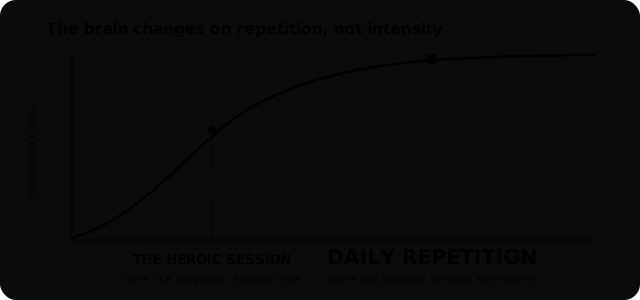
Twenty focused minutes beats two distracted hours. Daily reps win because plasticity rewards frequency. Miss a day, fine — just never miss twice. Momentum is a circuit too.
5. Sleep on it, on purpose
Protect your sleep like part of the practice, because it is. The consolidation that turns today's effort into permanent structure happens overnight. Skipping sleep is skipping the save button.
You don't force the new behavior into place. You build the pathway under the right conditions — regulated, focused, repeated, emotionally real, and consolidated in sleep — until it becomes the path of least resistance. Then the behavior runs itself.
What to expect, week by week
People quit because they expect change to feel finished in a week. Real rewiring has a shape. Here's the honest timeline.
| Window | What's happening | What it feels like |
|---|---|---|
| Days 1–7 | Functional changes begin; circuit is new and fragile | Effortful, awkward, easy to forget |
| Weeks 2–4 | Pathway strengthens; myelination begins | Slightly easier; old pattern still wins under stress |
| Weeks 5–9 | Automaticity approaches (~66-day average) | New response starts arriving on its own |
| Weeks 10–12+ | Deeper emotional and identity rewiring consolidates | It stops feeling like effort and starts feeling like you |
The gap between week one and week ten is where almost everyone quits — right before the wiring would have held. Knowing the curve is half the battle.
Rewiring is easier with a guide that adapts to you.
Marsa runs this science with you every day — regulating, focusing, and repeating the right patterns until they become who you are. Start with a free assessment of the system running underneath your results.
Take the Free Assessment →Frequently asked questions
Can you really rewire your brain at any age?
Yes. Neuroplasticity continues throughout the entire lifespan. Children's brains are more plastic, but adult brains remain capable of significant structural change — documented in taxi drivers, stroke patients, and meditators. Age changes the pace, not the possibility.
How long does it take to rewire your brain?
Functional changes begin within days. Behavioral automaticity averages around 66 days, with wide individual variation. Deeper rewiring of emotional and stress patterns typically takes 8 to 12 weeks of consistent practice.
What conditions does neuroplasticity require?
Focused attention, repetition, emotional salience, adequate sleep, and a regulated nervous system. Remove any one — especially regulation — and plastic change stalls.
Why do my attempts to change never stick?
Usually because they rely on willpower while ignoring the conditions plasticity needs. Under stress, the brain reverts to its strongest existing pathways. Lasting change means building the new pathway under the right neurological conditions, not forcing the behavior.