Oura Is Being Sued. The Ring Was Never the Problem.
What’s in this article
Oura is being sued over the precision of its sleep tracking. The complaint is about a number. Sleep is decided somewhere the number cannot reach: at 10pm, by what you do.
What the lawsuit claims
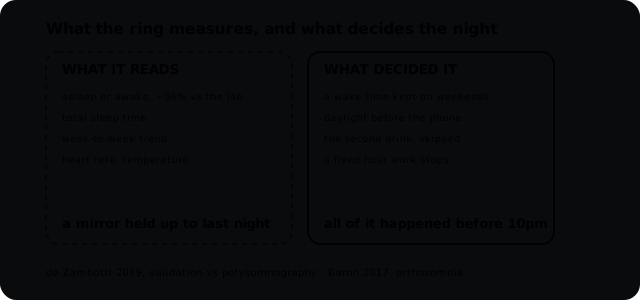
The class action, reported by TechCrunch this week, says Oura's sleep tracking is less accurate than its marketing suggests. That may be true. Oura's own validation study, published in 2019, found the ring agreed with laboratory polysomnography on whether you were asleep or awake about 96% of the time, and on which sleep stage you were in far less often. That is roughly what every consumer wearable manages. Staging sleep from a finger or a wrist is hard, and the companies know it.
So the court will spend months on a decimal point. Here is what it will not touch.
The number that keeps you awake
Sleep clinicians have a name for people who got worse after they started tracking. Orthosomnia. Baron and colleagues described it in 2017: patients arriving with a flawless bedtime routine and a device telling them they had failed, lying in bed trying to produce a better score. The measurement had become the stressor.
That is the quiet cost of a mirror you check every morning. It shows you the night. It changes nothing about the evening that produced it.
What actually moves the night
What changes 10pm is older and cheaper than any sensor. A wake time you keep on weekends, because the clock sets itself from when you get up, not when you lie down. Daylight in your eyes before the phone. The second drink you skip; alcohol is the single input a wearable shows most clearly, and the one the score cannot fix. The work you stop at a fixed hour instead of when it is done.
None of these need a ring. All of them show up in the ring, which is the one honest thing it does.
Your body already keeps the score
Resting heart rate in the morning. Whether you want a third coffee at 2:47pm. Whether the stairs got harder this year. The body has been keeping the score for as long as you have had one; the ring reads it back with a decimal point and a colour.
The decimal point was never the problem. The question was always what you do about the night, and how you read it.
My own research went looking in the obvious places for what protects people under pressure: nutrition, supplements, physical health. None of them predicted it. How someone read their own life did. A ring can measure the night. Only you can read it.
The Life Audit is free and comes back written: where your hours actually go, and what handing the repeatable half over would change.
Get the free Life Audit →Frequently asked questions
Is the Oura ring accurate?
For asleep versus awake, roughly as accurate as any consumer wearable; Oura's 2019 validation against laboratory polysomnography reported about 96% sensitivity for sleep. For sleep stages the agreement is considerably lower, which is true of every wrist or finger device. Treat the stage breakdown as an estimate, not a measurement.
What is orthosomnia?
A term coined by Baron and colleagues in 2017 for people whose sleep got worse because of sleep tracking: the pursuit of a better score became a source of anxiety that itself disrupted sleep. The fix in the case reports was simple: stop checking the score for a while.
Should I stop wearing a sleep tracker?
Only if the number has started to run your mornings. Used as an occasional audit, a wearable shows two things clearly: what alcohol does to your night and what an inconsistent wake time does to your week. If you already know both, the ring is telling you nothing you cannot feel.
Sourcetechcrunch.com ↗