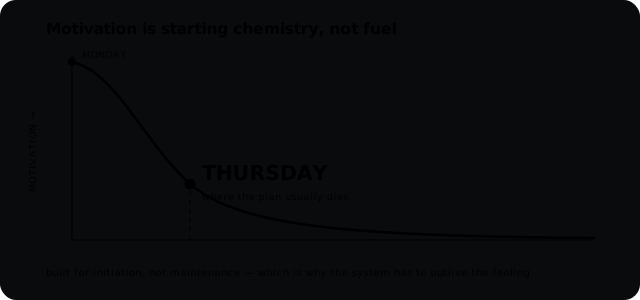
The Monday fire, examined
Reconstruct the last time motivation visited you properly. Probably a trigger — a documentary, a photo, a birthday, someone else's transformation. Then the surge: the plan written in one sitting, the app downloaded, the groceries replaced. The feeling is genuinely glorious, and it carries one embedded promise: this feeling is how the change will be powered.
That promise is the lie — not yours, your chemistry's. Notice the precise timing of the surge: it peaked before you had done anything. Day zero. The fire was at maximum when the work done was at zero, and every day of actual execution after that, the fire was a little smaller. By Thursday, gone — and here's the part that matters — gone on schedule. Nothing failed. You ran a starting system and expected it to sustain, like being angry at an ignition key for not being an engine.
The mechanism: prediction error
The chemistry under motivation is dopamine, and dopamine is widely misbranded as the "pleasure molecule." Its actual job, mapped in Wolfram Schultz's classic experiments, is closer to a prediction-error signal: it fires hardest when reality promises more than expected, and it goes quiet when outcomes merely match predictions.
Run your Monday through that machine:
- The new plan is pure unpredicted promise — a future self, vividly imagined, all upside, zero data. Maximum prediction error, maximum spike. This is why the planning night feels euphoric: anticipation is the product, and you already consumed it.
- Execution generates data. The workout is hard, the salad is fine, results are invisible at day four. Reality reports in, predictions adjust downward toward accuracy, and the error — the gap that fired the spike — closes.
- Repetition completes the silence. By week three the behavior is fully predicted. Chemically: nothing. Experientially: "I don't feel like it anymore." The system isn't broken. It's calibrated — and calibration feels like the death of motivation because it is.
Motivation doesn't abandon you. It completes its job — starting you — and clocks out. The error was assigning it a second job it has never once performed for anyone.
The plan-switcher's trap
Once you see the mechanism, you can see the trap it sets — and you've likely met people deep inside it, or been one. If novelty is what spikes the chemistry, there's an obvious way to feel motivated forever: keep switching plans. New program, new app, new diet, new niche, new business model — each one delivers a fresh, honest, chemically real surge. The switcher isn't weak-willed; they're chasing the only part of the process their reward system actually pays for.
The cost is silent and brutal: every switch resets the clock on the only thing that produces results, which is boring accumulated repetition. The plan-switcher experiences more motivation than anyone in the gym — and owns the least progress, because progress lives precisely in the chemically quiet zone they keep escaping. (The same loop, pointed at content instead of plans, is the dopamine story — different costume, same molecule.)
The diagnostic question, worth asking once a quarter: am I changing strategy because the strategy failed — or because it stopped paying me in feelings?
Building for the cold
So the design brief writes itself: build a system that runs at zero motivation, because zero is the guaranteed operating condition within weeks. Everything below works in the cold:
- Set the minimum dose at survives-your-worst-Thursday. Not the dose that impresses anyone — the one that's executable while tired, busy, and uninspired. Two minutes of stretching. Three sentences. One set. The repetition is what builds automaticity; the size can grow later, on top of a foundation that never broke.
- Anchor to a cue that already happens. "After I pour my coffee" beats "when I feel ready" — because the coffee happens daily and the feeling doesn't. You're wiring the behavior to the calendar, not the mood.
- Let the environment do the wanting. Shoes by the door, phone in the kitchen, the document already open. On cold days you don't need desire — you need the next action to be the easiest object in the room. (Full toolkit: discipline is design.)
- Buy commitment with teeth. A partner expecting you, a paid booking, money staked. Calm-you decides once; cold-you inherits a decision too expensive to unwind.
- Track attendance, not transformation. Results lag by months and feelings lie by Thursday — but "did I show up: yes/no" is a number you control completely, and a chain of yeses is its own quiet payment. You're giving the prediction system something small and real to be right about.
Stop treating motivation as fuel and start treating it as weather. You don't cancel the harvest because Tuesday is overcast; you built irrigation precisely because you knew the rain was occasional. Feelings are forecast-proof on no known system. Calendars, cues, and environments are.
Motivation's proper job
None of this exiles motivation — it has a real job, and it's excellent at it. Use the spike for what spikes are for: starting things, choosing directions, and funding the setup costs. The Monday fire is the right time to book the sessions, find the partner, redesign the kitchen, write the implementation intentions — to spend the surge building the system that won't need it. That's the whole trick: convert weather into infrastructure while the weather is good.
And below all of it runs the layer where this finally becomes permanent: repetition compounds into identity, "I'm trying to run" becomes "I'm a runner," and the behavior starts defending itself — no spike required. That layer is the deepest one we work with, and it has its own article: why change never lasts.
Stop rebuilding on a feeling. Build on a system.
Seven questions, about a minute. See which layer keeps collapsing — and what to build there instead.
Take the Free Assessment →Frequently asked questions
Why do I lose motivation so quickly?
Because motivation runs on dopamine's prediction-error signal, which pays for novelty and anticipation — both decay on contact with repetition. The spike peaks before you start and quiets as the behavior becomes predicted. It's calibration, not failure.
How do I stay consistent without motivation?
Build for zero-motivation days: a minimum dose that survives your worst Thursday, stable daily cues, an environment where starting is the easiest move, commitments with teeth, and tracking attendance instead of feelings.
Is discipline better than motivation?
Both lose to design. Effortful discipline fails under stress; motivation fails on schedule. The working hierarchy: design first, identity second, motivation third — welcomed when present, never load-bearing.
What's the difference between motivation and dopamine?
Dopamine is a prediction signal — it spikes for better-than-expected and quiets for as-expected. Motivation is the felt urge that signaling produces. That's why new plans feel electric and week three feels like nothing: no prediction error, no spike.