"And then I did the thing"
A client — successful, self-aware, exhausted by her own pattern — once summarized it in a sentence I never improved on: "Everything was finally going well. So, naturally, I did the thing." The thing varies by person: the inexplicable missed deadline on the project that was about to land. The fight picked the week the relationship got truly safe. The diet broken the night before the milestone weigh-in, with a precision no enemy could match.
What unites every version is the timing. Self-sabotage doesn't strike randomly — it strikes on approach: near the finish line, after the win, in the unfamiliar quiet of things working. That timing is the diagnostic clue the "character flaw" story can't explain and the systems story explains perfectly. Flaws fire randomly. Regulators fire at thresholds.
The thermostat model
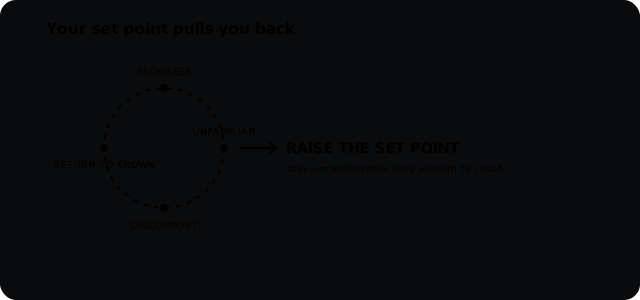
Your body runs on homeostasis — temperature, glucose, blood pressure all held near set-points by systems that correct deviations in either direction. The psychological apparatus runs a remarkably similar program around something less visible: the familiar range — of success, intimacy, calm, visibility, money — that your history calibrated as "normal for someone like me."
Here's the part that reorganizes everything: the range defends familiarity, not quality. A person whose normal was chaos finds calm physically uncomfortable — the quiet reads as the held breath before something breaks. A person whose normal was being overlooked finds visibility alarming. When life rises above the familiar ceiling, the discomfort is real, somatic, and nameless — and the psyche resolves nameless discomfort the efficient way: return conditions to the setting. Miss the deadline. Pick the fight. Do the thing.
From inside, this never feels like sabotage. It feels like the deadline genuinely slipping, the fight genuinely being about the dishes. The system is old enough and quiet enough that its corrections arrive disguised as circumstances. (Gay Hendricks calls the ceiling version the "upper limit problem" — the pop framing; the clinical machinery below is what's actually turning the dial.)
The thermostat doesn't hate the heat. It just returns the room to the only temperature it was ever taught to call home.
The four mechanisms, named
1. Identity coherence — the deepest one
If your self-image says "people like me don't get to have this," then success creates a contradiction — and as the self-verification research shows, the psyche resolves contradictions in favor of the existing identity with unsettling reliability. The achievement gets un-achieved not despite the win but because of it: the win was evidence against the incumbent self, and the incumbent voted it off the record. This is why sabotage so often follows the milestone rather than preceding it.
2. Self-handicapping — the insurance scheme
Documented since Berglas and Jones (1978): people pre-install obstacles before performances that matter — the all-nighter before the exam, the "didn't really prepare" before the pitch. The payoff is attributional: failure now blames the obstacle, not the ability ("I'd have done well with more time"), and success-despite-obstacle reads as extra talent. It's a brilliant defense of self-image with one flaw: it's purchased with the actual outcome, every time. Most common where self-worth is welded to proving competence — which is why procrastination on your most important work is so often this mechanism wearing a time-management costume.
3. The unfamiliar-state alarm
Calm, abundance, and safety are states, and to a nervous system calibrated on their absence, they're unfamiliar states — which the threat system treats as suspicious by default. The peace feels like the eye of something. The good month feels like a setup. Many people then generate a crisis simply to return to a state they have skills for; chaos, after all, is home turf. (This is regulation work as much as psychology work — the system has to learn that calm is survivable.)
4. Secondary gains — the quiet payroll
The honest, awkward one: the problem pays. The struggle that earns sympathy, the chaos that excuses the unattempted dream, the busyness that holds intimacy at a comfortable distance. None of this is conscious scheming — it's old accounting still running. But until the payment is named, the problem has a salary, and salaried problems don't resign.
Mapping your trigger thresholds
Sabotage is predictable, which makes it auditable. Take the last three "and then I did the thing" episodes and ask three questions of each: What was going unusually well just before? (Completion, visibility, intimacy, calm, money — circle the recurring one; most people have a primary axis.) What form did the correction take? (Procrastination, conflict, abandonment, health collapse — your equipment has a signature move.) What did the return-to-baseline protect you from feeling? Exposure? Responsibility for sustained success? The grief of how long the old ceiling held?
Three episodes are usually enough to see it: not randomness — a regulator, with a setting, firing at its threshold. That visibility alone changes the next episode, because a correction you can see coming is a correction you can interrupt.
Stop asking "what's wrong with me?" — that question feeds the incumbent identity. Ask instead: "what is this pattern protecting, and is the protection still needed?" Self-sabotage is almost always yesterday's safety strategy running on today's life. You don't defeat it. You thank it, audit it, and retire it.
The repair: moving the setting
- Name the correction in real time. "Things are going well, and I notice the urge to do the thing." Naming converts you from the system's instrument into its observer — and regulators lose most of their power over observed processes.
- Expand the range in increments, not leaps. Thermostats recalibrate by sustained exposure, not arguments. Let life be 10% better than familiar and practice staying there — through the discomfort, with regulation tools (the long exhale exists precisely for the moment "too good" starts to itch). Each tolerated week at the new level moves the setting.
- Pre-commit at your known thresholds. If your signature move is the pre-completion stall, build accountability that activates near finish lines. If it's the post-win fight, schedule the difficult conversations away from the good weeks. You know your equipment now; design around its firing schedule.
- Retire the secondary gain openly. Find the legitimate version of what the problem was paying you — rest without crisis, attention without struggle, distance negotiated instead of engineered. The problem resigns when its job has been honestly reassigned.
- Vote the new identity in. The ceiling, ultimately, is the self-image's — and self-images yield to accumulated, undeniable evidence. Small daily votes for "someone whose life works at this level" is the long game that makes every other repair permanent.
When it's deeper than a setting
The honest clinical line: when good states produce not just itchiness but dread — when success triggers somatic alarm, when the pattern traces to a history where achievement or visibility was genuinely punished — that's not a thermostat quirk; that's old protection with deep roots, and it deserves a qualified professional, not a protocol. Everything above remains useful alongside that work. Nothing above replaces it. The strongest move a self-saboteur can make is, fittingly, the one the pattern most resists: letting someone help before the wheels come off.
Find your setting.
Seven questions, about a minute. See which system is holding the ceiling — and where the repair starts.
Take the Free Assessment →Frequently asked questions
Why do I sabotage myself when things are going well?
Because "well" often means "outside the familiar range," and your protective systems defend familiarity, not happiness. Identity coherence, unfamiliar-state alarm, and old learned costs of success all pull life back to the known setting.
What is self-handicapping?
Pre-installing obstacles before performances that matter (procrastination, under-preparing) so failure blames the obstacle, not your ability. Attributional insurance — paid for with the actual outcome.
How do I stop self-sabotaging?
Map your thresholds (it fires predictably), name the protective function, expand the familiar range in 10% increments while regulating the discomfort, retire the secondary gains openly, and vote in the identity the new level belongs to.
Is self-sabotage a trauma response?
Sometimes — when success or visibility was historically punished, sabotage is old protection still running, and that depth deserves professional support. The tell is intensity: if good news produces physical dread, work with someone qualified.