AI removed every bottleneck in your business but one: you
What's in this article
For decades, scaling a business meant two things: hire more people, and grind yourself harder. AI just rewrote the first one. And in doing so, it quietly revealed the bottleneck that was there the whole time — the one no org chart ever showed you.
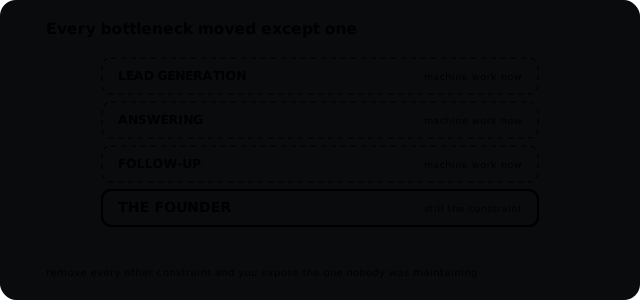
This is the strategic shift most founders are missing in the AI wave. They're racing to automate, which is correct, and then hitting a wall they can't explain. The wall has a name, and understanding it is the difference between a business that scales past you and one that just exhausts you faster.
The shift no one prepared you for
Until recently, the binding constraint on most businesses was labor capacity. There was always more work than hands. So you hired — and every hire pushed the ceiling out a little, while adding cost, management overhead, and complexity.
AI agents change the equation. Work that used to require a person — qualifying leads, answering support, onboarding customers, generating reports, chasing follow-ups — can now run on systems that don't sleep, don't churn, and cost a fraction of a salary. For the first time, operational capacity is no longer the scarce resource.
That sounds like pure upside. But removing one constraint always reveals the next one. And the next one is uncomfortable.
What the real bottleneck becomes
When the operational drag disappears, the constraint doesn't vanish. It moves — to you. Your bandwidth. Your stress. Your clarity. The decisions only you can make. The identity you've quietly fused to the company's performance.
Headcount used to hide this. With a team absorbing the chaos, the founder's own limits were buffered. Strip the chaos away with automation and the buffer goes too — leaving the human at the center as the obvious, measurable ceiling on everything.
A business, like a person, can only grow as far as the system running it. Automate everything around a dysregulated founder, and you just reach the same ceiling faster.
This is why so many founders automate aggressively and still feel stuck. They solved the operation and never touched the operator.
Why AI alone won't break your ceiling
Every system in your company still routes through one human. AI raises the ceiling on output and operations — but the things that actually cap a growing business live in the founder and can't be delegated to an agent:
- Judgment under pressure — the quality of decisions when stakes and stress are high.
- Composure — staying regulated enough to think clearly instead of react.
- Clarity of direction — knowing what matters most when everything feels urgent.
- Identity — a sense of self that doesn't collapse with every dip in the numbers.
No agent provides these. And when they're missing, more automation just amplifies the chaos — faster output routed through a bottleneck that's now more exposed than ever.
What to automate first
The sequence still starts with automation — you need the time back before you can use it. Prioritize by cost and repeatability. Here's the typical order, with the founder hours each one tends to return:
| Function | Why automate it first | Typical hours/week returned |
|---|---|---|
| Lead qualification & follow-up | High-volume, rules-based, revenue-critical, lost to slow response | 8–12 hrs |
| Customer support & onboarding | Repetitive, predictable, drains the team | 6–10 hrs |
| Reporting, invoicing & admin | Pure overhead, fully systematizable | 4–6 hrs |
| Internal ops & coordination | Hidden time sink, compounds across the team | 5–8 hrs |
For most founders that's 25–40 hours a week of non-strategic work that an agent stack can absorb. That reclaimed time is the raw material for everything that comes next.
The reclaimed-time trap
Here's where almost everyone goes wrong. You automate, you get 20+ hours back — and within a month those hours have silently refilled with more reactive work. New fires, new tools to manage, new things to check. The ceiling didn't move; you just found new ways to hit it.
Why? Because the patterns that made you the bottleneck — the inability to step back, the compulsion to be in everything, the self-worth tied to busyness — were never addressed. Automation gave you a bigger container; the old operating system filled it with the same behavior.
Reclaimed time refills with old patterns unless you change the operator. That's the difference between buying time and using it.
How to rebuild the operator, not just the operation
This is the half no AI agency does, and it's the half that compounds. Rebuilding the operator means working on the founder's own operating system — the same clinical layers that govern any human's performance:
| System | What it controls for a founder | What changes when it's rebuilt |
|---|---|---|
| Nervous system | Composure, reactivity, decision quality under pressure | You respond instead of react; judgment holds when it counts |
| Perception | How you read pressure, risk, and setbacks | The same quarter registers as a solvable problem, not a threat |
| Identity | Whether your worth is fused to the company | You lead from solid ground, not fear of every dip |
Settle the nervous system and you stop micromanaging from anxiety. Recalibrate perception and you make cleaner calls. Separate identity from outcome and you can finally take the long view. That is what turns reclaimed time into a genuinely higher ceiling instead of a faster treadmill.
Key takeaways
- AI removed operational capacity as the scarce resource — revealing the founder as the real constraint.
- Judgment, composure, clarity, and identity can't be automated; they live in the operator.
- Automate the highest-cost, most repetitive work first to reclaim 25–40 hrs/week.
- Reclaimed time refills with old patterns unless you rebuild the operator.
- Rebuilding the operator means working on nervous system, perception, and identity.
- The winning move of the decade: automate the operation, then upgrade the operator.
The full sequence: automate, then upgrade
Put together, the highest-leverage play of the AI decade is a two-step sequence — and doing only the first step is why most founders plateau:
- Deploy the agents. Take the repetitive, expensive work off your plate. Buy back the time first — this funds everything else.
- Rebuild the human. Invest part of that reclaimed time in upgrading the operator, so the freed capacity compounds into the next level instead of evaporating into busywork.
Everyone in the AI race is doing step one. Almost no one is doing step two. That gap is the opportunity — and it's exactly where the founders who'll define this decade are quietly investing.
See where you've become the bottleneck
Apply for a free AI audit. We map where agents take over — and where the real leverage is. A clear return, or we don't build.
Get your Agent Blueprint →Frequently asked questions
What is the real bottleneck in a business once AI is deployed?
Once AI agents handle the repetitive operational work, the remaining constraint is the founder: their bandwidth, clarity, stress, decision quality, and the identity they've fused to the company. The business can only grow as far as the person running it.
Should founders automate the work or work on themselves first?
Both, in sequence. Deploy AI agents to remove the repetitive work and buy back time first. Then invest part of that reclaimed time in rebuilding clarity, composure, and judgment — so the freed-up capacity compounds instead of refilling with busywork.
Why won't AI alone solve a founder's growth ceiling?
AI raises the ceiling on output and operations, but every system still routes through the human at the center. If that human stays dysregulated and reactive, automation just reaches the same ceiling faster. The leverage is in upgrading the operator, not only the operation.
What work should a founder automate with AI first?
Start with the highest-cost, most repetitive work: lead qualification and follow-up, customer support and onboarding, reporting and admin, and internal coordination. These are predictable and consume the most founder hours, so automating them returns the most time fastest.
How do you rebuild the founder, not just the business?
By working on the human operating system: nervous-system regulation for composure, perception for clearer decisions, and identity so self-worth isn't fused to the company's performance. This is what turns reclaimed time into a higher ceiling.
Is an AI agency the same as this?
No. A typical AI agency automates the work and stops there. The complete approach automates the operation and rebuilds the operator — because the founder is the part every system runs through, and the part no agent can replace.