The strongest predictor of your stress isn't what happens to you
What's in this article
- The finding that reorders everything
- What cognitive appraisal actually is
- Why perception is biological, not "positive thinking"
- Threat vs. challenge: the same event, two physiologies
- Why perception sits upstream of habits
- Can you actually change the lens? (the two levers)
- A practical reappraisal protocol
- Frequently asked questions
Two people live through the same hard week. One is wrecked by it; the other comes out steadier, even sharper. The difference usually isn't the week. It's the lens each one ran it through — and that lens turns out to be one of the most powerful health variables we have.
We spend enormous energy trying to control what happens to us, and almost none learning to control how we read it. Yet the research keeps pointing one layer up from events, to interpretation. This article walks through exactly why, and what to do about it.
The finding that reorders everything
When researchers examine what actually drives chronic stress and its downstream effects on health, a striking pattern emerges again and again: appraisal — how a person interprets their circumstances — often predicts stress and health outcomes more strongly than the circumstances themselves, and more than many individual lifestyle behaviors.
This was the finding at the center of my own clinical research into stress and wellbeing in high performers. The single most powerful variable wasn't sleep, diet, or workload in isolation. It was perceived stress — how participants read their own lives. And it reorders the usual advice. We obsess over what to do. The data keeps pointing higher: how you see what's happening shapes what it does to you.
What cognitive appraisal actually is
Psychologists call the mechanism cognitive appraisal — the largely automatic process by which your mind evaluates what a situation means for you. It happens in two fast steps:
- Primary appraisal: "Is this a problem for me?" — is it irrelevant, positive, or threatening?
- Secondary appraisal: "Can I handle it?" — do I have the resources to cope?
The ratio between perceived demand and perceived resources is what your nervous system reads as "stress." Crucially, both halves are interpretations, not facts. Two people facing the identical deadline, diagnosis, or quarter can land in completely different physiological states based purely on how these two appraisals resolve.
Why perception is biological, not "positive thinking"
This is the part people get wrong, in both directions. Skeptics dismiss it as "it's all in your head." Wellness culture flattens it into "just think positive." Both miss the mechanism. Perception is biological.
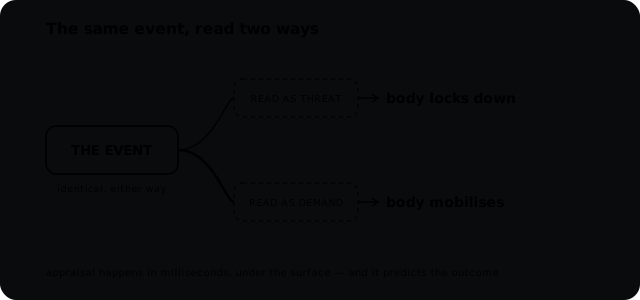
The moment you appraise a situation as a threat, your body responds measurably: the amygdala fires, the hypothalamic-pituitary-adrenal axis activates, cortisol and adrenaline rise, the sympathetic nervous system engages, heart rate variability drops. Appraise the same situation as a challenge you can meet, and the physiological signature is different — energy mobilizes without the same damaging, defensive cascade.
Perception isn't positive thinking. It's a physiological lever — change the appraisal, and the body's stress response changes with it.
So this isn't about pretending things are fine. It's about the fact that your interpretation is itself a biological event, with real, cumulative consequences for your cardiovascular system, immune function, and long-term health.
Threat vs. challenge: the same event, two physiologies
The clearest way to see this is the threat-versus-challenge distinction. The event is constant; the body's response is not.
| Dimension | Threat appraisal | Challenge appraisal |
|---|---|---|
| Underlying read | "Demand exceeds my resources" | "Demanding, but I can meet it" |
| Physiology | Defensive: high cortisol, vasoconstriction, low HRV | Mobilizing: efficient cardiac output, focused energy |
| Thinking | Narrows, tunnel vision, rumination | Widens, problem-solving, access to options |
| Over time | Wear on heart, immunity, mood | Builds resilience and capacity |
| Performance | Degrades under pressure | Often rises under pressure |
The goal is not to never feel threatened. It's to stop your nervous system from defaulting to threat for situations that are merely difficult — which is where most chronic stress quietly comes from.
Why perception sits upstream of habits
Here's why this matters more than the next habit hack. Perception sits upstream of behavior. Your appraisal sets your physiological state, and your state shapes what behavior is even available to you.
Run your life through chronic threat appraisal and you stay in a stress state regardless of how good your habits look on paper — and that state makes healthy behavior harder to sustain (poor sleep, cravings, reactivity). Recalibrate the lens, and baseline stress drops, which makes the good behavior easier and more durable. You're working at the cause instead of fighting the symptom.
Key takeaways
- How you perceive your life predicts stress and health more than most single behaviors.
- Cognitive appraisal (demand vs. resources) sets your stress response — and both sides are interpretations.
- Perception is biological: it directly drives cortisol and autonomic activation.
- The same event can be a threat or a challenge — with measurably different physiology.
- Perception sits upstream of habits, so recalibrating it makes everything else easier.
- The lens is trainable through nervous-system regulation and deliberate reappraisal.
Can you actually change the lens?
Yes. Perception feels like a fixed trait — "this is just how I see things" — but it's a trainable pattern with real neural plasticity behind it. Two levers move it, and they work best together:
Lever 1 — Regulate the body first
A dysregulated nervous system biases every appraisal toward threat; when you're activated, everything looks more dangerous than it is. This is why you can't simply "decide" to see things differently mid-spiral. Settle the body first — through breath, orienting, and recovery — and the lens widens on its own, because the brain regains access to the prefrontal cortex where flexible appraisal lives.
Lever 2 — Practice deliberate reappraisal
Once regulated, you can actively retrain the interpretation: notice the automatic appraisal, question its accuracy, and choose a more accurate read. Repeated over time, this engages and strengthens prefrontal regulation of the amygdala — and the default appraisal begins to shift, not just the in-the-moment one.
A practical reappraisal protocol
Here is the sequence, in order. Doing it out of order is why most "reframe your thoughts" advice fails — people try to reappraise while still dysregulated.
- Notice the body. Catch the stress response early — tight chest, shallow breath, racing thoughts.
- Regulate first. Slow the exhale (longer out than in) for 60–90 seconds until the body settles. No reframing until this is done.
- Name the appraisal. "I'm reading this as a threat I can't handle." Naming engages the prefrontal cortex and loosens the automatic grip.
- Question it. Is that read accurate? What resources do I actually have? Is this threatening, or just difficult?
- Choose the truer read. Not a fake-positive one — the most accurate one, which is usually "this is hard and I can handle hard things."
Do this consistently and the baseline moves. The same life starts registering differently — not because reality changed, but because the instrument reading it did.
Find out what lens you're running
Seven questions, about a minute. See how you're reading your life right now — and where to recalibrate.
Take the Free Assessment →Frequently asked questions
What is the strongest predictor of stress and health?
A growing body of clinical research shows that how a person appraises or perceives their life predicts their stress, anxiety, and health outcomes more powerfully than most single behaviors or circumstances. The interpretation of events often matters more than the events themselves.
Does that mean stress is all in your head?
No. Perception is biological: appraising a situation directly shapes the body's stress response, including cortisol release and autonomic activation. Changing the appraisal changes the physiology — it's a real, measurable intervention, not positive thinking.
What is cognitive appraisal?
It's the largely automatic process of evaluating what a situation means for you — threat, challenge, or neutral. Primary appraisal asks "is this a problem?" and secondary asks "can I handle it?" Together they determine your stress response more than the situation itself.
Can you actually change how you perceive your life?
Yes. Perception is a trainable pattern, not a fixed trait. Through nervous-system regulation and deliberate reappraisal that engages the prefrontal cortex, the default lens can be recalibrated over time.
What's the difference between a threat and a challenge appraisal?
A threat appraisal triggers a defensive stress response that narrows thinking and harms health over time. A challenge appraisal mobilizes energy and focus toward action. The same event can be either — and shifting from threat to challenge measurably changes the physiology.
Why does perception matter more than habits for health?
Because perception sits upstream of behavior and directly drives stress physiology. Chronic threat appraisal keeps the body in a stress state regardless of good habits, while a recalibrated lens lowers baseline stress and makes healthy behavior easier to sustain.