How stress became the villain
The case against stress looked airtight: chronic stress damages the heart, the brain, the immune system — all true, all documented, all covered honestly in the allostatic load article. From there, the culture took one step too far: if chronic stress harms, stress itself must be the enemy — to be eliminated, minimized, managed into silence. An entire industry formed around the elimination.
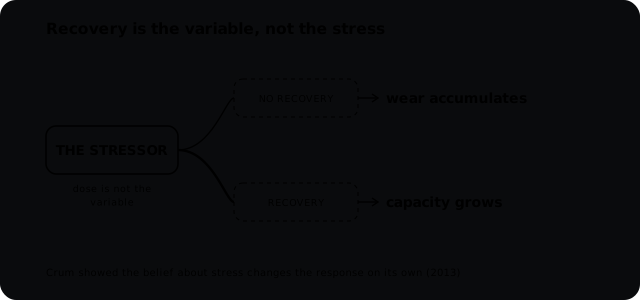
But watch what got smuggled into that step. The stress response is the body rising to meet demand — fuel mobilized, focus narrowed, heart delivering. It's what you feel at the start line, in labor, before the speech that matters. Declaring war on it is declaring war on your own capacity to meet life — and the research kept producing findings the war couldn't explain: people with demanding, meaningful lives reporting more stress and more flourishing; the stress-free as a profile skewing toward disengagement; and one cohort finding so inconvenient it deserves its own section below. A decade of behavioral-science work kept confirming the same thing: the people in real trouble were almost never the ones with big demands. They were the ones with no recovery — or with a war running against their own physiology.
Dose and recovery: the hormesis principle
Biology's oldest pattern: the dose makes the medicine. Lifting tears muscle so it rebuilds stronger. Cardio stresses the heart into capacity. Even deliberate cold works by this logic — hormesis, adaptation through dosed challenge. Remove all challenge and systems don't stay safe; they atrophy. Bones demineralize without load. Minds dull without difficulty.
Psychological stress runs the same curve. Challenge-level stress sharpens attention, consolidates learning (memories formed under moderate arousal encode more strongly), and — completed and recovered from — builds the capacity researchers call stress inoculation: the system that has handled demands handles the next one with less cost. The formula was never stress = damage. It was always stress × chronicity ÷ recovery — and the recovery term is the one modern life zeroed out, then blamed the numerator.
Nobody calls a workout 'muscle damage' — though it is. The difference between training and harm was never the stress. It was whether the recovery half of the cycle ever ran.
The belief finding that reorders everything
Now the study that should be more famous than any wellness product built on stress-fear. Keller and colleagues tracked nearly 30,000 U.S. adults for eight years, with two baseline questions: how much stress did you experience last year, and do you believe stress harms your health? The result: people with high stress plus the belief had a dramatically elevated death risk — while people with equally high stress who didn't hold the belief showed no such elevation; in the data they fared as well as anyone. The researchers' grim arithmetic: if the association were causal, believing-stress-kills would itself rank among the leading causes of death.
One observational study deserves caution — but it doesn't stand alone. It sits inside the larger appraisal literature (the foundation of the perception article, and the subject of my own master's research): how you read your stress shapes what your stress does. Crum's mindset experiments push it further — people shown "stress is enhancing" framing showed better hormonal profiles and performance under identical stressors. The story isn't decoration on the biology. The story is an input to the biology. Which means the war on stress — teaching millions to read every racing heart as damage in progress — may itself be a public-health own goal.
Challenge vs. threat: the trainable switch
The mechanism under the mindset findings has a cardiovascular signature. Blascovich's work mapped two distinct profiles under pressure: challenge — appraised resources meet demands; the heart pumps efficiently, vessels stay open, fuel flows, performance rises — and threat — demands appraised as exceeding resources; vessels constrict, the system braces for damage, performance narrows. Same exam, same audience, same deadline: different appraisal, measurably different body.
And the switch takes training. Jamieson's reappraisal studies gave anxious performers one instruction — your arousal is your body delivering resources; it's helping — and measured improved performance and healthier cardiovascular profiles under identical pressure. Note what this is not: forced calm. Telling a mobilized body to relax is rowing against physiology; the racing heart is already there. Reappraisal goes with the mobilization and changes only its meaning — "I'm ready" instead of "I'm in danger" — which turns out to be the cheapest performance enhancement in the literature.
The actual enemy: chronicity
None of this rehabilitates the thing actually hurting people. The stress response was engineered for episodes — surge, resolve, recover. What modern life built is the unresolvable episode: the inbox that refills, the numbers that reset monthly, the news that never concludes. Activation without end isn't strong stress; it's load — and no reframe fixes a structurally unending stressor. Reframing chronic overload as "challenge" is how high performers gaslight themselves into burnout with a positive attitude.
So the honest sorting, before any technique: is this stress a sprint or a sentence? Sprints — the launch, the exam, the hard season with an end date — get the reappraisal treatment and the recovery protocol. Sentences — the role with no boundaries, the always-on operation, the relationship that never resolves — need structural surgery: boundaries, delegation, automation, exit. The mindset work is powerful precisely and only where the dose is survivable.
Your stress response is not a malfunction — it's the oldest ally you have, mobilizing on your behalf exactly as designed. Stop fighting the mobilization and start managing the cycle: meet the demand, then complete the recovery. The enemy was never the surge. It was the surge that never got to end.
Making stress work for you
- Re-narrate the arousal, in words, before performances. "My body is delivering resources. I'm ready." Clumsy, evidence-backed, and better than every calm-down ritual that fights the physiology.
- Complete every cycle you can. After the demand: movement, the long exhale, real sleep. Recovery isn't the reward for finishing the stress — it's the half of the cycle where the adaptation gets built.
- Attach demands to meaning where it's true. Stress in service of something you value metabolizes differently — purpose is a documented buffer. (And where no meaning exists, that's data about the demand, not a framing assignment.)
- Audit for sentences quarterly. List your active stressors; mark each sprint or sentence. Sprints get protocols. Sentences get structural decisions — and the courage those take is itself a sprint, with an end.
- Retire the elimination fantasy. A stress-free life isn't available and wouldn't be good — the demand-free system atrophies. The target was never zero. It was cycles that complete, in a life worth mobilizing for.
Sprint, sentence, or cycle that never closes?
Seven questions, about a minute. See which pattern your stress is actually running — and whether the fix is mindset, recovery, or structure.
Take the Free Assessment →Frequently asked questions
Is stress actually bad for you?
Not inherently — dose, recovery, and belief decide. Acute stress with recovery builds capacity; chronic unrecovered activation damages; and believing stress is harmful predicted worse outcomes than the stress itself in cohort data.
What is eustress vs distress?
Selye's split: challenge-flavored stress (energizing, meaningful, recoverable) versus threat-flavored (overwhelming, uncontrollable, endless). The physiology overlaps; appraisal, control, and recovery draw most of the line.
What is the challenge vs threat response?
Two cardiovascular profiles under pressure: efficient fuel delivery when resources feel adequate, braced constriction when they don't. Reappraising arousal as readiness shifts people toward challenge — measurably.
How do I make stress work for me instead of against me?
Reframe arousal as readiness, complete recovery cycles, attach demands to meaning, and ruthlessly distinguish sprints (protocols) from sentences (structural fixes). The target is completed cycles, not zero stress.