The brilliant system with a billing department
Start with respect for the machinery. When demand arrives — a deadline, a near-miss in traffic, a hard conversation — your body doesn't defend a fixed setting; it changes the settings to meet the moment: heart up, fuel mobilized, attention narrowed, immune system pre-positioned. Bruce McEwen, the neuroscientist whose lab mapped much of this, called the process allostasis — stability through change — and it's why you can sprint, present, and survive a Tuesday at all.
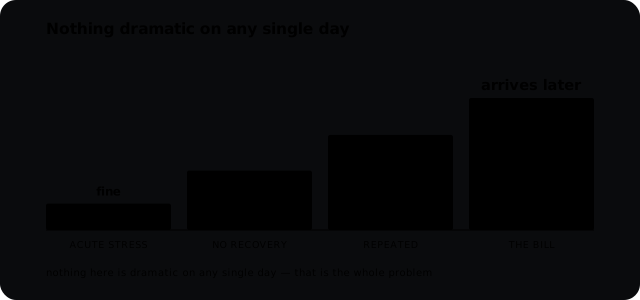
The design has one assumption baked in: the cycle completes. Demand passes, systems stand down, recovery runs, hardware gets repaired. Activation was never the cost — activation without the recovery half is. McEwen's second term names what accrues when the assumption fails: allostatic load, the cumulative wear of adaptations that kept running, on a body that kept paying. It's the missing concept between "stress is normal" and "stress causes disease" — both true, connected by an account nobody was watching.
The four ways the account overdrafts
McEwen identified four distinct overload patterns, and they're worth knowing by shape, because most people run at least one:
- Too many hits. Stressors arriving without gaps — the inbox, the news, the commute, the call, each individually trivial, collectively a system that activates dozens of times daily. The cycle never even gets scheduled.
- Failure to habituate. A healthy system learns: the tenth presentation should cost less than the first. When it doesn't — when the same recurring stressor triggers the full alarm every time — each repetition bills at the original rate. (This is where appraisal earns its outsized role: the stressor's meaning is what the system responds to.)
- Failure to switch off. The demand passed at 18:00; the cortisol didn't. The wired evening, the 3am audit, the vacation that takes four days to arrive in — activation outliving its purpose is pure load, all bill and no benefit. (The off-switch is trainable: the wired profile's whole repair.)
- Inadequate response. The sleeper: a blunted, exhausted stress system that under-responds forces backup systems — inflammation chief among them — to compensate. This is partly why late-stage burnout shows up as illness: the primary system stopped answering, and the backup runs hot.
Notice what all four patterns share: none of them is "too much stress." All of them are recovery that didn't happen — too rare, too late, too incomplete. The account doesn't bill for the sprint. It bills for the standing-down that never came.
Where the load lands in the body
The same mediators that save you acutely damage you chronically — the dose-and-duration story of all physiology:
- Cardiovascular: blood pressure surges are adaptive per-event and remodeling when constant — vessel walls thicken, baseline pressure climbs, and the load becomes hypertension with a stress biography.
- Metabolic: chronically elevated cortisol keeps mobilizing fuel nobody burns at a desk, drives visceral fat deposition specifically (the stress-belly is a documented pattern, not a metaphor — half of the weight story), and degrades insulin sensitivity.
- Neural: sustained glucocorticoid exposure is unkind to the hippocampus (memory) while sensitizing the amygdala (threat) — the high-load signature of fog-plus-reactivity is those two changes experienced from inside.
- Immune: acute stress sharpens immunity; chronic load suppresses surveillance while elevating baseline inflammation — sick more often, recovering slower, with inflammation quietly feeding every other column.
Researchers measure the total with biomarker batteries — pressure, cortisol rhythm, inflammatory markers, waist-hip ratio, glucose, lipids — and high scores predict disease and mortality across decades of cohort work. The phrase that captures the clinical picture: aging faster than your age.
Reading your own balance
No home test returns your allostatic score, but the account leaks information. The readable signs: recovery failure first and most tellingly — the stress that once cost an evening now costs a week, because spare capacity is what the load consumes before anything visible. Then: sleep that stops restoring regardless of duration, the waistline moving while habits didn't, every cold catching you and staying, resting heart rate creeping up and post-exertion recovery slowing (one place wearables earn their keep), and the cognitive-emotional pair — fog plus a shorter fuse — that the hippocampus-amygdala shift predicts.
If several of those are checked, the conclusion isn't panic — it's that the account is due some payments, and payments work. The same plasticity that accumulated the load runs the paydown; McEwen was emphatic about this to the end. The system is not a ratchet.
Stop asking "how do I have less stress?" — demand is mostly not negotiable, and the system was built for demand. Ask instead: "where is my recovery half, and what's eating it?" The load was never the stress you faced. It's the standing-down you skipped — and standing-down is schedulable.
The paydown protocol
- Sleep is the principal payment. The deepest physiological repair runs during sleep — glymphatic clearance, hormonal reset, tissue maintenance. Every other item on this list works at a fraction without it. (The full architecture; the one-line version: same wake time, dark cool room, caffeine fenced.)
- Train the off-switch daily. Five minutes of exhale-weighted breathing — the sigh protocol — teaches the system, through repetition, that standing down is available. You're directly treating pattern three, which for most modern professionals is the biggest line item.
- Exercise — the paradox payment. Moderate exercise is itself a stressor, which is precisely the point: it runs the complete cycle — activate, peak, recover — and a system that practices complete cycles regains the ability to complete them elsewhere. Regular movers show measurably better stress recovery. Keep it moderate while the account is deep in the red; punishing training on a loaded system is another deposit, not a withdrawal.
- Work the appraisal layer. The system responds to the meaning of demands, and meaning is partly trainable — the same week, appraised as challenge versus threat, bills differently (the perception evidence is the strongest in this whole field). This is also where habituation (pattern two) gets repaired: the recurring stressor, reframed and rehearsed, finally starts costing less.
- People are a payment channel. Co-regulation is measurable: safe company buffers cortisol responses and accelerates standing-down. Isolation, conversely, is its own load source. The calendar's social column is part of the protocol, not a reward for finishing it.
- Give it months and keep score gently. Loads accumulate over years and pay down over months — the markers (sleep restoring again, recovery time shrinking, the fuse lengthening) move before the bloodwork does. This is account management as a way of living, which is exactly what the longevity literature keeps converging on from the other direction.
How loaded is your system, actually?
Seven questions, about a minute. See which overload pattern you're running — and which payment to start with.
Take the Free Assessment →Frequently asked questions
What is allostatic load in simple terms?
The cumulative wear from stress systems that activate too often, too long, or never fully stand down. Each adaptation is healthy; incomplete cycles compound into hardware damage — measured by biomarker batteries across pressure, cortisol, inflammation, and metabolism.
What are the signs of high allostatic load?
Recovery failure first — stress that once cost an evening costing a week — plus unrestorative sleep, waist-specific weight gain, frequent slow-resolving illness, rising resting heart rate, fog, and a shorter fuse.
What's the difference between stress and allostatic load?
Stress is the event and response; load is the residue of incomplete recovery. All four overload patterns McEwen described — too-frequent hits, no habituation, no switch-off, blunted response — are recovery problems.
How do you reduce allostatic load?
Restore the recovery half: sleep as the principal payment, daily exhale-weighted downshifts, moderate exercise (complete cycles), appraisal work, and real social contact. Months of management, not a weekend detox.