One word, two opposite conditions
"I'm so tired" is the most common opening sentence I heard in a decade of working with people — and it's also the least informative, because two completely different physiological states hide behind it.
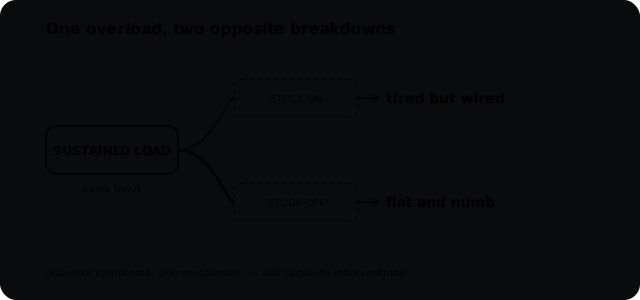
Your autonomic nervous system has, crudely, an accelerator and a brake — mobilization and restoration. A healthy system moves fluidly between them: up for the deadline, down for the dinner. Chronic stress breaks that fluidity, but here's what the wellness industry flattens: it breaks it in one of two directions. Some systems get stuck with the accelerator pinned — revving at midnight, revving at dinner, revving in savasana. Others, usually after months or years of that, do something more unsettling: they stop revving and stop responding — the brake jammed on everything, including joy.
Two opposite failure modes, one shared word, one shelf of identical advice. Which is why "just rest more" rescues one group and quietly buries the other — and why the first real question is never how do I fix my stress? but which direction am I broken in?
The wired profile: a system that can't stand down
The wired state is mobilization without resolution. The biology evolved for sprints — threat appears, system surges, threat resolves, system stands down. Modern stressors don't resolve; the inbox refills, the numbers reset monthly. So the surge just... stays, and the profile assembles itself:
- Exhausted at 22:00, wide awake at 23:30. The body begs for sleep; the system vetoes it. Sleep onset requires the brake, and the brake is out of service. (Why this loop feeds itself: the sleep mechanics.)
- The body keeps the ledger: jaw clenched at the laptop, shoulders at the ears, the sigh you didn't notice you'd been holding.
- Reactivity at low thresholds — the slow driver, the chewing sound, the question asked twice. A mobilized system treats minor friction as confirmation.
- Rest that doesn't restore. The weekend happens; Monday arrives unimproved — because the body lay still while the system idled at 4,000 RPM.
The defining tell, worth memorizing: stillness feels worse than stimulation. Five quiet minutes and the agitation surfaces — so the wired person refills every silence with input, mistaking the anesthesia for preference.
The numb profile: a system that stopped trying
The second profile gets a fraction of the airtime and at least half the cases. When mobilization runs too long with no exit, many systems eventually flip strategies: if the threat can't be fought or outrun, conserve. Volume down. Engagement down. Everything down.
- Flatness where feelings used to be — not sadness, which is at least alive, but a gray nothing. Good news lands with a thud. The hobby sits untouched, not resisted, just... unappealing.
- Fog and autopilot. Whole commutes unremembered. Conversations attended in body only.
- Sleep that doesn't add up — nine hours and still unrestored, because dampened isn't the same as resting.
- Pleasureless consumption. Scrolling for two hours feeling nothing, eating without tasting — stimulation-seeking by a system too dampened to receive it.
And the sentence that gives the history away, which I heard in some version a hundred times: "I used to be so stressed. Now I don't feel much of anything." That's not recovery. That's the wired phase's invoice — the system protecting itself by turning down the gain on life itself. (When it deepens and persists, this profile overlaps with clinical territory — burnout and depression — which deserve professional eyes, not just protocols.)
Wired is a fire alarm that won't stop ringing. Numb is the building deciding alarms are pointless. Neither one is safety.
The three-question diagnostic
- The stillness test. Sit five minutes — no phone, no task. What rises? Agitation, planning, the itch to move → wired. Heaviness, blankness, near-sleep → numb.
- The night test. What's broken about sleep? Can't fall asleep, mind racing → wired. Sleep plenty, wake unrestored → numb.
- The feeling test. Too much, or too little? Irritability, anxiety, startle → wired. Flatness, indifference, nothing-tastes-like-anything → numb.
Two-of-three points at your current direction. Score it this week, not in general — and we'll come back to why "in general" is the wrong timeframe.
Two repairs — and why swapping them backfires
The wired system needs downshifting. Long-exhale breathing as a daily practice — the physiological sigh is the precision tool. Caffeine honesty (a wired system on three coffees is arson investigating itself). Training loads lighter than pride prefers — walks and easy sessions over the bootcamp the wired person is drawn to, because intensity reads as more mobilization. Deliberate deceleration rituals: the slow evening, the single-tasked meal. The project is teaching the system, through repetition, that standing down is survivable.
The numb system needs careful upshifting. Morning light, first hour, outside. Brisk movement — not punishing, but genuinely activating; the 10-minute fast walk that raises the pulse. Cold at the end of the shower — thirty seconds of honest, controllable arousal. Real social contact, which is the most underrated activator in the toolkit. Novelty in small doses: the new route, the new room, the changed default. The project is the mirror image: showing the system, through small safe surges, that activation is survivable — that the volume can come back up without the threat coming back with it.
Now run the swap and watch the damage. Send the numb person to the silent retreat — more stillness onto a system already over-stilled — and they come home foggier, now with a story about being broken beyond meditation's reach. Send the wired person to high-intensity everything and the system reads it as confirmation: see, we are under attack. Half of all generic advice fails not because the advice is wrong but because it's aimed at the other half of the room.
Stop asking "how do I have more energy?" and ask "which direction is my system stuck in?" The same protocol that heals one direction deepens the other. Diagnosis before dosage — it's the first rule of every clinic, and it applies to Tuesdays.
The cycle most people actually live in
The clinically honest complication: most chronic cases aren't purely one or the other. The common pattern is a cycle — wired through the workweek (deadlines as fuel, caffeine as infrastructure), then a crash into numb on Saturday, two days of pleasureless couch, and re-mobilization Monday morning. Wired weeks, numb weekends, repeating until one state finally wins. Usually numb wins.
If that's you: treat the state that owns the current moment (downshift on Wednesday, gently activate on Sunday), but understand the deeper project is the cycle itself — a system that has lost its mid-range and only knows sprint or collapse. Rebuilding that mid-range is the actual skill, the one underneath every protocol in this article: nervous system regulation. The instruments differ by direction; the instrument-rack is the same.
Find out which direction you're stuck in.
Seven questions, about a minute. The assessment maps your state — wired, numb, or cycling — and shows you which repair to start with.
Take the Free Assessment →Frequently asked questions
What does tired but wired mean?
Exhausted body, stress system that won't stand down: racing mind at night, jaw tension, irritability, unrestorative rest. The tell: stillness feels worse than stimulation, because in stillness the revving becomes audible.
Why do I feel emotionally numb and flat instead of stressed?
Numbness is the conservation response — after long inescapable stress, many systems stop mobilizing and turn the volume down on everything, including the good things. It often follows a long wired phase. Nothing is not recovery.
How do I know if I'm wired or numb?
Three tests: stillness (agitation = wired, heaviness = numb), night (can't fall asleep = wired, unrestorative sleep = numb), feelings (too much = wired, too little = numb). Two of three points at your direction — this week, not in general.
Do wired and numb states need different treatments?
Opposite ones. Wired needs downshifting: long exhales, deceleration, lighter loads, caffeine honesty. Numb needs careful activation: morning light, brisk movement, cold, people, small novelty. Swapping them deepens the break.