The effect that's actually real
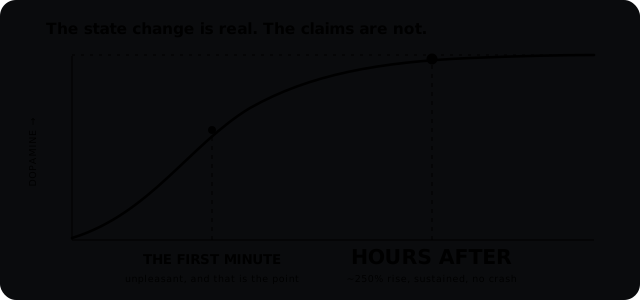
Begin with what the skeptics undersell. In the most-cited cold-immersion study (Šrámek and colleagues — an hour in 14°C water, more than your shower will ask of you), plasma dopamine rose roughly 250% above baseline and noradrenaline more than 500% — and unlike the spike-and-crash signature of most chemical mood boosters, the rise built gradually and stayed elevated for hours. That's the neurochemistry under the testimonials: the strangely bright, sharpened, quietly triumphant state that follows deliberate cold. People aren't imagining it. It's one of the most reliable legal state-changes available, and it costs a plumbing bill of zero.
For mood specifically, the trial evidence is early but pointed the right way — small studies and a well-known case literature on cold swimming and depressive symptoms — and the mechanism (catecholamines plus the arousal reset) is plausible. Honest framing: a real, repeatable state tool, with the trait-level claims still being earned.
The deeper benefit: stress you chose
The second genuine benefit is subtler and, for my money, more valuable than the chemistry: cold is a stress inoculation you control. The first seconds produce a full, honest alarm — gasp, racing heart, every system shouting exit. And then you stand there, exhale long, and the system discovers the alarm can be survived without obedience. Repeated, that's training: not of the skin, but of the relationship between alarm and action.
This is dosed hormesis — the same logic as exercise — and it transfers: the person who has practiced staying composed at 12°C has rehearsed the exact move needed in the difficult meeting, the hard conversation, the 3am worry surge. (Cold even pairs mechanically with the toolkit: the long exhale is precisely how you steer the first thirty seconds, and cold-on-the-face is already a clinical downshift via the dive reflex.) One caution from the two-directions framework: cold is an arousal tool — excellent for numb, flat, under-activated states; redundant-to-counterproductive as a daily ritual for someone already wired to the ceiling. Match the tool to the break.
The cold doesn't toughen your skin. It retrains the gap between alarm and action — and that gap is where most of life's hard moments are actually decided.
The sick-day finding, read carefully
The famous Dutch trial (3,000+ participants) had people end showers with 30–90 cold seconds for a month. Result: 29% fewer sick days in the cold groups — with a detail almost every retelling drops: they reported getting sick at roughly the same rate. They just lost fewer days to it. Whether that's a true severity effect, an energy effect, or partly the kind of person who keeps cold-showering also being the kind who shows up, the trial can't fully say. What it does support, modestly: regular brief cold tracks with carrying winter loads better. What it doesn't support: "cold showers supercharge your immune system" — a sentence the data never said. Interestingly, 30, 60, and 90 seconds performed similarly, which is the quiet case for the minimal dose.
The fat-loss audit
The claim that least survives: cold as a leanness tool. The mechanism is genuinely real — brown adipose tissue burns calories to make heat, and cold activates it — but the magnitude is a rounding error: practical cold exposure costs tens of calories, undone by one absent-minded biscuit, and cold reliably increases appetite (your body would like the heat back, with interest). No quality trial shows meaningful real-world fat loss from cold showers. If body composition is the goal, the boring stack — the 80% rule, strength work, sleep — outperforms the ice bath by orders of magnitude. Do cold for the dopamine and the training. Anyone selling it for the waistline is selling the halo, not the lamp.
Recovery: the two-sided file
Athletes' favorite use has the most genuinely two-sided evidence. Side one: cold-water immersion reduces soreness and the feeling of fatigue — athletes report recovering faster, and for in-season schedules where tomorrow's freshness beats marginal adaptation, that's a real trade. Side two: the inflammation cold suppresses is partly the signal that drives adaptation — and studies of post-strength-training cold immersion show blunted long-term strength and muscle gains versus active recovery. The cold was erasing some of what the session was for.
The working rules: keep cold out of the hours after lifting; use it before training, on rest days, or after endurance work; and if maximal adaptation is the current goal, let yourself be sore — the discomfort was the receipt.
Stop asking whether cold showers "work" and ask what job you're hiring them for. Hired as a state tool and a composure gym: excellent, cheap, honest. Hired as fat-loss, immunity armor, or a personality: you've bought the brochure. The lamp is real. The halo was marketing.
The protocol (and the safety lines)
- End warm showers with 30–60 cold seconds. Fully cold tap, uncomfortable-but-safe. This minimal dose captures most of the dopamine and all of the composure training — the Dutch trial found little difference between 30 and 90 seconds.
- Steer with the exhale. The first ten seconds, ride long exhales through the gasp. That's the actual exercise — the cold is just the gym.
- Progress by preference, not penance. 1–3 minutes, colder water, occasional immersion if you genuinely enjoy it. The ~11-minutes-weekly figure from the research community is a sufficiency estimate, not a membership requirement.
- Schedule it as an upshift. Morning or pre-work slumps — it's an arousal tool; evening cold can push sleep later for some people.
- The hard safety lines: heart conditions or pregnancy → doctor first (cold spikes blood pressure sharply). Never breath-hold practices in or near water. Open water cold is a different sport with real drowning physics — never alone. And the gasp reflex is involuntary: enter cold water face-last, always.
Cold is one tool. The protocol is the system.
Longevity builds the full stack — sleep, movement, food timing, recovery — into one operating system. One action a day, for ninety days.
See Longevity →Frequently asked questions
What do cold showers actually do?
Trigger a large catecholamine release — dopamine up ~250% for hours, no crash — and train composure under voluntary stress. The Dutch trial found 29% fewer sick days with similar illness rates: better carrying, not fewer colds.
Do cold showers help with fat loss?
Marginally at best — brown fat is real but the calorie math is trivial, and cold raises appetite. The honest reasons are the state change and the stress training, not the waistline.
Are cold showers good for muscle recovery?
They reduce soreness but blunt adaptation when taken right after strength training. Keep cold away from the post-lifting window; use it on rest days, before sessions, or for in-season freshness.
How long and how cold should a cold shower be?
30–60 seconds of genuinely cold water at the end of a normal shower; build toward 1–3 minutes by preference. Heart conditions → doctor first; never breath-holds in water; face-last entry, always.