What caffeine actually does
Start with the accounting truth: caffeine is not an energy source. It has no calories your brain can spend, no fuel to add. What it has is a shape — one nearly identical to adenosine, the molecule your brain accumulates from the moment you wake as a running meter of time-awake. High adenosine is what "tired" physically is: the meter reading delivered to consciousness as heavy eyelids and the pull toward the couch.
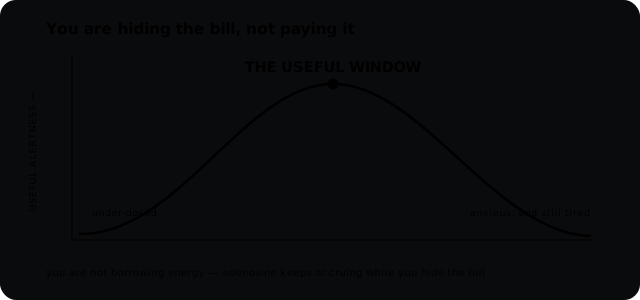
Caffeine's entire trick is parking in adenosine's receptors without activating them. The meter gets covered. The reading stops arriving. You feel awake — genuinely, neurochemically awake — while the adenosine continues accumulating behind the blockade, unreported. Then the caffeine clears, the receptors open, and the full accrued total lands at once. The afternoon crash isn't new fatigue. It's deferred fatigue, delivered in a lump sum.
None of this makes caffeine bad — blocking the gauge before a 6am flight is precisely the point. It makes caffeine a deferral instrument, and deferral instruments are only as good as your repayment plan.
The half-life arithmetic nobody runs
Caffeine's average half-life is 5–6 hours (genetics swing it from ~3 to 8+ — you likely know which side of the family you're on). Most people have heard the number. Almost nobody runs the arithmetic against their own evening:
- 16:00 — a 200mg coffee.
- 21:30 — ~100mg still circulating, sitting on the receptors that build sleep pressure.
- 02:00 — ~50mg still on duty. A quarter of the dose, in the middle of the night.
"But I fall asleep fine." The research's reply is the uncomfortable part: caffeine taken even six hours before bed measurably shortens sleep and — the stealth cost — disproportionately suppresses deep slow-wave sleep, the stage doing the heaviest restorative work. Slow-wave loss doesn't feel like insomnia. It feels like eight hours that somehow didn't take — a morning that needs coffee to feel survivable. Which brings us to the loop.
The 4pm coffee doesn't keep you awake. It keeps you shallow — and shallow sleep is the invoice you pay without ever seeing the line item.
The loop: how the cure manufactures the disease
Trace the full circuit, because most heavy caffeine use lives inside it: afternoon caffeine quietly degrades the night's deep sleep → tomorrow starts with elevated adenosine (the debt survived the night) → tomorrow feels heavier → tomorrow's dose grows or arrives earlier → which degrades the next night. Each loop tightens. Within months the baseline is: can't function before coffee, crashes mid-afternoon, "needs" 400mg to feel like the person who once needed none.
Here's the part I watched land hardest with clients: that person attributes the exhaustion to age, stress, workload — anything but the subscription. The caffeine is treating a fatigue that the caffeine's timing is manufacturing. Not entirely, not for everyone — but the only way to know your share is to break the loop and measure, which is what the audit below is for. (And if the exhaustion survives the audit untouched, the cause is elsewhere — the seven kinds of tired is the map.)
The anxiety impersonator
One more honest ledger entry. Caffeine's body is anxiety's body: elevated heart rate, raised vigilance, primed startle. The two states are nearly indistinguishable from inside — and your brain, registering the arousal, helpfully drafts reasons for it: the meeting, the message, the mortgage. A meaningful slice of "mystery anxiety" in high-caffeine people is well-brewed pharmacology wearing an emotional costume (the body-writes-the-story mechanism). Sensitive systems, anxious seasons, and slow metabolizers deserve a lower dose — or the audit's honest zero — before any deeper conclusion gets drawn.
Using it like a tool: the fences
- Start: 60–90 minutes after waking. Cortisol is near its natural peak in the first half hour — alertness is already arriving free, and caffeine on top buys little. (Modestly evidenced, mechanistically sensible — the morning verdicts cover it; the two-week test settles it personally.)
- Stop: 8–10 hours before bed. The non-negotiable fence. Sleep at 23:00 means last caffeine 13:00–15:00, slow metabolizers earlier. This single rule recaptures most of the deep sleep the loop was eating.
- Dose in pulses, not drips. 100–200mg for a purpose — the workout (where the performance evidence is strongest), the deep-work block — beats continuous top-ups that keep the receptors permanently bargaining.
- Respect the tolerance treadmill. Daily high doses just reset your baseline to "blocked" — the fourth cup of a heavy user delivers less than the first cup of an abstainer. Periodically lowering the dose is how you keep the tool sharp.
- Don't use it to skip the actual repair. Caffeine before a presentation is a tool. Caffeine instead of fixing the sleep system is a payday loan against a salary that's already garnished.
Stop asking "how much caffeine is okay?" and ask "what is my caffeine currently hiding?" A tool reveals its honesty by what happens when you put it down for two weeks. If the answer is "mild headaches, then normal," it was a tool. If the answer is "I discovered I'm exhausted," it was a blindfold — and the exhaustion was the information you'd been paying to not receive.
The two-week audit
- Week zero (optional but clarifying): log your real intake — every cup, can, and pre-workout, with times. Most people undercount by a third.
- Weeks one–two: halve the dose and enforce the 13:00–15:00 cutoff. Expect three to five days of mild withdrawal — headache, grumpiness. That's the receptor count renormalizing; it passes.
- Measure two things: afternoon energy (the crash should soften noticeably as deep sleep returns) and morning state on waking (before any caffeine — this is your true baseline, possibly meeting it for the first time in years).
- Then decide from data. Many people land at: one or two well-timed morning doses, pre-exercise use, and a clean afternoon — alertness up, total intake down. Some discover a sleep debt that needs real repair. Either way, you've replaced a subscription with a decision.
Find out what your energy looks like under the hood.
Seven questions, about a minute. See whether your tiredness is caffeine's loop, a sleep system, or something upstream — and where to start.
Take the Free Assessment →Frequently asked questions
How does caffeine actually work?
It blocks adenosine — the molecule that reports time-awake as sleepiness — by parking in its receptors. The tiredness signal gets hidden, not removed; the crash is the accumulated total arriving when the blockade clears.
How long does caffeine stay in your system?
Half-life 5–6 hours on average (3 to 8+ by genetics): a 16:00 cup is ~25% active at 2am. Even 6 hours before bed it measurably cuts sleep, hitting deep slow-wave sleep hardest.
When is the best time to drink coffee?
Start 60–90 minutes after waking; stop 8–10 hours before bed (13:00–15:00 for a 23:00 sleeper). Use pulsed doses for purpose — strongest evidence is pre-exercise.
Is caffeine bad for you?
Moderate doses, well-timed: no — coffee's epidemiology is largely favorable. The real costs are behavioral: eroded deep sleep, masked sleep debt, the dependency loop, and an anxiety impersonation sensitive people misread. The two-week half-dose audit gives the personal answer.