The most ignored advice in business
"You need to delegate more" might be the single most-given, least-followed piece of business advice in existence. Every founder has heard it. Most agree with it. Almost nobody does it — and the gap tells you something important: when universally available information universally fails to change behavior, the problem was never information.
I spent a decade watching this exact pattern in health — everyone knows what to eat, nobody changes — and the diagnosis transfers perfectly. Delegation isn't a knowledge gap. It's a behavior with three psychological costs that the advice never prices in, billed instantly, while the benefits arrive in months. Of course the instincts win. They always win against a brochure.
So let's do what the brochure doesn't: name the actual obstacles, run the actual math, and build a protocol that works on the species we are.
The three instincts that block the handoff
1. The competence trap
Here's the cruelty: you actually are better at the task. You've done it a thousand times; the new person has done it twice. So every early handoff produces a real, visible quality dip — and your brain files it as evidence: see, delegation degrades the work. What the filing system misses is that you were once the person who'd done it twice. Competence is a curve, you're comparing someone's week two against your year ten, and the dip you're avoiding is the tuition every competence — including yours — was bought with.
2. The "faster myself" fallacy
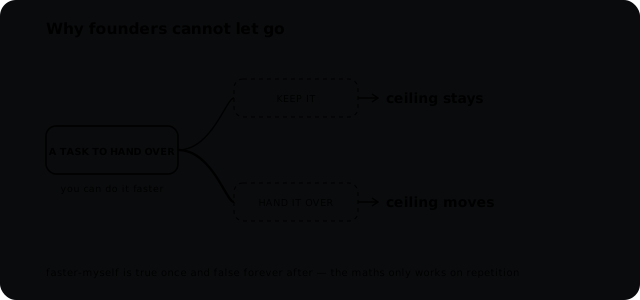
"By the time I explain it, I could've done it." Correct — this instance. The fallacy is in the units: you're pricing a recurring task as a single event. Explaining costs once; doing-it-yourself costs every week, forever. It's the classic trade of asset versus expense — training builds an asset that produces the task without you; doing it yourself is a pure expense, renewed weekly — and founders who'd never confuse the two on a balance sheet confuse them daily in a calendar.
3. The identity underneath
And the quiet one, the one I'd watch surface in session after the first two were dismantled: if the business runs without me — what am I? For most founders, being needed isn't a bug in the workload; it's the load-bearing identity. Every fire only you can fight confirms you matter. Delegation, at that layer, isn't a process change — it's an identity threat, and identity defends itself with impeccable-sounding logic about quality and speed. (This is the same layer where all lasting change is actually decided — and why founder burnout is so often a systems failure wearing a stamina costume.)
The founder who "can't find good people" has usually never let anyone be bad at a task long enough to become good at it — the way the founder once was.
The math, run honestly
Take one real task: the weekly proposal assembly, three hours, yours. Delegation costs: call it ten hours of total training — documentation, walkthrough, corrections across the first month. The instinct says ten hours is too expensive this quarter.
The year says: 3 hours × 52 weeks = 156 hours retained, against a one-time 10-hour investment — a 15:1 return in year one, and the asset keeps paying in year two with zero reinvestment. Now multiply by your real hourly value as a decision-maker (not your salary math — what your judgment hour is worth to the business), and the retained task reveals itself as one of the most expensive subscriptions you own. Your Tuesday Number is, mostly, a stack of these subscriptions — each one renewed by an instinct that felt like prudence.
The handoff protocol
- Pick the right first task: high frequency, low stakes, clear rules — scheduling, triage, report assembly, invoice chasing. Early delegation needs wins, and high-frequency tasks repay training fastest. The high-judgment work comes later, after your tolerance is trained.
- Record yourself doing it once. Screen-record with narration — the why included, not just the clicks. Twenty minutes, and the training asset exists forever. (This becomes the seed of the SOP; the full documentation method is in how to systemize your business.)
- Define done, observably. Not "handle the proposals" — "proposal sent within 24 hours of the call, using the template, pricing checked against the sheet, cc me." Vague handoffs manufacture the failures that confirm the instinct.
- Delegate the outcome with checkpoints — not the method with surveillance. A draft at day two, a review at day five. Between checkpoints: silence. Continuous oversight isn't delegation; it's doing the task with extra steps and a witness.
- Pre-authorize decisions inside boundaries. "Refunds under $200, decide yourself. Schedule changes, decide yourself. New pricing, come to me." Every question that no longer boomerangs to you is the actual product being built.
- Fix the system, never silently the work. When it comes back at 80%, the founder move is to quietly fix it at 11pm — which teaches the team that final quality is your job and drafts are theirs, permanently. Instead: name the gap, improve the instruction or checklist, return it. Slower this week. Compounding forever.
Surviving the J-curve
Set the expectation now: weeks one through four will cost you time. Training, corrections, the dip. This is the J-curve every delegation rides, and it's precisely where most founders quit — at the bottom, with maximum cost paid and zero return collected, concluding the whole thing was a myth. The week-eight rule exists for this: no delegation may be judged before week eight. By then the repetitions have outnumbered the training sessions, the quality has climbed the curve, and the hours have started flowing back. Quit at week two and you've bought the tuition and skipped the degree.
Delegation isn't giving away your work. It's changing what your work is — from doing the thing to building the system that does the thing. The first is a job. The second is a company. Every task you hand off properly is a brick moved from the first pile to the second.
The layer that skips humans entirely
One update the classic delegation advice hasn't absorbed: the bottom layer of the delegation stack — the rule-based, repetitive, digital work — increasingly shouldn't be delegated to a person at all. Scheduling, reminders, data transfer between tools, standard inquiry responses, follow-up sequences: this is agent territory now, at a fraction of a salary, with no J-curve of mood or turnover.
Which clarifies the human layer beautifully: delegate judgment to people, rules to machines. Humans get the work that needs reading a client, weighing a trade-off, caring about an outcome — the work that grows them into the senior people you currently wish you could hire. The machines get the rest. The founder, finally, gets the only job that was ever truly theirs: deciding what the whole system is for.
Want the bottom layer handled this quarter?
The audit maps which of your retained tasks belong to people, which belong to agents, and what the hours are worth — before anything is built.
Get your Agent Blueprint →Frequently asked questions
Why is delegation so hard for founders?
Three stacked mechanisms: the competence trap (your year-ten skill vs. their week-two), the "faster myself" fallacy (pricing a recurring task as a single event), and identity threat (being needed as the load-bearing self-image). The skills take an afternoon; these are why the afternoon never comes.
What should a founder delegate first?
High-frequency, low-stakes, clear-rule tasks: scheduling, triage, invoice chasing, report assembly. Wins first, judgment work later — and the most repetitive digital layer should go to agents, not people.
How do I delegate without micromanaging?
Outcomes with checkpoints, not methods with surveillance: define done observably, set draft/review moments, pre-authorize decisions within boundaries, and fix the system rather than silently fixing the work.
When does delegating actually pay off?
After the J-curve: weeks 1–4 cost time, then repetitions outnumber training and the return compounds — typically 10–15:1 in year one for a weekly task. Judge at week eight, never week two.