The definition, without hype
An AI agent is software that pursues a goal on its own. You give it an outcome — "answer this customer," "qualify this lead," "chase these unpaid invoices" — and it decides the steps, executes them using real tools, evaluates the results, and continues until the work is finished or it determines a human is needed.
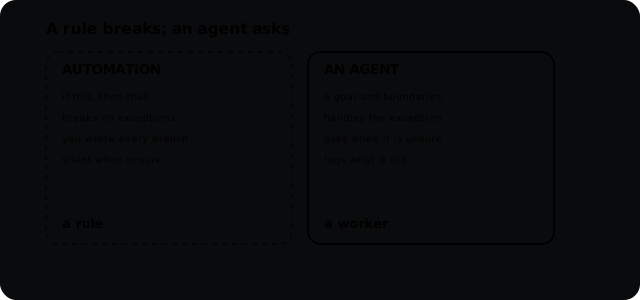
The load-bearing word is pursues. Every previous generation of business software waited for instructions at each step. A spreadsheet computes what you type. A chatbot answers what you ask. An automation runs the exact script someone wrote. An agent is the first category of software you can hand an outcome instead of a procedure.
That's the whole shift, and it's worth stating plainly because the hype obscures it: agents move software from tool you operate to work that gets done.
Agent vs. chatbot vs. automation
These three get conflated constantly, including by people selling them. The differences are practical and worth real money:
| Automation | Chatbot | AI Agent | |
|---|---|---|---|
| What it does | Runs a fixed script | Answers messages | Completes goals |
| Handles surprises? | No — breaks or skips | Somewhat — in conversation only | Yes — re-plans around them |
| Acts in your systems? | Yes, exactly as scripted | Rarely | Yes, adaptively |
| Multi-step work? | Only pre-mapped steps | No | Yes — plans its own steps |
| Example | "When form submitted, add row to sheet" | "Our hours are 9–6, Monday to Friday" | "Refund this order, update inventory, email the customer, flag the pattern if it's the third return this month" |
Note that the rows aren't competitors — they stack. The strongest real-world systems use automation for the predictable rails, agents for the judgment-bearing middle, and a conversational layer in front. (Most of what's marketed as "an AI agent" is actually a chatbot with a logo. The test: does it write to your systems and finish multi-step work without you driving each step? If not, it's a chatbot.)
How an agent actually works
Under the hood, a working agent is four components in a loop:
- A reasoning engine — a large language model that reads the goal and the current situation and decides what to do next.
- Tools — connections to real systems: email, CRM, calendar, database, payment processor, internal APIs. This is what separates acting from chatting.
- Memory — context about your business, past interactions, and the current task, so decision number seven remembers decisions one through six.
- The loop — act, observe the result, decide again. If the email bounced, find another contact. If the data looks wrong, re-check before proceeding. If confidence is low, escalate to a human.
That last behavior — knowing when to stop and hand off — is the difference between a production agent and a demo. Anyone can build an agent that acts. The engineering is in building one that knows when it shouldn't.
The question isn't whether software can now do the work. It's which work you should hand it first — and that's a business decision, not a technical one.
What agents can do in a business today
Filtering out the demos and keeping what runs reliably in production, by function:
Customer-facing
- Support triage and resolution — answering the 70% of inquiries that are variations of the same twenty questions, end-to-end: look up the order, process the change, send the confirmation. Humans get the genuinely hard 30%.
- Lead qualification and follow-up — responding to inquiries in minutes instead of days, asking qualifying questions, booking the call, updating the CRM. Speed-to-lead is one of the most documented revenue levers in sales, and it's the thing tired humans are worst at.
- Scheduling — booking, rescheduling, reminders, no-show follow-ups.
Back office
- Invoicing and collections — generating invoices, matching payments, and the polite-but-persistent chasing of late payers that owners hate most.
- Reporting — pulling numbers from your actual systems into a weekly summary a human would have spent Friday afternoon assembling.
- Data hygiene — the CRM that updates itself is no longer a joke.
Marketing
- Content drafting and scheduling from your existing material and voice — with a human approving, which is the right division of labor.
The common pattern in everything above: high volume, repetitive structure, clear success criteria. That's the territory agents own today.
What they can't do (yet) — and the honest failure modes
Anyone selling agents without this section is selling something else.
- Open-ended judgment. "Should we enter this market?" is not agent work. Agents execute defined outcomes; they don't carry your context, taste, or risk tolerance.
- High-stakes one-offs. An agent earns trust on volume. A decision that happens once and matters enormously is exactly where the human belongs.
- Zero-error domains without review. Agents fail at low rates, but not zero. Where a 2% error rate is catastrophic — legal commitments, large payments — the architecture must include human checkpoints, and a good builder will insist on them.
- Reading the room. The angry customer who needs to feel heard before any solution will land — that's human work, and the agent's job is recognizing it fast and routing it to you.
The failure mode to avoid isn't trusting agents too little — it's deploying them on the wrong work, getting burned, and concluding the technology doesn't work. The technology works. The selection of what to hand it is where projects live or die.
Don't ask "what can AI agents do?" Ask "what do I do every week that follows the same shape every time?" That list — not the technology — is your agent roadmap. Most owners find 15–30 hours a week on it.
How to start without burning money
- Audit before you automate. List every recurring task in the business, who does it, how long it takes, and what it costs in salary and latency. The highest-frequency, most rule-shaped items rise to the top on their own.
- Start with one process, not a platform. The graveyard of AI projects is full of "transform everything" initiatives. One well-chosen agent in production beats a roadmap of twelve.
- Pick work with a measurable before/after. Response time, hours reclaimed, collection rate. If you can't measure the win, you can't defend the spend — or compound it.
- Insist on escalation paths. Every production agent needs a defined "this goes to a human" boundary. Ask any vendor or builder where theirs is; the quality of the answer tells you who you're dealing with.
- Reinvest the reclaimed hours deliberately. This is the step everyone skips. The agent buys back your time; what you do with it determines whether this was a cost optimization or a transformation. (We've written about where those hours actually go — usually back into the same reactive loop — in the founder bottleneck piece.)
Find out what agents could take off your plate.
We audit your operations, find the highest-ROI processes, and build custom agents that run them — starting from a written blueprint. The blueprint is where it starts.
Get Your AI Audit →Frequently asked questions
What is an AI agent in simple terms?
Software that pursues a goal on its own. You give it an outcome — "answer this customer," "qualify this lead" — and it plans the steps, uses real tools, checks its results, and keeps working until the job is done. A chatbot answers and stops; an agent acts and finishes.
What is the difference between an AI agent and a chatbot?
A chatbot responds to messages — a human still drives every step. An agent executes multi-step work autonomously in your actual systems: looking things up, writing data, sending communications, deciding next steps from results. Many real systems combine both.
What can AI agents actually do for a small business today?
Reliably: support triage and resolution, lead qualification and follow-up, scheduling, invoicing and payment chasing, reporting, CRM upkeep, and content drafting with human approval. The pattern that works is high-volume, rule-rich work with clear success criteria.
How much does it cost to implement AI agents?
Point solutions run roughly $50–500/month per function; custom agents range from a few thousand dollars for one well-defined process to five figures for multi-agent systems. Compare against the salary, latency, and error rate of the manual process — well-chosen first agents typically recover 10–30 hours a week and pay for themselves within months.