One word, two products
The confusion isn't your fault. For a decade, "chatbot" meant the little widget that asked How can I help you today? and then mostly couldn't. Then language models got good, everything conversational got rebranded "AI," and now the same two syllables — AI assistant, AI employee, AI agent — are stapled onto products separated by an order of magnitude in capability and price.
So let's draw the line where it actually sits. Imagine a customer writes: "Can I move my Thursday appointment to next week?"
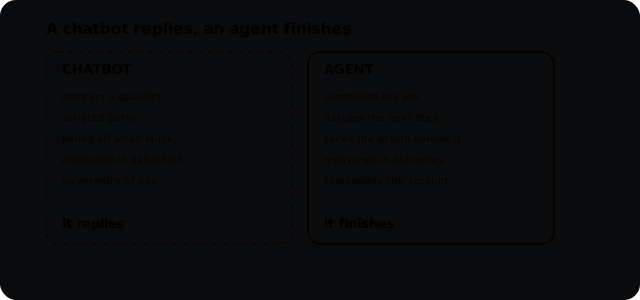
- The chatbot answers: "Of course! You can reschedule by calling us at... or using this link." Helpful. Polite. The work — checking the calendar, finding a slot, moving the booking, confirming — is still yours.
- The agent checks the real calendar, sees Tuesday 14:00 is open, moves the booking, updates the CRM, sends the confirmation, and schedules the reminder. The conversation ends with the task done, and no human ever touched it.
Same inquiry. Same friendly tone. Entirely different economics. The first is a communication layer; the second is labor.
What a chatbot is (and is honestly good at)
A chatbot is a question-answering surface. Modern ones — grounded in your actual documents rather than a hard-coded script — are genuinely good at a real job: absorbing informational volume. Hours, pricing ranges, policies, "do you take insurance," order status, "where do I park." If your inbox and phone are clogged with questions whose answers never change, a competent chatbot removes that clog cheaply, around the clock, in any language.
Respect what that is — and notice what it isn't. Answering "do you take walk-ins?" was never the work drowning your team. The drowning work is what happens after the answer: the booking, the rebooking, the chasing, the entering of the same data into the second system. A chatbot ends where that work begins. Buy one when your problem is conversation volume. Don't expect it to give anyone their Tuesday back.
A chatbot is a better front door. An agent is staff. The expensive confusion is paying staff prices for a door.
What an agent is — the three capabilities
Strip the marketing and an agent is defined by three concrete capabilities a chatbot lacks (the full plain-English tour is in what are AI agents):
1. Tools — hands, not just a mouth
An agent is connected to your real systems: it can read and write your calendar, CRM, invoicing tool, phone and email. This is the hard, unglamorous part of agent-building — the integrations — and it's exactly the part a demo on a vendor's website doesn't show. No tool access, no agent. It's that binary.
2. Multi-step execution — a goal, not a reply
Chatbots live one exchange at a time. An agent holds a goal — get this lead qualified and booked — and runs the sequence: answer in seconds, ask the qualifying questions, check the calendar, offer slots, book, confirm, remind, and follow up in two days if there's no reply. The steps span hours or days. The thread doesn't drop. That persistence, not the chat, is the product. (It's also why agents fix the speed-to-lead problem in a way no staffing plan can.)
3. Conditional judgment within boundaries
Real agents handle the if-thens of operational life: if the slot is taken, offer alternatives; if the customer sounds upset, stop and hand off to a human with a summary; if payment fails twice, flag it instead of retrying forever. The boundaries are the design work — a well-built agent knows exactly where its authority ends, and a badly built one is a liability with a friendly voice. This is build quality, not model quality, and it's where implementations live or die.
The Tuesday test
Here's the practical filter, and it costs you one ordinary day. Run the time audit — log a Tuesday, tag the blocks — and look at what your machine-work actually consists of:
- Mostly answering the same questions? Your problem is conversational volume. A grounded chatbot solves it for a fraction of agent cost. Buy the door.
- Mostly doing — booking, chasing, transferring, confirming, following up? A chatbot will not touch that pile. You need hands, which means an agent, which means integrations into the systems where that work lives. Buy the staff.
- Both? Normal. Start where the hours are: the doing usually outweighs the answering three to one — which is why the chatbot industry's quiet secret is satisfied customers whose workload didn't change.
Stop asking "should we get AI?" — that question has no answer because it has no object. Ask instead: "which recurring work, exactly, do we want to stop doing by hand?" Name the work and the right product names itself. A leak in conversations needs a chatbot. A leak in hours needs an agent.
How to not get sold the wrong one
- Ask the one-sentence question: "Show me a task it completes end-to-end in my systems — not a conversation it has." A completed action — something booked, updated, sent — is the entire dividing line. A demo that's all dialogue is a chatbot, whatever the proposal calls it.
- Watch how much they ask about your business. Real agents are built into your stack and processes, so honest builders interrogate your stack and processes — which tools, which workflows, what happens when, who handles exceptions. A vendor who can quote you a price without asking how your business runs is quoting you a template.
- Ask what happens when it fails. Everything fails sometimes. The professional answer is specific: escalation rules, human handoff with context, logging, what the customer experiences during an outage. A blank look here predicts your worst month next year.
- Make the ROI math precede the build. The work being automated has a measurable cost — hours, missed leads, no-shows. If a vendor can't show that number before building, the project is running on vibes. (Our own rule, stated plainly: the audit comes first, and if it doesn't show a clear return, we don't build.)
- Distrust "it does everything." Current agents excel at frequent, structured, rule-bounded work and are not a replacement for judgment or relationships. A vendor who claims otherwise is selling ahead of the technology — and you'll be the one explaining the gap to your customers.
Name the work. We'll tell you what it takes.
The audit maps your recurring work, prices the leak, and shows whether an agent is even justified — before anything is built. If the numbers don't show a clear return, we don't build.
Get your Agent Blueprint →Frequently asked questions
What is the difference between an AI agent and a chatbot?
A chatbot converses; an agent acts. Agents have tool access to your real systems and can carry a goal across steps — check the calendar, book, confirm, update the CRM, follow up. Chatbots deflect conversations; agents complete work.
When is a chatbot enough for a business?
When the job really is answering questions — hours, policies, order status, FAQ volume. If the action after the answer is trivial, a grounded chatbot with human handoff is cheaper and adequate. Just don't expect it to reduce operational workload.
What can an AI agent actually do in a small business?
The proven uses: instant lead response and qualification, booking against a live calendar, no-show-cutting reminders, polite invoice chasing, data transfer between systems, routine reports. Frequent, structured, rule-based work — not judgment or relationships.
How do I know if a vendor is selling me an agent or a chatbot?
Ask to see a task completed end-to-end in your systems, not a conversation. Real agent builders ask detailed questions about your stack before quoting and have concrete answers about failure handling. All-dialogue demos at agent prices are the tell.