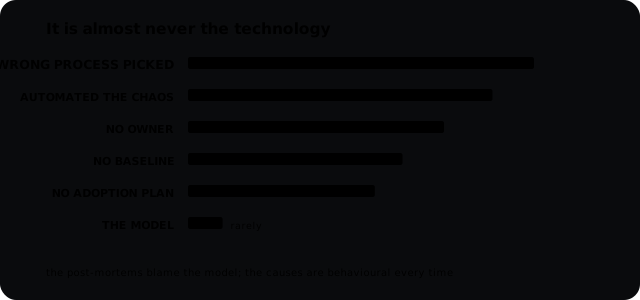
The diet parallel
Before the taxonomy, the framing that makes it stick. Ask why diets fail and the popular answer is "the diet didn't work." Ask the clinical literature and you get a different story: most diets work — mechanically, predictably — and fail anyway, because the system around the eater never changed. The stress, the sleep, the environment, the identity: untouched. So the old behavior reasserts itself, and the method takes the blame. (We've written that story in full: why diets fail.)
AI projects fail by the identical mechanism. The model performs. The pilot impresses. And twelve months later the team is back to spreadsheets, because the processes, incentives, and habits around the technology were never redesigned. A diet bolted onto an unchanged life; a model bolted onto an unchanged business. Same physics, same outcome, same misdiagnosis.
This is good news, for the same reason it's good news in health: if failure is behavioral, it's preventable. Here are the five ways it actually happens.
Killer #1: The wrong process was chosen
Projects get green-lit by excitement, not arithmetic. The flashy use case — the AI that writes strategy memos, the chatbot with the brand personality — beats the boring one that would have paid: invoice chasing, lead response, inquiry triage.
The arithmetic that should decide: frequency × structure × measurable cost. A process that runs fifty times a week, follows rules, and bleeds countable hours will return its investment in months. A process that's occasional, ambiguous, and "strategic" will demo beautifully and deliver nothing attributable. We've published the full selection framework in the automation guide — most failed projects die in this first decision, before any code runs.
Killer #2: Chaos was automated as-is
If a task is done three different ways depending on who does it and what mood they're in, automation doesn't resolve the inconsistency — it picks one version at random and executes it faster. Garbage in, garbage at scale.
The unglamorous prerequisite is standardization: write the one-page version of how the process works, including the exceptions, before anything is built. Teams skip this because it feels like bureaucracy. It's the opposite — it's the engineering. Every exception named on paper is an error that never reaches a customer. (The full method for extracting processes from heads into systems: how to systemize your business.)
Automation is an amplifier. It amplifies order into leverage — and disorder into incidents. The amplifier is never the problem.
Killer #3: Nobody owned it, nothing measured it
The signature of a doomed project: launched by enthusiasm, owned by everyone, measured by vibes. Six months in, nobody can say whether it worked because nobody captured the baseline — what the process cost in hours, latency, and errors before. Without a baseline there's no defensible win; without a defensible win there's no budget for round two; and the slow fade begins.
The discipline is almost insultingly simple: one named owner, one primary metric, baseline captured before launch. "Response time: 9 hours → 4 minutes" survives budget season. "The team likes it" doesn't.
Killer #4: The data lied
Every automation is built on a description of how work happens — and in most businesses, that description is fiction. The CRM says leads are followed up; reality says the follow-up lives in one rep's personal inbox. The official process has five steps; the real one has eight, two of which are "ask Deniz."
Build on the fiction and the system breaks on contact with reality — then gets blamed for breaking. The fix is anthropology before engineering: watch the work actually happen, capture the workarounds, and build for the process that exists, not the one in the slide deck.
Killer #5: The humans routed around it
The most common cause, and the least technical. The tool launches; within a quarter, the team has quietly rebuilt the old workflow around it. Post-mortems file this under "resistance to change," which is a label, not an explanation.
The explanation is behavioral and rational. People don't resist change — they resist loss: of competence (the skill they're valued for just got automated), of autonomy (a system now decides what they decide), of status (they weren't consulted on a process they know best). Add the practical insult — most tools add steps to the worker's day while saving hours elsewhere — and routing around the system isn't sabotage. It's sensible.
The remedies follow directly: involve the people who run the process in designing its replacement; make the tool visibly remove their tedium, not just management's costs; and make the new path easier than the old one — the same friction law that governs every habit ever changed. An organization is a nervous system with a payroll: it repeats what's easy and rewarded, not what's announced.
The six-discipline playbook
- Select by arithmetic. Frequent, rule-shaped, measurably costly. The boring process that pays beats the exciting one that demos.
- Standardize before you automate. One page, exceptions included, validated by watching real work.
- One owner, one metric, baseline first. If you can't state the before, you'll never prove the after.
- Run parallel for two weeks. Automation alongside the human process, outputs compared daily. Cut over when the gap closes — not when the demo impresses.
- Draw the escalation boundary explicitly. What the system never decides alone, and where humans take over. Trust is earned on volume inside that boundary, then the boundary moves.
- Redesign the humans' path. Their steps reduced, their input visible in the design, their new role named. Adoption is a behavior-change project wearing a software badge — run it like one.
Projects that run all six rarely fail. Projects that skip two or more rarely succeed — regardless of how good the model is. The technology stopped being the bottleneck years ago. The behavior around it never was anything else.
Stop asking "which AI should we buy?" Ask "which process have we standardized, baselined, and assigned an owner — and is the team's new path easier than their old one?" Answer that, and almost any competent tool succeeds. Skip it, and none will.
We don't sell tools. We run the six disciplines.
Audit, standardize, baseline, parallel-run, escalation boundaries, adoption design — that's why we can guarantee a clear return, or we don't build.
Get Your AI Audit →Frequently asked questions
Why do most AI projects fail?
For organizational reasons, not technical ones: the wrong process selected, chaos automated without standardization, no ownership or metrics, data that misdescribes real work, and teams routed around systems that made their day harder. The technology usually works; the project around it doesn't.
What percentage of AI projects fail?
Industry analyses have repeatedly put failure-to-deliver-value at well over half, with some estimates at 70–80% against original goals. The pattern matters more than the number: failure concentrates in selection and adoption — which makes it largely avoidable.
How do you make an AI project succeed?
Six disciplines: select by frequency × structure × cost, standardize first, one owner + one metric + baseline, a two-week parallel run, explicit escalation boundaries, and a redesigned path that makes the team's day easier. All six rarely fail; skipping two rarely succeeds.
Why do employees resist AI tools?
Rationally: the tool adds steps to their day, threatens the skill they're valued for, and arrived without their input. People resist loss — competence, autonomy, status — not change. Involve them in design and remove their tedium first, and adoption follows.