How AI projects actually die
The failure mode isn't dramatic. No explosion, no angry meeting — just a slow dissolve: the pilot that stayed a pilot, the dashboard nobody opens after week three, the subscription a bookkeeper quietly questions in month seven and nobody defends. Surveys keep finding most AI initiatives stall before producing value, and the autopsies — we've read a lot of them in audit conversations — show the same three wounds with almost boring regularity:
- Too wide: five workflows touched, none completed. Half-automated processes are worse than manual ones — they add oversight without removing work.
- Unmeasured: no day-0 baseline, so even genuine wins can't prove themselves — and unprovable line items lose every budget review they ever enter.
- Unaccompanied: the team found out at launch. Systems that staff experience as done to them get routed around with a creativity no vendor anticipates.
Notice the common thread: none of these is a technology failure. They're project-design failures — behavioral, structural, and entirely preventable, which is what the next ninety days are for. (The full failure taxonomy has its own article: why AI projects fail.)
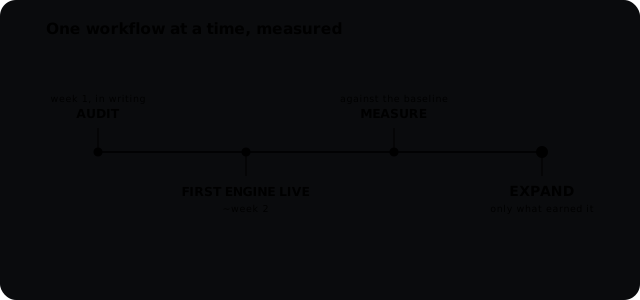
Days 1–30: audit and baseline
The first month contains no AI. This is deliberate, and it's the single highest-leverage decision in the plan.
- Map where hours and money actually leak. Missed calls and their timestamps. Lead response gaps. No-show rates. Hours of manual data transfer. The same five questions answered forty times a week. (The founder's version of this is the Tuesday audit; the business-wide version is the same instrument at scale.)
- Score the candidates: frequency × structure × measurable cost. Daily beats monthly; rule-based beats judgment-based; priceable beats vague. The usual podium — lead response, reminders, invoice chasing — emerges from arithmetic, not enthusiasm. (The twelve examples, pre-ranked by payback.)
- Pick exactly one. Resist the platform fantasy. One workflow, end-to-end, is the unit of success — and the discipline here is what separates the businesses with working automation from the ones with subscriptions.
- Write the baseline. Current response time, hours consumed, leak cost in currency, error rate — dated, documented, agreed. This page is the project's birth certificate and, in ninety days, its verdict sheet. "We should use AI" is a sentiment. "Leads wait 9 hours; it costs ~$8K/month; done = under 5 minutes, 24/7" is a project.
The audit isn't preparation for the project. The audit is the project — everything after it is execution of what the numbers already decided.
Days 31–60: build and shadow
Month two is construction plus the phase almost everyone skips and then pays for: shadow mode.
The build itself: the automation implemented against your real systems — calendar, CRM, phone, invoicing — because a system without hands isn't an agent, and integration is where the actual work (and the actual value) lives. Grounded in your real documentation, with escalation rules written before launch: what triggers a human, with what context, to whom.
Then the shadow weeks: the system runs in assisted mode — drafting replies a human approves, proposing bookings a human confirms — while the team watches, corrects, and teaches. This phase has two products. First, the edge cases: the hyphenated name that breaks the form, the customer who always pays cash, the Tuesday-only exception nobody documented. Every correction is a defect harvested cheaply — in shadow, errors cost a click; live, they cost a customer. Second, trust: the team that spent three weeks correcting the system stops fearing it and starts owning it. By go-live, it isn't the vendor's robot. It's theirs — they trained it.
Days 61–90: live and measured
Full operation, with three disciplines that keep it honest:
- Escalation paths live and visible. Emotion, stakes, repetition → human, instantly, with context. The handoff design from the customer-service playbook applies to every customer-facing workflow.
- Weekly output reviews — someone reads the transcripts. Twenty minutes a week. The failed conversations are the edit list: each one is a documentation gap, a missing integration, or a mis-tuned trigger. Systems improve at exactly the rate someone reads them; unread systems decay at the same rate.
- The day-90 verdict, against the day-0 page. Response time, hours recovered, leak recaptured, error rate — side by side with the baseline. Three outcomes: a measured win (proceed to workflow two, with the same discipline), a fixable shortfall (the reviews will have shown where), or an honest miss — which the audit-first approach makes rare, because workflows that can't show a return shouldn't have been built. We hold ourselves to exactly that line: if the audit doesn't show a clear return, we don't build.
The human half of the roadmap
Run a parallel track from day one, because adoption is decided before launch: ask the team where the tedious work is (they know precisely, and the question itself signals the project's intent); frame it honestly — this removes the work you complain about; it doesn't evaluate your worth (and mean it: the recovered hours need a named, better destination — the service quality, the backlog, the growth work that never had staffing); make them the teachers in shadow mode, with their corrections visibly shaping the system; and celebrate the day-90 numbers as theirs, because they are. The alternative — the surprise launch — produces the quiet sabotage that no model upgrade fixes. People support what they helped build. The sentence is old because it keeps being true.
Stop treating AI adoption as a technology purchase and run it as what it actually is: a behavior-change project with software attached. The model is the cheapest, most reliable component in the whole system. The audit, the baseline, the shadow weeks, and the humans are where the outcome gets decided — which is excellent news, because those are all yours to control.
Day 91 and the compounding
The quiet payoff of doing one workflow properly: the second one costs half as much. The integrations exist, the escalation patterns are proven, the team's trust is banked, and the audit already ranked the queue. Businesses that run this loop — one measured workflow per quarter — wake up two years later with operations that largely run themselves, having never once done anything dramatic. The ones that bought the platform in month one are, two years later, explaining to a new vendor what went wrong with the last one.
Slow is smooth, smooth is fast, and the baseline page is the whole religion.
Month one is the audit. We'll run it with you.
The audit maps your leaks, prices them, and hands you the ranked build order — before anything is built. If the numbers don't show a clear return, we don't build.
Get your Agent Blueprint →Frequently asked questions
How should a small business start with AI?
With measurement: audit the leaks, score candidates by frequency × structure × cost, pick one workflow, and write its day-0 numbers. "We should use AI" is a sentiment; a priced leak with a definition of done is a project.
What does a 90-day AI implementation look like?
Month one: audit and baseline. Month two: build against real systems, then shadow mode where the team corrects and teaches. Month three: live with escalation paths, weekly reviews, and a day-90 verdict against day-0.
Why do most AI implementations fail?
Behavioral causes: scope sprawl, no baseline, excluded teams, vendor-led scoping. None are technology failures; all are preventable design choices.
How do I get my team on board with AI?
Involve them before the decision: ask where the tedious work is, frame the project as removing it, make them the system's teachers in shadow mode, and name what the recovered hours become. People support what they helped build.