A tale of two screenshots
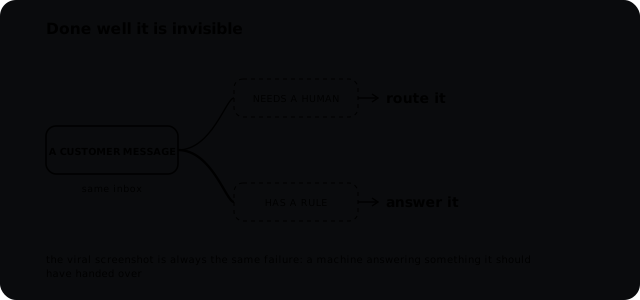
The first screenshot never gets posted, because nothing notable happened: a customer messaged a clinic at 23:40, asked whether Thursday's appointment could move, got it moved — calendar checked, slot offered, confirmation sent — in under two minutes, and went to bed. No hold music, no "we'll get back to you," no human woken. Multiply that non-event by thousands and you have the actual product.
The second screenshot you've seen: the airline bot inventing a refund policy, the delivery chatbot swearing at a customer, the support AI cheerfully upselling someone mid-complaint. Forty thousand retweets, a PR apology, and a thousand business owners concluding "AI isn't ready."
Here's the diagnosis that decade-of-behavior-work plus years of building these systems insists on: the two screenshots run on the same technology. What differs is governance — what the machine was permitted to touch, how grounded its answers were, and how fast it surrendered the conversations it should never have kept. AI customer service isn't a model question. It's an architecture question, and architecture is choosable.
Where AI is genuinely better than humans
Audit any support inbox and the composition repeats: 60–80% routine — where's my order, what are your hours, can I move my appointment, how do I reset this, what's the policy on that. For exactly this layer, a well-grounded system isn't a cheaper substitute for a human. It's better, on the dimensions customers actually feel:
- Speed: forty seconds at midnight beats nine minutes of hold music at noon — and response speed is read as respect before any content arrives.
- Consistency: the two-hundredth identical question gets the same quality answer as the first. No human achieves that at 17:40 on a Friday, and no human should be asked to.
- Coverage: evenings, weekends, holidays — when a large share of real inquiries actually arrive (the missed-call math applies to every channel).
- Memory: full history, instantly — no "let me look that up," no re-explaining to the third representative.
And the second-order benefit lands on your team: humans relieved of the repetitive 70% stop being tired FAQ machines and become what the remaining 30% needs — rested judgment, warm on arrival. Support quality rises at both ends of the split. That's the design goal, and it's reachable.
The never-touch list
Now the other half of the architecture — the conversations the machine must recognize and release, every time:
- High emotion. The grieving customer, the furious one, the frightened one. A machine consoling distress is a category error the customer feels instantly — and the service recovery paradox means these moments are your highest-leverage loyalty events, which is precisely why they belong to your best humans, not your cheapest channel.
- High stakes. Big refunds, cancellations, legal-flavored complaints, anything touching safety or health. The cost of a wrong answer here isn't a bad interaction; it's a liability with a timestamp.
- Genuine exceptions. The situation your documentation never imagined. A grounded system says "let me get someone" — an ungrounded one improvises, confidently, and improvisation in customer service is how policies get invented on Twitter.
- Relationship judgment. The decade-long client asking for an exception, the account that needs reading between lines. Judgment about people stays with people — rules to machines, relationships to humans, always.
Automate the conversations nobody wanted to have. Protect the conversations that decide whether there's a relationship at all. Every AI service disaster is those two lists swapped.
The handoff: the whole game in one design decision
If one design decision separates the two screenshots, it's this one. The handoff fires on three triggers: emotion (sentiment is detectable — frustration vocabulary, caps, the second "I already told you"), stakes (thresholds defined in advance: refund size, cancellation intent, complaint severity), and repetition (the customer repeating themselves or the bot looping means the conversation has already failed — the only correct retry is a human).
And the handoff must carry full context: the human arrives knowing everything the customer already said, so the customer never performs the re-explanation ritual that converts a minor issue into a churn event. Done right, the customer experiences one continuous conversation that simply got more capable. Done wrong — "please describe your issue" after eight minutes of describing the issue — the handoff punishes the customer for having a real problem, and they file the lesson permanently.
One more rule that costs nothing and saves reputations: the human door stays visible. "Talk to a person" available at every step, not hidden behind four menus. Paradoxically, the visible door reduces its own use — customers who know they can escalate relax and let the machine finish the routine job.
What customers actually punish
The survey literature is consistent and more forgiving than the horror stories suggest: customers happily accept automation for speed-priority jobs and want humans for emotional or complex ones. What they punish, hard, is three specific sins: deception (a bot performing humanity — naming it "Jessica," denying being a bot; the discovered lie spends trust at the worst exchange rate in business), confident incompetence (wrong answers delivered fluently — which is a grounding failure: a properly built system answers only from your real documentation and says "let me check with the team" past its edges), and imprisonment (no path to a human — the single fastest generator of public complaints in the genre).
Invert the sins and you have the policy: honest about being a machine, grounded so it can't improvise, exits everywhere. None of this is a technology constraint. All of it is a choices document — which is exactly why "AI customer service" varies from invisible excellence to viral disaster across businesses buying the same models.
Stop asking "should we automate support?" and ask "which conversations does each party actually win?" The machine wins the instant, the routine, the 2am. Humans win the emotional, the exceptional, the relational. The businesses embarrassing themselves automated by cost. The ones quietly winning automated by fit.
Building it right: the checklist
- Audit the queue first. Pull a month of tickets; tag routine vs. emotional vs. exceptional. The routine share is your automation scope — and your business case, in hours.
- Ground it in your real documentation — policies, SOPs, actual answers. No grounding, no launch. This single requirement prevents the improvisation class of disaster.
- Integrate, don't deflect. Resolution requires action: calendar, CRM, order system. A bot that explains the reschedule process deflected the ticket onto the customer; an agent that reschedules closed it.
- Write the handoff rules before launch: the three triggers, the thresholds, the context-transfer, the named escalation paths. This document matters more than the model choice.
- Read the transcripts weekly, forever. The failed conversations are your edit list — each one is either a documentation gap, a missing integration, or a trigger tuned wrong. The system improves at exactly the rate someone reads them.
What's in your queue, actually?
The audit tags a month of your real inquiries — routine vs. human-needed — and prices both sides before anything gets built. If the numbers don't justify it, we don't build.
Get your Agent Blueprint →Frequently asked questions
Is AI customer service actually good now?
For routine conversations — 60–80% of most queues — yes: instant, consistent, around the clock, often beating tired humans on satisfaction. For emotional, high-stakes, or exceptional conversations, no — and the quality of your system is decided by respecting that line.
When should AI hand off to a human?
On emotion, stakes, or repetition — instantly, with full context carried so the customer never re-explains. A clean handoff feels like one conversation getting more capable; a context-free one punishes the customer for having a real problem.
Will customers accept talking to an AI?
Yes, for speed-priority jobs — what they punish is deception, confident wrong answers, and no path to a human. Honest, grounded, with visible exits, the 40-second midnight answer wins loyalty.
What's the difference between a support chatbot and an AI support agent?
Answering versus acting: the chatbot explains how to reschedule; the agent reschedules, confirms, and logs it. Resolution needs integration with your real systems — which is where the ROI, and the build effort, both live.