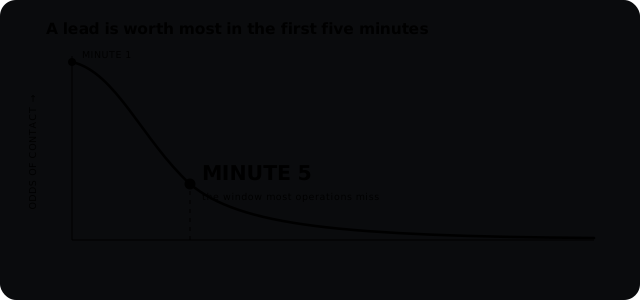
The most lopsided data in sales
Most sales research produces modest effects — a technique that lifts conversion a few points, a script that helps at the margin. Lead response time is not that kind of variable. The numbers are almost rude:
- The classic lead-response study (analyzing millions of call attempts, led by James Oldroyd) found the odds of making contact at all drop roughly 10x after the first 5 minutes. The odds of qualifying the lead were about 21x higher at 5 minutes than at 30. Thirty minutes — the length of one routine meeting.
- A Harvard Business Review audit of 2,241 US companies found firms that responded within an hour were 7x more likely to have a meaningful conversation with the decision-maker than those who waited even two hours — and 60x more likely than those who waited a day.
- The same audit's quiet headline: the average response time was 42 hours, and nearly a quarter of companies never responded at all.
Hold those two facts together. The window that decides the outcome is five minutes wide; the average business shows up almost two days later. I've watched owners spend five figures on ads to generate inquiries that their own inbox then quietly euthanized. The leak isn't in the funnel. It's at the doorstep.
Why: buying intent is a state, not a trait
The behavioral mechanism matters, because once you see it you stop treating fast response as a nice-to-have and start treating it as physics.
"Hot lead" and "cold lead" imply temperature — a property of the lead that fades politely over days. Wrong model. The person who filled out your form was in a state: their problem was salient, their motivation peaked hard enough to overcome inertia (most people never inquire about anything), and — rarest of all — their attention was on you. That configuration is a spike, not a plateau.
Twenty minutes later, the spike is gone. They're in a meeting. The school called. The tab closed. When your reply lands the next morning, it isn't received by the motivated problem-solver who wrote to you — it's received by a busy person being interrupted about something they half-remember. Same name, different state. This is the same mechanics I wrote about in the psychology of selling: people don't buy products, they buy from inside a predicted change of state — and the prediction is loudest at the moment of inquiry.
The lead never went cold. The person changed state — and your reply arrived addressed to someone who no longer exists.
There's a second decay curve running in parallel: simultaneous shopping. The motivated state that produced your form fill usually produced two others in the same sitting. You're not in a queue. You're in a race you may not know you entered.
The first-responder advantage
Speed doesn't just win contact — it wins framing. The first business to hold a real conversation gets to define what the problem is, what a good solution looks like, and what things should roughly cost. Every later conversation the prospect has is unconsciously measured against that anchor; behavioral economists have documented anchoring for decades, and sales is where it cashes out. Second responders don't start at zero — they start at minus the first responder's frame.
And there's a quieter signal underneath: response speed is a sample of your service. Before a prospect has seen your work, your speed is your work. A reply in ninety seconds says this is what being our customer feels like. A reply on Thursday says the same thing.
Your own math, on one napkin
Skip the industry benchmarks; run your own numbers:
- Leads per month across every channel — forms, calls, DMs, email. Call it L.
- Your real median response time. Don't guess — check timestamps. Owners who guess "20 minutes" routinely measure 6+ hours, because nights, weekends, and busy days are when leads actually arrive.
- Average customer value, first year. Call it V.
If your median response sits beyond an hour, the research suggests a large share of L never even becomes a conversation. Recover even a quarter of those at value V and you have the monthly cost of the leak. For a typical service business — say 40 leads a month at $2,000 first-year value — moving response time from hours to minutes routinely pencils out to tens of thousands a year. Not from more ads. From answering the door.
Stop asking "how do we get more leads?" until you can answer "what happens in the first five minutes after one arrives?" More volume through a slow front door just buys a bigger pile of missed states. Fix the window first; the ads you're already running get cheaper on the spot.
How to win the window
- Measure it honestly, this week. Pull the last 20 inquiries across every channel and write down the real gap between arrival and first meaningful reply. Include the 9pm Saturday form fill. That number — not your impression of it — is the baseline.
- Collapse the channels. Inquiries scattered across a contact form, a personal inbox, Instagram DMs, and a voicemail box can't be answered fast because they can't be seen fast. One routed destination, one owner.
- Make the first response useful, not just fast. "We got your message" is a receipt, not a response. The first reply should start the actual work: confirm the need, ask one or two qualifying questions, offer times. Speed gets attention; substance keeps it.
- Set a human SLA for the follow-through. Whatever the first touch is, a human conversation should follow within a defined window during working hours — minutes, not "today."
- Put software on the door. Here's the structural truth: a 5-minute standard, 24/7, is not a job a human team can hold — not at 2am, not mid-appointment, not on holiday. It is, however, exactly the job an AI agent holds without noticing: answer in seconds, every channel, every hour; ask the qualifying questions in your voice; book the call; hand your team a warm, scheduled conversation instead of a name that's been aging in a spreadsheet. The humans still do the part humans win — they just stop losing the race before it starts.
One of the first things we examine in any business audit is this exact pipeline — where inquiries arrive, how long they wait, and what they're worth. It's usually the shortest line between a business and recovered revenue, because the leads are already paid for. They're just standing at the door.
How long do your leads wait?
The audit maps your inquiry-to-conversation pipeline and puts a number on the leak — before anything gets built. If the audit doesn't show a clear return, we don't build.
Get your Agent Blueprint →Frequently asked questions
What is speed to lead?
The time between a prospect's first inquiry and your first meaningful response. It's among the strongest controllable predictors of conversion: ~21x better qualification odds at 5 minutes vs 30, while the average business takes 42 hours.
What is the ideal lead response time?
Under 5 minutes — near-instant if possible, because the prospect is still in the buying state and not yet talking to competitors. Since humans can't hold that standard around the clock, winners automate the first response and reserve humans for the real conversation.
Why do leads go cold so fast?
Because "cold" is the wrong metaphor — people change state. Inquiry is a motivational spike that decays in minutes; your next-day reply interrupts a different mental context. The first responder also sets the anchor every later quote is judged against.
How do I improve my speed to lead?
Measure the real number, collapse all inquiry channels into one routed destination, make the first response useful (qualify + offer times), set a human follow-up SLA, and put an AI agent on first response so the 5-minute window is covered 24/7.