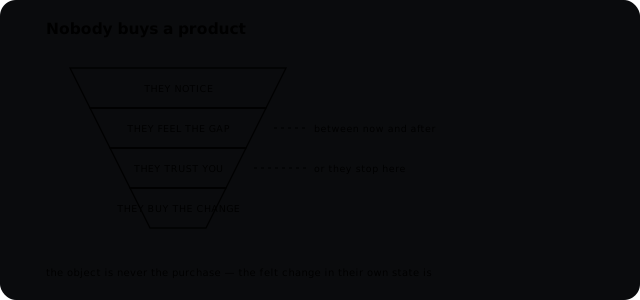
What people are actually buying
Strip any purchase to its core and you find the same transaction: the buyer trades money for a predicted state change. Not the drill — the hole, and more honestly, the feeling of being someone whose shelves are finally up. Not the coaching program — the version of themselves who doesn't dread Mondays. Not the automation — the evening they get back.
This is why feature-led selling underperforms everywhere it's tested: features describe the product, but the decision is happening in the buyer's self-prediction — "what will my life feel like after this?" The seller's first job is not to present; it's to name the current state more precisely than the buyer can name it themselves. When a prospect reads your page and thinks "this is exactly my situation," half the sale is done — accuracy about the pain is the deepest proof you can offer that you hold the cure.
Mechanically, the anticipation machinery driving this is the same dopamine circuitry that runs every other human pursuit — the brain buys the prediction of reward, not the reward. (We unpacked that machinery in the dopamine piece; selling is its commercial application.)
Perceived value: the only value that converts
A decade of selling — and a behavioral-science degree on top — teaches one impolite truth: actual value closes nothing. Perceived value closes everything. The two should match (more on ethics below), but they are built differently. Perceived value is assembled from:
- Contrast. Value is never judged absolutely — it's judged against an anchor. The price next to the cost of the problem ("this costs less than the hours you lose to it monthly") reads differently than the price alone.
- Framing. "Save 10 hours a week" and "stop losing 40 hours a month" describe the same automation; the second converts better, because of the next section.
- Specificity. "a decade of work on what makes people thrive" outperforms "thousands of happy clients" — precision reads as truth, vagueness reads as marketing.
- Identity fit. People buy what someone-like-them buys. The testimonial that converts isn't the most glowing — it's the one from the person your prospect recognizes as themselves.
Loss aversion: the engine under the yes
The most replicated finding in behavioral economics: losses hurt roughly twice as much as equivalent gains feel good. Humans will work harder, decide faster, and pay more to avoid losing something than to acquire the same thing.
In selling, this changes where the energy lives. The benefit list ("here's what you'll gain") engages the weaker circuit. The honest cost-of-inaction ("here's what staying exactly where you are costs you per month — in hours, in money, in evenings") engages the stronger one. The best sales conversations spend most of their time making the status quo concrete, because the real competitor is almost never another vendor. The real competitor is "do nothing" — and "do nothing" wins most deals precisely because its costs are invisible until someone makes them visible.
What you don't change, you choose. The seller's deepest service is making that choice visible — and then making the alternative easy.
The trust stack
Every buying decision carries risk, and trust is how the brain prices risk down. The robust trust-builders, in rough order of power:
- Demonstrated expertise — teach something genuinely useful before asking for anything. Reciprocity is real: value given first creates a pull to respond, and competence shown beats competence claimed.
- Social proof — specific, verifiable, similar-to-the-buyer. We follow what people like us did, especially under uncertainty.
- Authority signals — credentials, published work, a real bibliography. They work because they lower perceived risk, not because they impress.
- Risk reversal — guarantees move the residual risk from buyer to seller. A strong guarantee isn't generosity; it's the seller pricing their own confidence, and buyers read it exactly that way.
- Consistency — small commitments precede large ones. The free assessment before the subscription, the audit before the build. Each kept micro-promise compounds the trust account.
Friction: the silent deal-killer
Here's the part most businesses refuse to believe until they test it: more sales die from friction than from price. By the time a buyer reaches your checkout or booking page, they're operating on a depleted decision budget — modern life spends it for them before lunch (the full mechanics here). At the moment of commitment, loss aversion peaks: the money is concrete, the outcome still abstract. The buyer's resolve is at its most fragile exactly when most funnels pile on fields, options, surprise costs, and ambiguity.
The audit questions: How many decisions does your funnel demand? (Each option set is a tax.) How many steps between "yes" and "done"? What appears at checkout that wasn't promised before? Can a tired person complete this at 9 p.m. on a phone? The highest-ROI redesigns are usually deletions: one recommended plan instead of five, one clear next step instead of a menu, the guarantee stated at the point of maximum hesitation.
Speed: the most underrated close
Buying intent is a state, not a trait — and states decay. The classic lead-response research found that contacting an inquiry within minutes makes qualification many times more likely than waiting even an hour; most deals go to whoever responded first. Not who was best. Who was present while the state was hot.
Yet average response times run to hours and days, because follow-up depends on busy humans with depleted budgets — the seller's psychology failing the buyer's psychology. This is the one part of selling where machines now beat humans cleanly: an agent answers in ninety seconds at 11 p.m., asks the qualifying questions, books the call, and runs the follow-up sequence humans abandon after attempt two. The human takes the conversation that matters; the machine guarantees the conversation happens. That division of labor is the modern sales stack in one sentence.
The line: persuasion vs. manipulation
Everything above is dual-use, so the line needs stating plainly. Persuasion is helping someone do what's genuinely good for them, faster. Manipulation is using the same levers to move someone toward what's good for you. Operationally: fake scarcity, invented social proof, and pressure on a misfit prospect all "work" once — and the research on trust is unambiguous about what happens when they're discovered. The compounding strategy is alignment: sell hard to the people your product genuinely serves, and disqualify the rest early. It's also, conveniently, the only version of selling you can do for a decade without burning out your soul or your market.
Stop asking "how do I convince them?" Ask "what is the cost of their status quo, and how do I make it visible — then make leaving it frictionless?" Conviction is the buyer's job. Clarity and ease are yours.
Your leads are deciding while you're busy.
We build agents that respond in minutes, qualify, book, and follow up — so the psychology of the moment works for you instead of expiring. A written blueprint first.
Get Your AI Audit →Frequently asked questions
What is the psychology behind buying decisions?
Decisions are made emotionally and justified rationally. The buyer purchases a predicted change in their own state, shaped by perceived value, loss aversion, trust, and the friction of the path to yes. Sellers who name the felt problem outconvert sellers who describe the product.
What are the most effective psychological triggers in sales?
Social proof, authority, genuine scarcity, reciprocity, commitment consistency, and similarity. The caveat the research is equally clear on: fabricated versions destroy trust permanently when discovered. These principles compound only when true.
Why do customers abandon purchases at the last step?
Friction and risk, not desire. At commitment, loss aversion peaks while decision budgets are depleted — every extra field, surprise cost, or ambiguity lands at the worst moment. Fix with clarity, no surprises, risk reversal, and fewer steps.
Does responding faster to leads really increase sales?
Dramatically. Contact within minutes makes qualification many times more likely than waiting an hour; most buyers choose whoever responded first. Buying intent is a state that decays — speed-to-lead automation is usually the highest-ROI sales improvement available.