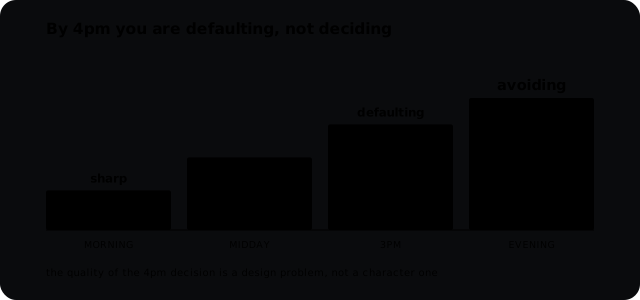
One budget, every decision
The core finding of decision-fatigue research is simple and brutal: choosing is a resource-consuming act, and the resource is shared. The decision about the investor email, the decision about lunch, the decision about whether to answer the phone — all of them draw from one account, and the account depletes with use.
As it depletes, the brain doesn't announce bankruptcy. It quietly switches strategies. Studies of sequential decision-making show three predictable late-budget behaviors: impulsivity (take the vivid option, skip the analysis), default bias (whatever we did last time), and avoidance (defer, delegate upward, leave the cart abandoned). None of these feel like fatigue from the inside. They feel like reasonable choices — which is exactly what makes the tax invisible.
And the consequences scale with the stakes. Depleted decision-making has been documented everywhere from consumer choices to professional judgments — the pattern is the same: as the session wears on, the easy option wins more and the considered option wins less.
The signature of a depleted decision-maker
Check yourself against the pattern — the key is the time signature, not any single behavior:
| 9 a.m. you | 5 p.m. you |
|---|---|
| Decides the pricing question in ten minutes | Re-opens the same question, closes the tab |
| Writes the hard reply directly | Marks it unread "for tomorrow" — the fourth tomorrow |
| Evaluates options on the merits | Picks whatever resembles last time |
| Hears a request, gives a clean yes or no | Says "let me think about it" to everything |
| Calm in front of a menu of choices | Quietly furious in front of a menu of choices |
If the right column is recognizably your evening, the problem isn't discipline — it's volume. And if your evenings also feature the tired-but-wired pattern, the decision load is part of a bigger regulation story: a system that's mobilized all day stops being able to power down at all. We've mapped that mechanism in nervous system regulation — decision load and stress load deplete through the same channel.
The founder's decision math
Now the uncomfortable arithmetic. A founder in a typical small business is the routing destination for: every exception ("customer wants a refund outside policy"), every approval ("can I order more stock?"), every ambiguity ("which version do you prefer?"), every interruption that ends in a question mark. Count honestly and most founders field dozens of decision-demands before lunch — the majority trivial, every one a withdrawal.
The cruel part: the trivial decisions arrive first and constantly, while the consequential ones — pricing, hiring, the product bet — wait politely for "when things calm down." So they get decided at 6 p.m., by the depleted version of you, with the budget spent on shipping questions and calendar Tetris. The most important decisions in the business are systematically made by the worst available decision-maker: the end-of-day founder.
You don't have a judgment problem. You have a judgment allocation problem — your best decision-hours are being spent on your least important decisions.
Choice overload: the customer-side twin
The same mechanics run on the other side of your business. The famous choice-overload research found that shoppers offered 24 varieties of jam stopped and browsed more — but purchased dramatically less than those offered six. More options produced more interest and fewer decisions.
Audit your funnel with that lens: five pricing tiers, twelve service options, a homepage with nine calls to action — every option you add transfers decision load onto a visitor who arrived with their budget already half-spent by the modern day. The businesses that convert best decide for the customer wherever possible: one recommended plan, one next step, one clear door. (This is half of sales psychology in one sentence — the other half is in the psychology of selling.)
The architecture: four moves
1. Take the routine decisions off a human entirely
The bulk of a founder's decision volume is rule-shaped: refund within policy? Reschedule request? Standard quote? These don't need judgment — they need a rule executed consistently, which is precisely what automation and AI agents do without depleting anything. Every routine decision an agent absorbs is budget returned to the decisions that compound.
2. Convert recurring decisions into policies
A policy is a decision you make once that eliminates hundreds: discounts up to X are auto-approved; meetings happen Tuesday–Thursday; we don't take projects under Y. Write the rule, publish it to the team, stop re-deciding it. (Steve Jobs' turtleneck and Obama's two-suit rotation were exactly this principle applied to wardrobe — trivial domain, correct math.)
3. Schedule consequential decisions at the peak
Your first two hours hold your best judgment. Spend them on the decision that matters — pricing, hire, strategy — before the inbox spends them for you. The end of day is for execution and shutdown, never for the big call. If a consequential decision lands on a depleted evening, the single best move is also the simplest: sleep on it, decide at 9.
4. Batch and bound the rest
Decisions that survive the first three filters get batched: one daily window where the team brings the day's questions at once, with a default attached ("we propose X unless you object"). Proposals-with-defaults cost a fraction of open-ended questions — reviewing is cheaper than generating.
The substrate nobody respects
Every technique above sits on a biological floor. Decision quality tracks glucose, sleep, and recovery — the research on depleted judgment shows effects strongest exactly when people are tired and hungry. A founder optimizing decision architecture while running on five hours of sleep and a skipped lunch is tuning the engine while draining the oil.
The floor: real sleep (here's what's actually draining you if you're unsure), regular meals on heavy decision days, and genuine recovery blocks. Boring, foundational, non-negotiable.
Stop treating decisions as free. Every choice you make is paid for from a finite daily account. The question that reorganizes a founder's entire week: "is this decision worth what it costs me — and does it need to be mine at all?"
Most of your decisions don't need you.
We audit what's routing through you, encode the rules, and deploy agents that execute them — so your judgment is spent only where it compounds. A written blueprint first.
Get Your AI Audit →Frequently asked questions
What is decision fatigue?
The measurable decline in decision quality after a long run of choices. As decisions accumulate, the brain shifts to shortcuts: impulse, default, or avoidance. The budget is shared across all decisions — trivial and critical alike.
What are the symptoms?
Small choices feeling heavy by late afternoon, postponing decisions your morning self would make instantly, defaulting to "last time," irritability at options, and impulse calls you regret by morning. The tell is the time pattern.
How do you fix decision fatigue?
Reduce volume (automate and delegate routine choices), pre-decide the recurring (policies), schedule consequential decisions at your morning peak, and protect the substrate — sleep, meals, recovery. A depleted brain shortcuts regardless of technique.
Why do leaders wear the same thing every day?
Deliberate budget management: converting daily choices into one-time policies preserves decision capacity for choices that compound. The wardrobe is trivial; the principle isn't.