The price that doesn't exist
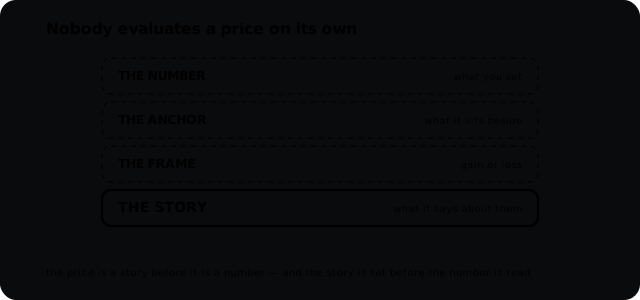
Quick experiment from the behavioral classics: is $4 expensive for a coffee? You can't answer — not because you lack information, but because the question is malformed. $4 against the petrol-station machine: outrageous. Against the hotel lobby café: a bargain. Same coffee, same wallet, opposite verdicts. There is no perception of price in isolation; there is only price-against-context — and the context is built from anchors, frames, memories, and the story running in the buyer's head at the moment of judgment.
This is the founding fact of pricing psychology, and most small businesses price as if it weren't true: cost-plus arithmetic, a nervous glance at competitors, a number chosen to feel safe. The arithmetic is fine. What's missing is the half of the price that was never a number — the story it gets evaluated inside. (This is the same architecture as the psychology of the yes: people don't buy products, they buy predicted changes of state — and the price is judged against the size of that predicted change, not against your costs.)
Anchoring: the first number wins
Tversky and Kahneman's anchoring studies are among the most replicated in behavioral science: the first number encountered — even an explicitly random one — drags every subsequent estimate toward it. In pricing, the anchor effectively is the context. Applications, all honest:
- Sequence high to low. Present the premium option first. The $5,000 package makes the $2,500 one read as moderate; led with the $1,000 option, the same $2,500 reads as a stretch. Nothing changed but the order — and the order is doing the work of a discount without costing you one.
- Anchor against the problem, not the market. The strongest anchor available to a service business isn't a competitor's rate — it's the cost of the unsolved problem. "Your missed calls are costing roughly $3,000 a month" makes a $500 monthly fix read correctly: small. This is why we run the audit before any proposal — the audit isn't sales theater; it's the only honest anchor in the building.
- Beware the anchors you set by accident. The "starting at $99" line on your site is anchoring every conversation that follows — including the ones where the real scope is $4,000. Cheap anchors are loyal; they follow you into every negotiation.
You don't get to choose whether anchoring happens. You only choose whether you set the anchor — or inherit whichever one the buyer walked in with.
Loss aversion: insurance beats discounts
Kahneman and Tversky's other gift to pricing: losses weigh roughly twice as much as equivalent gains. The fear of paying for something that doesn't work is, gram for gram, about twice as motivating as the appeal of the thing working. The strategic consequence is underused everywhere: a dollar spent removing risk outperforms a dollar spent discounting.
Risk-removal in practice: trials, guarantees, phased engagements, transparent exit terms — and the structural version we use ourselves: audit-first, where the buyer pays nothing until the numbers show the build is justified, and if the audit doesn't show a clear return, we don't build. That isn't generosity; it's loss-aversion engineering with the incentives pointed the right way. The discount says "pay less for the same risk." The guarantee says "pay the same for less risk" — and the second sentence, per fifty years of data, is the louder one.
Price as confession: the underpricing trap
Here's the finding that hurts the most founders: in markets where quality can't be verified before purchase — which is every service business — buyers read the price as evidence of the quality they can't inspect. The wine studies are the famous demonstration (identical wine rates better with a higher tag, with brain-imaging showing the pleasure response itself shifting), but the everyday version is harsher: the $40 logo, the suspiciously cheap consultant, the agency at half the market rate. The buyer's inference isn't snobbery; it's rational signal-reading in an information vacuum. If this were good, why would it be priced like it isn't?
Underpricing then compounds through selection: the lowest prices attract the most price-sensitive, churn-prone, support-heavy customers — while quietly filtering out the buyers who use price to shortlist serious providers. And the thin margins fund no excellence, which eventually makes the low price accurate. I've watched this trap close on talented people for a decade, and the root cause is almost never strategy. It's the founder's own doubt, doing the positioning while nobody was supervising it.
The pain of paying (and its honest painkillers)
Neuroeconomics found that paying activates pain-associated regions — spending literally hurts, and the hurt varies with format. The honest painkillers: reframe the denominator ("$1,200 a year" hurts; "$3.30 a day, less than the coffee" describes the identical number inside a survivable frame); bundle into one decision (ten itemized line-items administer ten doses of payment pain — one clean package price administers one, which is also why per-hour billing makes every invoice an audit of your every hour); and separate payment from consumption where you can (subscriptions hurt once and deliver continuously — part of why the model works so well for both sides when the value is real).
The ethical line, stated plainly: all of these describe the same true number more humanely. None of them license hiding fees, fabricating urgency, or anchoring against invented "regular prices" — tactics that buy a transaction by spending the relationship, which is the worst trade in business.
Your price is part of your product. It tells the buyer what category you're in, what to expect, and how seriously to take the work — before a single deliverable exists. Stop asking "what can I charge?" and ask "what does this number say — and is it telling the truth about us?"
How to raise prices without losing trust
- Write the value story first. Concrete outcomes, results, what clients actually walked away with. Most underpriced businesses have never documented this — the raise feels arbitrary to them too, which is why it keeps not happening.
- Anchor the new price against the problem's cost, not the old price. The conversation is "here's what the problem costs you; here's what solving it is worth" — not "we're 25% more now."
- Honor the existing clients. Notice ahead, grandfather period, or legacy rates for the loyal — the goodwill costs little and the alternative (loyal clients discovering they're paying more than strangers... or less, with no acknowledgment) costs trust either way.
- Expect a small, profitable loss. A well-storied 20–30% raise typically loses a sliver of the most price-sensitive accounts — frequently the least profitable to serve — while total revenue rises. Run the math before fear runs it for you: at +25%, you can lose one client in five and break even on revenue while working less.
- Let the price and the product rise together. The most durable version of all of this is the boring one: charge what funds excellence, deliver the excellence, and let the number and the story keep telling the same truth. Pricing psychology gets you a fair hearing. The work is still the witness.
Want the honest anchor for your own pricing?
The audit puts real numbers on what your operational leaks cost — missed calls, slow leads, manual hours — so every pricing and automation decision starts from evidence.
Get your Agent Blueprint →Frequently asked questions
What is pricing psychology?
The science of how prices are actually perceived: relative to anchors, shaped by frames, weighed against losses (~2x gains), and read as quality signals when quality can't be verified in advance.
Why does underpricing hurt my business?
It signals low quality in unverifiable markets, selects for price-sensitive high-maintenance customers, and starves the margins that would fund excellence — a self-confirming trap usually built by founder doubt, not strategy.
How do I raise prices without losing customers?
Story before number: document value, anchor against the problem's cost, give loyal clients notice or legacy terms, and expect a small loss of the least profitable segment while revenue rises.
Do charm prices like $99 actually work?
The left-digit effect is real in price-sensitive retail; premium services usually do better with confident round numbers. Match the format to the signal — a .97 ending undercuts a high-trust story.