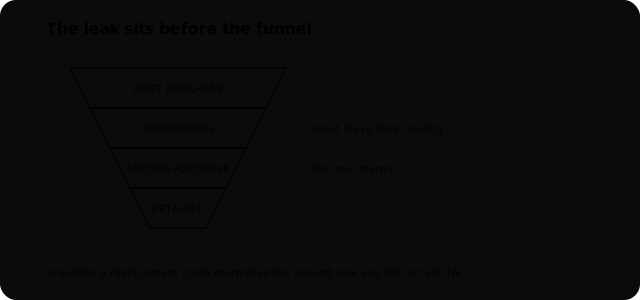
The party at the front door
Walk into any growth meeting and watch where the energy goes: the new campaign, the lead count, the funnel conversion by stage. Acquisition is celebrated like a harvest. Now ask the same room two questions: how many customers did we lose last month, and why? The first answer is usually a guess. The second is usually a theory — nobody asked the leavers, because leaving happens quietly, off-dashboard, while everyone faces the front door.
This is the strangest standing imbalance in business behavior, and I say that as someone who spent years studying consumer behavior before building systems for businesses: companies obsess over the expensive way to grow and neglect the cheap one. Partly it's visibility — new logos are announcements, churned ones are silence. Partly it's psychology — acquisition feels like winning; retention feels like maintenance, and nobody gets promoted for maintenance. The leak doesn't care about the reasons. It compounds either way.
The lopsided math
The numbers have been stable for decades. Acquiring a new customer costs 5 to 25 times more than retaining an existing one, depending on industry. Frederick Reichheld's research at Bain produced the most-quoted finding in the field: a 5% improvement in retention lifts profits 25–95%. The mechanisms stack like compound interest:
- No persuasion cost. Trust — the most expensive asset in any sale — is already built. The entire psychology of the yes has already run once.
- Expanding wallets. Retained customers buy more over time, and tolerate fair price increases (they're paying partly for accumulated certainty about you — a real product).
- Falling service costs. They know your systems; the fifth year asks fewer questions than the first month.
- Free acquisition. Referrals — the only marketing channel with built-in trust transfer — come almost exclusively from this group.
Run the comparison honestly in your own books: what you spent last year to acquire a customer versus what it would have cost to delight an existing one into staying and referring. The ratio is usually embarrassing — and it's the cheapest strategic insight you'll collect this quarter.
Why customers actually leave
Now the behavioral core, because the standard theory of churn — they found cheaper / something went wrong — misdiagnoses most cases. Across defection research and exit-survey work, the leading cause is consistently some version of perceived indifference: the customer's accumulated sense that the business stopped noticing them. Not an incident. An absence — of contact that isn't an invoice, of recognition, of any evidence that their staying registered with anyone.
It maps perfectly onto the relationship psychology it actually is. Customers rarely storm out; they drift, the way neglected relationships drift: usage softens, replies slow, the renewal becomes a question instead of a default — and then one ordinary Tuesday, a competitor's ad lands on a person who no longer has a reason to ignore it. The cancellation reads "out of nowhere" only because nowhere was where the business had been looking. The signals were emitted for months. There was simply no instrument tuned to receive them.
Customers don't leave when something goes wrong. They leave when nothing goes anything — month after month of being a line item to a business they once chose.
The recovery paradox: complaints are gifts
Here's the finding that should reorganize every complaints process: service research has repeatedly documented the service recovery paradox — customers whose problem was handled quickly and generously often end up more loyal than customers who never had a problem at all. A well-run failure is a trust demonstration no marketing can buy: the customer learned, from evidence, what you do when things break — which is the exact information they could never verify before buying.
Two consequences. First, the complainer is not your churn risk — complaining is engagement; the complainer still believes you're worth the effort of telling. The silent account with softening usage is the one walking. Second, complaint handling deserves real budget and real speed, because each one is a loyalty-conversion opportunity wearing an inconvenience costume. (And handled badly — defensiveness, friction, the apology that arrives as policy — the same moment converts the other way, permanently. Speed and generosity are the whole recipe; this is one place automation must hand off to humans, every time the temperature rises.)
The retention system
- Engineer time-to-first-value. The opening days set the trajectory: a customer who experiences real value in week one files you under "good decision," and that file resists later wobbles. Map the path from purchase to first felt win; remove every step that delays it; automate the welcome sequence so the great onboarding isn't dependent on someone's calm week. (This is automation example #7 for a reason.)
- Build the noticing instrument. Define your decline signals — usage drop, slower replies, missed sessions, shrinking orders — and have something watching them weekly. This is precisely the monitoring work an agent does without fatigue: flagging the quiet accounts while they're still reachable, weeks before the cancellation email gets drafted.
- Schedule contact that isn't an invoice. The direct antidote to perceived indifference: check-ins, value drops, the "saw this and thought of your situation" note, the anniversary acknowledged. Small, systematic, sincere — and almost nobody's doing it, which makes it disproportionately loud.
- Resolve failures fast and slightly too generously. The paradox pays for itself: the refund that stings this month buys the testimonial and the decade. Empower the team (or the escalation rules) to fix things without a committee.
- Make leaving easy and staying valuable. Exit friction — retention dark patterns, hostage cancellation flows — converts neutral leavers into hostile reviewers. The loyalty worth having comes from earned switching costs: accumulated history, personalization that actually personalizes, relationships with names. Easy door, warm room.
Stop treating retention as a defensive metric and see it as what it economically is: your highest-ROI growth channel, running unstaffed. The business that assigns retention an owner, an instrument, and a budget grows on owned ground — while competitors keep renting theirs back from the ad platforms every month.
The five numbers to watch
| Metric | What it tells you | Cadence |
|---|---|---|
| Churn rate (by cohort) | The leak's size and where it clusters | Monthly |
| Repeat / renewal rate | Whether first value converted to habit | Monthly |
| Customer lifetime value | What retention is worth vs. the ad budget | Quarterly |
| Engagement trend | The leading indicator — churn's early warning | Weekly |
| Time-to-first-value | Onboarding quality; predicts everything downstream | Per cohort |
Most small businesses track none of these and can quote their cost-per-click to the cent. That gap — instrumented front door, uninstrumented back door — is the leak's entire habitat. Close the gap and the leak loses its best feature: invisibility.
Want the back door instrumented?
The audit maps your retention signals, your follow-up gaps, and what the quiet leavers are costing — before anything gets built.
Get your Agent Blueprint →Frequently asked questions
Why is customer retention more profitable than acquisition?
Acquisition costs 5–25x more, and +5% retention lifts profits 25–95% (Reichheld/Bain). Retained customers buy more, cost less to serve, tolerate fair pricing, and refer — acquisition buys revenue; retention compounds it.
What is the real reason customers leave?
Perceived indifference — the sense that nobody's noticing them — ahead of price or incidents. The dangerous churner is silent, with softening usage; the complainer is still engaged.
How do I improve customer retention?
Engineer fast time-to-first-value, build a noticing system for decline signals, schedule contact that isn't an invoice, resolve failures fast and generously (the recovery paradox pays), and replace exit friction with earned switching costs.
What retention metrics should a small business track?
Churn by cohort, repeat/renewal rate, lifetime value, engagement trend (the early warning), and time-to-first-value. Most businesses track none — while quoting ad spend to the cent.