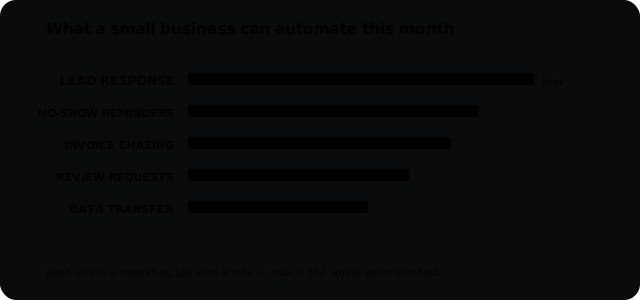
Tier 1: pays back in weeks
1. Instant lead response & qualification
The mechanism: every inquiry — form, DM, email — gets a useful reply in seconds: confirms the need, asks one or two qualifying questions, offers booking slots. The math: responding inside 5 minutes makes qualification ~21x more likely than at 30 minutes, and the average business takes 42 hours (the full data). If you spend anything on marketing, this automation is the difference between buying leads and buying conversations. Replaces: the apologetic Monday-morning reply to Friday night's lead.
2. Appointment reminders
The mechanism: booked appointment → confirmation now, reminder at 24 hours, reminder at 2 hours, one-tap reschedule link. The math: reminder sequences routinely cut no-shows 30–50%. A clinic with 200 monthly appointments at a 15% no-show rate and $150 average value is leaking $4,500 a month into empty chairs; halving that funds every automation on this page. Replaces: the receptionist's call list and the silent gap in the 2pm schedule.
3. Missed-call text-back
The mechanism: any unanswered ring triggers an instant text — "Sorry we missed you! What do you need? We'll reply in minutes." The math: ~80% of callers who hit voicemail leave no message and dial the next result (the missed-call math); the text-back intercepts a meaningful share mid-defection. Cheapest rescue in the entire stack — often a $30/month tool. Replaces: nothing. That's the point — it replaces a void.
4. Invoice chasing
The mechanism: unpaid invoice at day 7 → polite nudge; day 14 → firmer note with payment link; day 21 → final notice and flag to you. Tone consistent, never embarrassed, never forgets. The math: service businesses routinely carry 30–60 days of receivables purely from chase-reluctance — the machine has no reluctance. Owners report the awkwardness savings before the cash-flow savings. Replaces: the founder drafting "just following up on this :)" for the third time.
Tier 2: pays back in a quarter
5. Review requests, timed to the happy moment
The mechanism: job completed / result delivered → wait the right interval → personal-sounding request with the direct review link. Happy customers don't refuse; they just never get around to it — the automation converts goodwill into the asset. The math: review count and recency drive local search ranking, which drives the free lead flow that discounts your paid one. Replaces: "we should really ask people for reviews" (said quarterly, done never).
6. Form → CRM → invoice → spreadsheet data transfer
The mechanism: information entered once flows everywhere it's needed — no copy-paste, no transcription errors, no "let me find that email." The math: unglamorous, but audit a week honestly and the re-typing of known information often totals 3–5 hours — plus the occasional $400 error from a transposed digit. Replaces: the founder as human API between four tools.
7. Onboarding sequences
The mechanism: new client signs → welcome message, what-happens-next, intake form, first booking, expectations doc — delivered on schedule without anyone remembering. The math: the first 48 hours set the relationship's tone; inconsistent onboarding is where churn is quietly seeded. Replaces: the great onboarding your best clients got because you happened to have a calm week.
8. Quote/proposal follow-up
The mechanism: proposal sent → no reply in 3 days → value-add nudge; day 7 → "any questions?"; day 14 → graceful close-the-loop. The math: a large share of "lost" deals were never rejected — they were forgotten in an inbox. Recovering even one in ten typically pays for the whole automation layer. Replaces: the proposal graveyard.
Tier 3: the compounders
9. Routine-question deflection
The mechanism: a well-grounded assistant answers the questions whose answers never change — hours, pricing ranges, policies, parking — across site chat, DMs, and email, with a clean human handoff. The math: count one week of repeat questions; multiply by minutes; weep quietly; automate. Replaces: your team as a searchable FAQ with feelings.
10. Report assembly
The mechanism: the same numbers pulled from the same systems into the same format — weekly, automatically, before you ask. The math: 2 hours weekly of copy-paste reporting = 100 hours a year of someone's judgment spent on transport. Replaces: Sunday-night spreadsheet archaeology.
11. No-reply lead reactivation
The mechanism: leads that went quiet 30/60/90 days ago get a periodic, genuinely useful check-in — new availability, a relevant change, a simple "still on your list?" The math: your CRM contains paid-for attention that simply timed out; reactivation campaigns routinely out-ROI new acquisition because the acquisition cost is already sunk. Replaces: the database as a write-only archive.
12. The 24/7 phone agent
The mechanism: the full version — an agent, not a chatbot — answers every call in two rings, takes the need, answers routine questions, books into the live calendar, texts your team summaries, escalates anything complex to a human. The math: full-week coverage versus $35K+ for 40 human hours; justified when your missed-call and after-hours volume says so — which is a measurement, not a guess. Replaces: voicemail, and the customers it was donating to competitors.
Notice what's on this list: nothing visionary. Reminders, follow-ups, transfers, answers. Automation's dirty secret is that the money is in the boring layer — because the boring layer is where the hours were going.
What not to automate
- Relationships. Complaint resolution, the upset customer, the high-stakes sale, the condolence note. Automating these spends trust at a rate no efficiency gain repays. The rule: machines for rules, humans for relationships — and an automated apology is worse than none.
- Broken processes. Automation is an amplifier: it accelerates whatever exists. A confusing intake flow, automated, confuses people faster and at scale. Fix first, then automate the fixed version — paving the cow path just gets you a very fast cow path. (Process repair is its own discipline: systemize first.)
- Judgment calls in costume. Some tasks look rule-based until the edge cases arrive — refund decisions, scope negotiations, anything where "it depends" is the honest answer. Automate the gathering and the routing; keep the deciding human.
Stop asking "what can be automated?" — almost everything can, badly. Ask: "which leak, measured in money or hours, is biggest?" Then automate that one workflow end-to-end before touching a second. One complete win beats five dashboards of half-built enthusiasm — and the win pays for the rest.
Choosing your first: the scoring rule
Score each candidate 1–5 on three axes: frequency (how often it happens), structure (how rule-based it is — could a careful stranger follow written instructions?), and measurable cost (can you price the current leak?). Multiply. Highest score goes first. It's deliberately unsexy, and it reliably points at lead response, reminders, or invoice chasing — the same trio the automation framework arrives at from the other direction. If your top scorer surprises you, trust the arithmetic over the enthusiasm; enthusiasm is how businesses end up with an AI art generator and a still-ringing phone.
Which leak is biggest in your business?
The audit measures your actual numbers — missed calls, lead response gaps, no-show rates, chased invoices — and hands you the build order. If it doesn't show a clear return, we don't build.
Get your Agent Blueprint →Frequently asked questions
What are the best examples of business automation?
Fastest payback: instant lead response, appointment reminders (30–50% fewer no-shows), missed-call text-back, invoice chasing, timed review requests, and data transfer between tools. High frequency, clear rules, measurable cost — that's the pattern.
What should a small business automate first?
Score candidates on frequency × structure × measurable cost; the winner is usually lead response, then reminders, then invoicing. One workflow end-to-end before starting a second.
How much does business automation cost?
Off-the-shelf tools: $20–100/month each. Connected workflows: hundreds to a few thousand to set up. Custom agents: a real build, justified only when the audit shows a bigger leak. The error is buying before measuring.
What should you not automate?
Relationships (complaints, high-stakes sales, anything trust-bearing) and broken processes — automation amplifies what exists. Fix the process, keep humans on judgment, automate the rest.