The loss that produces no evidence
Businesses are built to notice losses. A refund shows up in the ledger. A bad review shows up in the inbox. A cancelled contract gets a post-mortem. The missed call is the exception — the only customer loss engineered to leave no trace. The phone rings in an empty office at 6:40pm. It rings four times. Then it stops, and somewhere a person you'll never know you almost met is saying "hi, yes, are you available this week?" to someone else.
I've sat with owners who could quote their ad spend to the dollar and their close rate to the point — and had genuinely no idea how many calls they missed last month. Not because they're careless. Because nothing in the business is assigned to know. The data exists (your phone system logs every unanswered ring); it's just that no one has ever multiplied it by what a customer is worth.
We're going to do that multiplication. It tends to change the meeting.
Voicemail: a referral service for your competitors
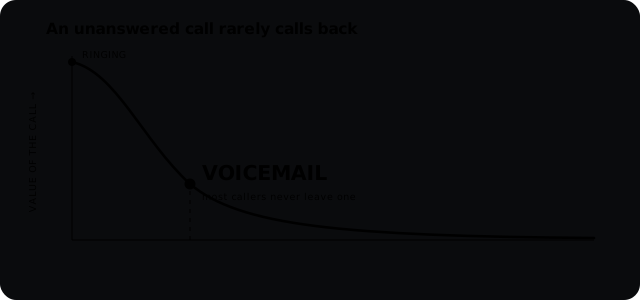
The standard defense is "we have voicemail." Here's what the behavior data says about that defense: roughly 80% of callers who reach a business voicemail hang up without leaving a message.
The mechanism is worth one paragraph, because it explains why this got so much worse in the last decade. A caller with a need is in a high-intent state — and they're holding a device that lists your three nearest competitors. Voicemail asks them to record a message, wait an unknown number of hours, and hope. The next search result offers to simply answer. For an existing customer with loyalty, voicemail is a minor friction. For a new customer — no history, no relationship, no reason to wait — it's a polite sign reading try the next one. (The state-decay mechanics are the same ones that govern web lead response: intent is a spike, and spikes don't queue.)
For a first-time caller, voicemail isn't a message system. It's a referral system — and every referral goes to your competitor.
Your number, in four lines
Skip the industry statistics; your phone log has your statistics. Four lines:
- Missed calls per week. Pull it from your phone system — it's in there. (Owners typically guess low by half.)
- × the share that are new inquiries. Walk through last week's list; a third is a common, conservative figure for service businesses.
- × average customer value. Be honest and use first-year value, not first-invoice value.
- × your normal close rate on inquiries you actually answer.
Worked example, deliberately modest: 15 missed calls a week → 5 new inquiries → $1,500 average value → 40% close rate = $3,000 a week. Call it $150,000 a year, leaking through a device that sits on the counter looking innocent. For clinics, law firms, and home services with higher ticket sizes, the same arithmetic regularly clears $300K.
Whatever your number is — and it may be smaller; run it honestly — compare it against what you spent last year to make the phone ring. That ratio is the whole argument.
When the expensive calls actually arrive
Here's the part that makes "we answer during business hours" a weaker defense than it sounds: a large share of high-intent calls arrive precisely when you can't answer.
- Evenings. People handle their own lives after handling their jobs. The burst pipe is discovered at 7pm; the toothache peaks at 9.
- Weekends. When homeowners are home, looking at the thing that's broken.
- Your busiest hours. The cruelest one: the lunch rush, the full waiting room, the team mid-job — peak demand is peak missed calls, meaning you miss the most calls exactly when the market wants you most.
Notice the pattern: these aren't fringe calls. The after-hours caller has often crossed a higher motivation threshold than the Tuesday-2pm caller. The calls you structurally cannot answer are, on average, your better leads.
Stop thinking of the phone as something you answer when available, and start thinking of availability as a product feature — one your customers comparison-shop. In a market where every competitor is one swipe away, "reachable" is part of the service, and it's being reviewed every time the phone rings into silence.
The three losses that stack
The weekly math above understates the damage, because three losses compound:
- The inquiry — gone in minutes to whoever answered. That's the $1,500.
- The lifetime — the missed plumbing call wasn't a $300 job; it was a decade of repeat work, plus the neighbors they'd have referred. Lifetime value typically runs 3–10× the first transaction, and all of it walked.
- The ad spend — if you pay for search clicks or run ads, you purchased that ring. An unanswered paid call is your marketing budget converted, with perfect efficiency, into a competitor's warm lead.
What answering everything takes now
- Get your real number this week. Phone system report: total missed, and the timestamps. The timestamps tell you whether your problem is staffing (missed during hours) or structure (missed after hours). The fixes are different.
- Close the trivial leaks first. Ring-to-mobile after two rings. A text-back on missed calls ("Sorry we missed you — what do you need? We'll reply in minutes"). Imperfect, cheap, immediate — a text-back alone rescues a meaningful share of would-be hang-ups.
- Stop treating 168 hours as a staffing problem. A human receptionist costs $35,000+ a year and covers 40 of the week's 168 hours, none of them Sunday night. This is not a hiring gap; it's a category error. Continuous availability is a job for software with a human handoff, not for a human with no sleep.
- Put an agent on the phone — built properly. A well-built AI agent answers every call in two rings, at 2pm or 2am: takes the need, answers the routine questions (hours, pricing ranges, availability), books the appointment into your real calendar, texts your team the summary, and escalates anything complex or emotional to a human immediately. The economics are not subtle — full-week coverage for roughly a phone bill. The honest caveat is equally real: a badly built phone agent (wrong answers, no escape hatch to a human) burns goodwill faster than voicemail ever did. This is a build-quality problem, not a technology problem — which is why we audit before we build, and don't build where the numbers don't justify it.
- Watch the number monthly. Missed-call rate is a vital sign. It should sit near zero and stay there — and once it does, every dollar of marketing you spend starts buying what you thought it was buying all along.
How many calls did you miss last month?
The audit pulls your real numbers — missed calls, timestamps, what they're worth — and shows you exactly where the leak is before anything gets built.
Get your Agent Blueprint →Frequently asked questions
How much do missed calls cost a small business?
Run: missed calls/week × % new inquiries × customer value × close rate. A modest service-business example — 15 missed, a third new, $1,500 value, 40% close — leaks about $3,000 a week. The loss is invisible because the customer vanishes before becoming data.
Do customers leave voicemails anymore?
Mostly no — around 80% of callers reaching business voicemail hang up without a message. The caller's alternatives are one swipe away, and for new customers with no loyalty, voicemail functions as a referral to your competitor.
What happens when a business doesn't answer the phone?
Three stacked losses: the inquiry (gone in minutes), the lifetime value (repeat work and referrals, typically 3–10× the first job), and the ad spend that paid for the call — converted directly into a competitor's lead.
Is an AI receptionist worth it for a small business?
Usually, if built well: every call answered 24/7, routine questions handled, appointments booked, humans brought in for anything complex — for roughly a phone bill versus $35,000+ for 40-hour human coverage. Built badly, it costs goodwill; quality and a clean human handoff decide everything.