Why knowing better doesn't work
Every smoker knows smoking is harmful. Everyone scrolling at 1 a.m. knows they'll regret it at 7. The gap between knowing and doing isn't a character flaw — it's an architecture problem.
Deliberate decisions run through the prefrontal cortex: slow, effortful, energy-hungry. Habits run through the basal ganglia: fast, automatic, nearly free. When a behavior repeats enough times in a stable context, the brain transfers it from the expensive system to the cheap one — a process called chunking. That's a feature. It's why you can drive home without consciously processing every turn.
The cost of the feature: once a behavior is chunked, the conscious brain is no longer consulted. The cue fires, the routine executes, and your prefrontal cortex finds out afterward — usually in the form of regret. More information, more shame, more New Year's resolve — none of it reaches the loop, because the loop doesn't run on information.
And there's a multiplier: under stress, sleep deprivation, or decision fatigue, the brain shifts even more control to the habit system. This is why bad habits surge during your hardest weeks — precisely when you have the least capacity to fight them.
The habit loop, precisely
Every habit — biting nails, evening wine, the reflex check of the phone — runs the same four-stage circuit:
| Stage | What it is | Example: doom-scrolling |
|---|---|---|
| Cue | The trigger that starts the loop | Sitting on the couch, phone in reach, slight boredom |
| Craving | The anticipation of relief or reward | The pull toward "just checking" |
| Routine | The behavior itself | Forty minutes you didn't decide to spend |
| Reward | The payoff that wires the loop deeper | Novelty hits, boredom relieved — briefly |
Two details most advice misses. First, the craving isn't for the behavior — it's for the state change the behavior delivers: relief from boredom, stress, loneliness, restlessness. Second, with repetition, dopamine fires at the cue, not the reward. By the time you feel the urge, the loop is already running. (This is the same anticipation machinery we unpacked in the dopamine piece.)
You don't have a bad habit. You have an unmet need with an efficient delivery system attached to it.
Why suppression backfires
The instinctive strategy — grit your teeth and resist — fails for a documented reason. Thought suppression produces a rebound effect: actively trying not to think about something increases how often it surfaces. Worse, every successful resistance drains the same limited prefrontal resource you need for everything else, while the cue keeps firing underneath. You're running an expensive program against a free one. The free one wins on any long enough timeline.
The professionals' move is different: don't fight the loop — re-route it.
The method: cue, friction, replacement
1. Map the loop before you touch it
For three or four days, change nothing — just record. When the habit fires, note: time, place, preceding emotion, what you were avoiding. Most people discover their "random" habit fires at remarkably consistent moments. You can't redesign a cue you haven't found.
2. Remove or weaken the cue
The cheapest victory is the one that never has to be fought. If the phone in reach is the cue, the phone charges in another room. If the route home passes the bakery, the route changes. This isn't weakness — it's the recognition that environment beats willpower roughly every time they're matched directly.
3. Add friction to the routine
Where cues can't be removed, raise the cost of the routine: log out of the app, delete it from the home screen, don't keep it in the house, put the credit card somewhere inconvenient. Even five seconds of added friction gives the prefrontal cortex a window to catch up to the loop — and five seconds is often all it needs.
4. Replace the routine — never just delete it
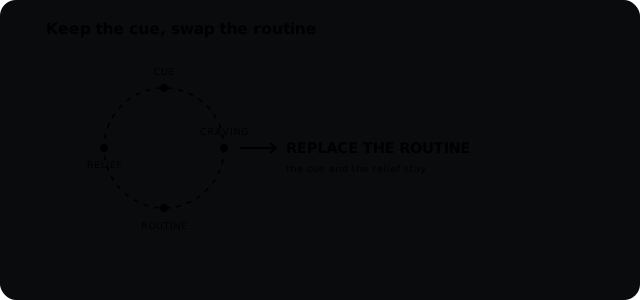
This is the load-bearing step. The craving is for a state change, and the need behind it is real. Remove the routine without a replacement and the need finds its way back — same habit or a new one wearing different clothes. So install a substitute that delivers a related payoff: the stress-smoke becomes the stress-walk; the boredom-scroll becomes a book that lives where the phone used to; the 9 p.m. wine becomes the 9 p.m. tea ritual with the same chair and the same music. Keep the cue and the reward; swap only the middle.
5. Make the reward land
New loops wire in when the reward is felt, not just performed. After the replacement behavior, take ten seconds to register the win — the calm, the small pride, the streak. It sounds trivial. It's how the basal ganglia learns what to automate next.
The identity layer — where it becomes permanent
Everything above will break a habit. One thing makes it stay broken: the story underneath has to change.
A person who "is trying to quit" and a person who "doesn't smoke" can perform identical behavior for months — and relapse at completely different rates. The first identity frames every cigarette not smoked as deprivation; the second frames it as simply not something they do. Behavior that contradicts identity is always temporary, because the brain treats the identity as ground truth and works to close the gap — in whichever direction the identity points.
So as the new routine stabilizes, do the quiet second piece of work: collect evidence for the new identity. Every repetition is a vote. Language matters too — "I don't" outperforms "I can't" in compliance research because one is an identity statement and the other is a rule waiting for an exception. This is the same principle we covered at full depth in why change never lasts — the behavior layer breaks habits; the identity layer keeps them broken.
Stop asking "how do I stop doing this?" Ask "what is this habit doing for me — and what else could do that job?" The first question starts a fight with your own brain. The second starts a redesign.
A realistic 30-day plan
- Days 1–4: Map. Change nothing. Log every firing: time, place, emotion, what you were avoiding. Find the pattern.
- Day 5: Redesign the environment. Remove every removable cue. Add friction to the rest. One hour of redesign saves a month of resistance.
- Days 5–7: Choose the replacement. One behavior, same state change, available at the same moment as the old cue. Set it up physically — the book on the couch, the kettle ready.
- Days 8–21: Run the swap. Cue fires → replacement runs → reward registered. Expect it to feel mechanical at first; that's the loop being rebuilt, not a sign it isn't working.
- Days 14+: Start the identity work. Begin saying — privately is enough — "I don't," not "I'm trying to stop." Notice the accumulating evidence.
- Days 21–30: Stress-test. The loop will be challenged by a bad day. Plan for it now: when X hits, my move is Y. A pre-decided response survives stress that improvisation doesn't.
What a relapse actually means
Old loops are never deleted — they're overwritten, and the original wiring stays dormant underneath. Stress, exhaustion, and old environments can temporarily resurface it. This is documented neuroscience, not a personal failing.
So treat a relapse as data: it tells you exactly which cue survived your redesign and what stress level exceeds your current regulation. One missed day has near-zero effect on long-term habit formation — the studies are clear on this. What does the damage is the second story: "I've blown it, so it doesn't matter now." Skip the story. Run the loop again tomorrow. The vote count is what matters, and it's still overwhelmingly in your favor.
The habit is the symptom. The system is the cause.
Find out what's actually running your patterns — and which layer to work on first. Seven questions, about a minute.
Take the Free Assessment →Frequently asked questions
How long does it take to break a bad habit?
The "21 days" figure is a myth. Research found new behaviors take about 66 days on average to become automatic, ranging from 18 to over 250 depending on complexity. Expect meaningful change in weeks, consolidation in months — and know that one missed day has almost no measurable effect.
Why can't I stop a bad habit even though I know it's bad?
Knowing lives in the prefrontal cortex; habits live in the basal ganglia, which executes automatically when cued. Information never reaches the loop. The fix is redesigning cues and replacing the routine — not accumulating more reasons.
Is it better to quit cold turkey or gradually?
For chemically reinforced habits, a clean break plus environmental redesign usually wins. For habits serving emotional needs, replacement beats removal — the need remains, so the routine must be swapped. Most everyday habits respond best to both: kill the cue, install the substitute.
Why do I relapse under stress?
Stress shifts the brain from goal-directed to habitual control, and old loops are overwritten, never deleted. A relapse means your stress exceeded your regulation that day — it's data about the system, not a verdict on you.