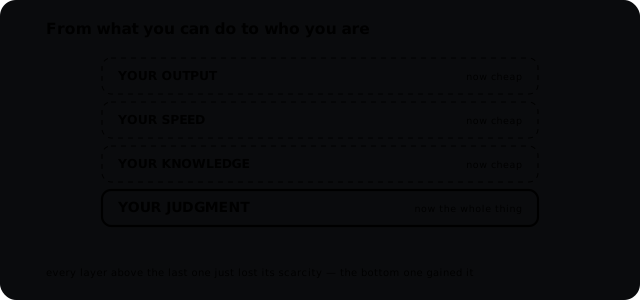
The great inversion
For the entire industrial and information age, the path to value was the same: become good at producing something — code, copy, designs, analysis, spreadsheets, reports — and get paid for the output. Skill meant execution. The better and faster you could do the work, the more you were worth.
AI is inverting that. When a machine can generate competent output in seconds, at near-zero marginal cost, the output stops being scarce — and scarcity is what creates value. The competent execution that used to be a career is becoming a commodity.
This sounds like bad news, and for one specific group it is: people whose entire value was the production of routine, repeatable output. But it points to something else for everyone willing to adapt. When output is free, the things that surround output — deciding what's worth making, knowing if it's any good, taking responsibility for it, building the trust that makes anyone care — become the whole game.
When everyone can produce the work, the value moves to the person who knows which work matters, and who can be trusted with it.
What AI genuinely can't replace
It's worth being precise here, because vague reassurance ("be more creative!") helps no one. AI is already creative in a shallow, recombinant sense. The durable human advantages are more specific — and they're mostly about being, not doing.
| Capacity | Why AI can't own it |
|---|---|
| Judgment & taste | Formed by lived experience and consequences; AI has no stakes and no history of being wrong in the real world |
| Trust & relationship | Built between people over time through accountability; you can't outsource being trusted |
| Presence & attention | The felt experience of being truly seen by another human; imitation isn't the thing itself |
| Emotional regulation | Leading and deciding under real pressure is an embodied skill, not an information problem |
| Moral responsibility | Someone has to be accountable for a decision; a model cannot be answerable |
| Meaning & lived experience | AI can describe a life; it cannot live one, and meaning comes from the living |
Notice that none of these are tasks. They're qualities of a person. That's the shift: the future doesn't reward what you can produce so much as who you've become.
Imitating an output vs. being a self
The deepest reason these capacities are safe deserves spelling out. AI works by modeling and reproducing the outputs of human behavior. It can generate the words a caring person would say, the analysis a sharp strategist would make, the painting in a given style. What it cannot do is be the source those outputs come from.
It cannot actually care about the outcome. It cannot be accountable when things go wrong. It has no body, no mortality, no stake in the future, no relationships it stands to lose. It can simulate the signature of presence without anyone being present. And it cannot do the one thing that gives all of this meaning: live a life.
This is why the human edge isn't a skill set you bolt on — it's a depth you develop. The more fully developed you are as a person — regulated, self-aware, trustworthy, clear about what matters — the more you offer exactly what the machines structurally cannot.
The meta-skill for the next decade
If specific skills can be automated faster than you can master them, then mastering any one skill is no longer the strategy. The strategy is the capacity to keep adapting — to learn, unlearn, and reinvent yourself repeatedly without falling apart.
And here's what most career advice misses: adaptability is not primarily an intellectual capacity. It's a physiological one. Reinvention means living through repeated uncertainty, and uncertainty is a stressor. People who can't regulate their nervous systems experience constant change as constant threat — they freeze, cling to the familiar, and get left behind. People who can regulate stay open, curious, and able to learn precisely when it matters most.
This is why the foundation of staying relevant isn't a course or a certification. It's a regulated nervous system and a flexible identity — both of which are trainable. We go deep on the first in nervous system regulation, and on the second in why change never lasts.
For founders: the same logic, amplified
If you run a business, this inversion is both your biggest threat and your biggest opportunity. AI agents can now run the repetitive operational work — the follow-ups, the bookings, the reporting, the first drafts, the routine support. The companies that deploy this well will out-execute the ones that don't, at a fraction of the cost.
But the same rule applies one level up: when execution is cheap and abundant, the bottleneck becomes the founder — your judgment, your vision, your ability to lead and to decide what's worth building. We covered this directly in the AI era founder bottleneck. The move is to let agents take the work so you can do the irreplaceable part: think clearly, build trust, and become the kind of person the business can't outgrow.
That's the whole thesis behind MARSA — agents for the business, and a daily guide for the human running it. Automate the doing. Develop the being.
Don't compete with AI on output — you'll lose, and you should. Direct it. Then take the time it frees and pour it into the only assets appreciating in value: your judgment, your relationships, your regulation, and your depth as a person. In an age of infinite output, a fully developed human is the scarcest thing there is.
How to build what lasts
Concretely, over the next few years:
- Automate your repetitive output. Whatever in your work is routine and repeatable, hand to AI deliberately — don't wait to be forced. Buy back the time.
- Reinvest the time in human capital. Use the freed hours on relationships, judgment, leadership, and learning hard things — not on more low-value busywork.
- Train regulation first. Build the nervous-system capacity that makes constant change survivable instead of threatening. It's the floor everything else stands on.
- Develop taste and judgment. Consume deeply, get real feedback, make consequential decisions, and learn from being wrong. This is the part experience buys and AI can't.
- Become trustworthy and present. Be the person others rely on and want in the room. In a world of synthetic everything, being real and accountable is a superpower.
- Keep a flexible identity. Hold your skills loosely and your character firmly. The people who thrive are those who can become someone new without losing themselves.
In the AI era, who you become is the only edge left.
Marsa is the daily guide that develops the human side of this equation — regulation, judgment, adaptability, depth. Start with a free assessment of the system running underneath your results.
Take the Free Assessment →Frequently asked questions
What skills will AI never be able to replace?
Embodied human capacities: genuine presence, emotional regulation under pressure, trust built through relationship, taste and judgment from lived experience, moral responsibility, and the lived experience of being human. AI can imitate their outputs but cannot be accountable, cannot care, and cannot live a life.
How do I stay relevant as AI automates my job?
Shift your value from execution to what execution can't substitute for: judgment about what's worth doing, trust and leadership, emotional regulation, and the ability to direct AI rather than compete with it. Automate repetitive output and reinvest the freed time into uniquely human skills.
Will AI make humans less valuable?
It lowers the value of routine output and raises the value of presence, trust, judgment, and accountability. People who build those become more valuable. The risk is to those whose entire value was the output AI now produces.
What is the most important skill for the next decade?
Adaptability rooted in self-regulation — the ability to stay regulated, keep learning, and reinvent yourself repeatedly. It depends on a regulated nervous system and a flexible identity, both trainable.