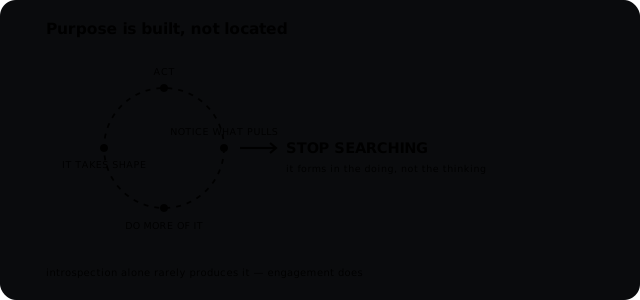
The treasure-hunt myth
Somewhere along the way, "purpose" got a geography. We talk about it like a buried object — find it, discover it, uncover your true calling — as if it were sealed inside you at birth and your job is excavation. The natural strategy follows: dig inward. Journal harder. Take the quiz. Wait for the click of certainty.
I've sat with people across a decade of this work, and I can tell you where the treasure-hunt strategy leads: a smart, capable person, years into the search, still at the trailhead — because every option fails the test of feeling like destiny. The myth doesn't just fail to help. It actively manufactures paralysis, because it sets the evidence bar at "certainty before action," and life only issues certainty after action.
The research community quietly abandoned the buried-treasure model a long time ago. What replaced it is better news, though it asks more of you.
What the research actually says purpose is
William Damon, who ran the major developmental studies of purpose at Stanford, defines it with precision: a stable and generalized intention to accomplish something that is at the same time meaningful to the self and consequential for the world beyond the self.
Three load-bearing words in there:
- Intention — purpose is a direction you commit to, not a feeling you receive. It's closer to a heading than a homecoming.
- Stable — it's built up over time and survives ordinary Tuesdays. A weekend of inspiration isn't data.
- Beyond the self — this is the component that separates purpose from preference, and the one self-help reliably drops. Hobbies energize you. Purpose energizes you and lands on someone else. In the longevity research — including the ikigai cohort work I covered here — the contribution component keeps showing up in what actually predicts well-being.
Notice what's absent from the definition: passion, certainty, a lightning bolt. Purpose in the research is an architecture you assemble, not an emotion you wait for. The emotion comes — but it comes the way warmth comes from a fire you built.
Purpose is not a discovery. It's a construction project that starts before you feel ready and produces the feeling as a byproduct.
Passion follows engagement — the evidence
The deeper myth under the treasure hunt is the belief that passion is pre-existing — that somewhere there's a thing you'd love instantly if only you found it. Psychologists Paul O'Keefe, Carol Dweck, and Greg Walton tested exactly this belief and found it has costs: people who hold a "fixed theory" of interest expect their passion to provide endless motivation once found — so the first patch of boredom or difficulty reads as proof of wrong choice, and they bail. People with a "growth theory" expect interest to develop, so they push through the boring patch — and develop it.
The broader interest-development literature (Hidi and Renninger's well-known model) maps the actual sequence: interest begins as situational — small, externally sparked, fragile — and becomes deep individual interest through repeated engagement, growing skill, and accumulating knowledge. Competence is the multiplier nobody advertises: things become interesting as you get good at them. The causality most people assume — love it first, then invest — runs backwards roughly as often as it runs forwards.
This is quietly liberating. It means your future purpose doesn't need to announce itself today. It needs only to be mildly interesting and worth two weeks. The depth is built in, later, by you.
When nothing sparks: the flat-signal problem
One clinical honesty before the method. Some people read "follow your energy" and report back: there is no energy to follow. Nothing sparks.
When interest is flat across the board — not low on this or that, but muted on everything — the problem is almost never that you're an empty person in a world of passionate ones. It's that curiosity is biologically expensive, and your system has no budget for it. Chronic sleep debt mutes interest. A stress system stuck in the on position mutes interest. Depression mutes it profoundly. In that state, introspecting for purpose is like checking the radio while the car battery is dead — the silence isn't information about the radio.
The order of operations matters: restore the system first — energy, sleep, a nervous system that can settle — and watch curiosity come back online on its own. It usually does, and it's one of the most reliable sequences I've seen in practice.
The build process, step by step
- Run the energy audit (two weeks). Track one variable: which activities leave you with more energy than they found you. Not what should. What did. You're collecting behavioral data, not aspirational data — the gap between the two is where most purpose searches die.
- Lower the bar to "curiosity that survives." From your audit, pick the strongest candidate — even if it's embarrassingly small or impractically odd. The research requirement isn't passion; it's an interest that survives two weeks of contact.
- Give it deliberate hours. Three sessions a week, calendar-protected. Interest compounds with engagement and skill — you're not testing whether you love it yet; you're giving the compounding a chance to start. Judge at week six, not day three.
- Add the beyond-the-self component. This is the step that converts preference into purpose, and almost everyone skips it. Teach it, share it, build it for someone, solve a real person's problem with it. Damon's research is blunt: the contribution element is what makes purpose stable and what makes it feed you.
- Review quarterly; revise without ceremony. Purpose develops in drafts. The version you build this year will be revised by the person this year builds — that's the design working, not failing. (It's the identity loop from why change never lasts, pointed at meaning instead of habits.)
You don't need to know your purpose to take the next purposeful action. Direction is available years before destination — and in the research, as in practice, direction is what actually changes a life. The people who seem to have found their purpose mostly built it, one engaged season at a time, and named it afterwards.
Does it have to be your job?
No — and the modern insistence that it must is a setup. One role asked to deliver income, identity, meaning, community, and joy simultaneously is carrying what entire villages used to carry. In the purpose research, as in the ikigai data, most of what people actually name runs outside their employment: raising humans, craft, mentoring, community, care.
Three honest architectures, all legitimate: your work is your purpose (rarer than advertised); your work overlaps your purpose (common, sustainable); your work funds your purpose (underrated, and the quiet structure of many genuinely meaningful lives). Choose the architecture that fits your decade — and let it be revised by the next one.
Start with the audit — properly structured.
Our free ikigai tool walks you through the reflection systematically: energy patterns, the honest four questions, and an analysis you can act on this month.
Try the Free Ikigai Tool →Frequently asked questions
How do I find my purpose in life?
Reverse the order: act first, conclude later. Audit what reliably energizes you, pick the strongest candidate, give it deliberate weekly hours, add a contribution component, and review quarterly. Purpose emerges from the loop — it doesn't precede it.
What if I don't feel passionate about anything?
Usually a signal problem, not an emptiness problem. Exhaustion, chronic stress, and depression flatten interest across the board — repair the system and curiosity returns. If energy is fine, lower the bar from "passion" to "curiosity that survives two weeks" and let engagement compound it.
Does your purpose have to be your job?
No. Work can be your purpose, overlap with it, or fund it — all three are legitimate. Most deep sources of meaning in the research earn nothing, and demanding one role provide income, identity, meaning, and joy is a modern invention with a poor record.
How long does it take to find your purpose?
It's a construction, not a discovery date. Clarity typically develops over months-to-years of engaged action — but direction shows up much faster than destination, usually within a few months of a serious audit-and-experiment loop. Direction is enough to move.