The scoring error that makes everyone quit
The standard first meditation goes like this: you sit, attend to the breath, and within eleven seconds you're planning dinner. You return. Nine seconds later you're re-arguing a conversation from 2019. Return. The meeting, the itch, the question of whether you're doing this right — and by minute eight you've reached the conclusion that ends most meditation careers: everyone else's mind must go quiet, and mine is broken.
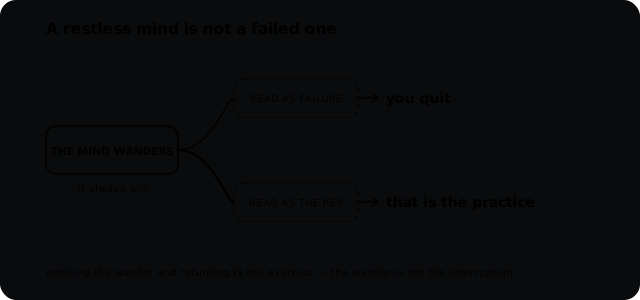
The conclusion rests on a scoring error nobody corrected. The instruction "focus on the breath" gets heard as "have no thoughts" — so every wandering registers as a failure, and the session becomes ten minutes of documented inadequacy. No wonder people quit; under that scoring, the practice is a shame machine. The correction is one sentence, and it changes everything: the wandering isn't the failure. The wandering is the equipment. Default-mode chatter is what brains do — dozens of departures per session, in novices and in teachers (the teachers just notice faster). The exercise was never the not-wandering. It was always the noticing and coming back.
The rep: what's actually being trained
Recast the session through the correct lens and watch it transform. Mind wanders (the weight). You notice — that flash of "oh, I'm in 2019 again" (the lift). You return to the breath, without commentary (the completion). That cycle is one repetition, and the research on mindfulness training maps the gains to exactly this circuitry: attention monitoring, conflict detection, the disengage-and-redirect move — trained at the moment of noticing, not during the quiet stretches. Mrazek's studies showed even brief training improving working memory and reducing mind-wandering on cognitive tests; the mechanism is the rep, repeated.
So the restless session — forty wanderings, forty returns — isn't the remedial class. It's the heavier workout. The veteran whose mind sits placidly is doing maintenance; you're doing forty honest lifts. "I can't meditate because my mind wanders" is, mechanically, "I can't lift weights because they keep being heavy." The heaviness was the point. Nobody told you, and an entire app economy of soothing voices has a commercial interest in the bliss framing — calm sells; reps don't.
A session with forty wanderings and forty returns is forty repetitions, not forty failures. The wandering is the weight. You were never failing — you were training, unscored.
Why restless systems backfire on the cushion
One honest clinical layer before the alternatives, because for some people the problem isn't scoring — it's state. A genuinely activated nervous system — the wired profile — often finds stillness itself stressful: sit a revving system in silence and the revving becomes the only thing in the room. Attention turned inward on an anxious body can amplify rather than settle (panic-prone practitioners know this well — breath-focus can spike them). The standard advice — "just sit with it" — asks the hardest version first.
The sequencing fix: downshift before you sit. A brisk walk to spend the mobilization, a few physiological sighs to apply the brake — then stillness has a chance. Or skip the sitting entirely, because—
The other doors
Stillness was always a delivery mechanism. The trainable skills — anchoring attention, noticing departure, returning — run through many doors:
- Walking practice. Canonical in every contemplative tradition, not a consolation prize: attention anchored to footfall and ground contact, wandering noticed, returned. The movement gives a restless body something to be, while the same circuits train. Ten minutes, no app, looks like a walk.
- The body scan, lying down. Attention moved systematically through the body — which simultaneously trains the returning rep and rebuilds interoception, the inward sense most modern people have let go dark. Two skills, one practice, horizontal.
- Attention-demanding movement. Lap swimming counting strokes, climbing, lifting with total attention to form — practices where performance requires presence train absorbed attention as a side effect. Not identical to meditation (less meta-awareness, more flow), but adjacent and additive — and for action-oriented people, the adherence is incomparably better.
- Single-tasked ordinary life. The dishes with full attention to water and weight. Coffee actually tasted. One conversation without the phone's gravitational field. Informal practice is the unsung half of the literature — the noticing rep, embedded where life already is.
The honest dose
The apps imply twenty minutes twice daily; the evidence is humbler. Trials showing real effects commonly run 10–15 minutes daily, several find benefits at 5–10 — and the Stanford comparison found five minutes of breathwork beating five of meditation for mood and arousal, a useful reminder that if calm is the only goal, faster tools exist. The dose-response rules: consistency beats duration (five daily minutes outperform Sunday's thirty-five — the same floor principle as everywhere), benefits accrue over weeks not sessions, and the operative question is never "how long is optimal?" but "what dose survives my actual life?" Three mindful breaths at a red light, repeated daily for a year, beats the retreat you're still planning.
Stop trying to silence your mind — that was never on offer, to anyone. Train the only thing that was: the speed of noticing. The gap between wandering and catching it shrinks with practice — from minutes to seconds — and that shrinking gap is the entire skill, the one that later interrupts the rumination spiral and the doomscroll in exactly the same motion.
Do you even need it?
Honest closing: no — not as an obligation. For acute calm, breathing protocols act faster. For baseline regulation, sleep and movement carry more load. Plenty of regulated, focused, flourishing people never sit on anything.
What meditation uniquely trains — the reason it stays in the toolkit — is meta-awareness: the standing capacity to observe your mind instead of living inside every thought. That's the skill that lets you catch the rumination loop mid-lap, watch a craving crest and pass without obeying it, and notice the story your activated body is drafting before signing it. If that capacity interests you, some practice that trains noticing — seated, walking, swimming, or three breaths at a red light — earns its five minutes. Pick the door that opens. They all lead to the same room.
Find the practice your system will actually keep.
Seven questions, about a minute. See whether your state needs stillness, movement, or downshifting first — and where to start.
Take the Free Assessment →Frequently asked questions
Why can't I meditate?
You're scoring wandering as failure when noticing-and-returning is the entire exercise. Forty wanderings and forty returns is forty reps. The wandering is the weight.
Do I have to sit still to meditate?
No — walking practice, body scans, and attention-demanding movement train overlapping circuits, and suit wired systems better. Downshift first (a walk, a few sighs) if stillness amplifies you.
How long do I actually need to meditate for benefits?
5–15 minutes daily shows measurable effects; consistency beats duration. For pure calm, five minutes of breathwork outperformed five of meditation in the Stanford comparison — match the tool to the goal.
Is meditation even necessary, or are there alternatives?
It's optional. Its unique product is meta-awareness — observing your mind rather than living in every thought. Any practice that trains noticing builds adjacent capacity; pick the door that opens.