Between the posters and the eye-rolls
Gratitude has the worst marketing department of any evidence-based practice: its loudest advocates attached it to manifestation logic and sunset typography, which handed the skeptics an easy dismissal — and both camps walked away from a real, replicated, usefully cheap effect. The honest job here is boring rescue work: pull the practice out of the incense, size it honestly, and hand back the version that works.
Worth saying up front why this matters beyond mood: in the well-being research that this site keeps returning to, the subjective layer — how life feels and gets appraised — keeps outperforming objective circumstances as a predictor of health. My own master's research lived in exactly that territory: life satisfaction as a protective factor against stress and anxiety. Gratitude practice is one of the few direct, trainable inputs to that layer with trial evidence behind it. That's why it earns an article — the typography never did.
What the trials actually found
The foundational work is Emmons and McCullough (2003): participants randomized to write weekly lists — gratitudes, hassles, or neutral events — for ten weeks. The gratitude group reported better mood, more optimism, fewer physical complaints, and (oddly, repeatedly) more exercise. Follow-up literature and meta-analyses have confirmed the direction while shrinking the headline: real effects on well-being and depressive symptoms, small-to-moderate in size — comparable to other active psychological exercises, not transformation-in-a-notebook.
Honest sizing cuts both ways, though. "Modest" describes the average effect of a five-minute weekly practice that costs nothing, has no side effects, and stacks with everything else. In a field where people pay monthly for supplements with effect sizes of approximately zero, a cheap reliable modest is a strong buy — it just doesn't poster well.
The mechanism: retraining the editor
Why would listing good things change anything? Because of what your attention does by default. The brain runs a negativity bias — threats, problems, and slights get priority processing, because for most of evolutionary history, missing the bad thing cost more than missing the good one. The result is an inner newsfeed with a tabloid editor: the day's seventeen fine-to-good events get spiked; the one friction gets the front page and the evening replay. (It's the same bias the feed economy monetizes — your editor was compromised long before the algorithm hired him.)
Gratitude practice is counter-training for the editor. Each session forces a memory search for what went right — and searches, repeated, become habits of retrieval. The documented downstream shift is the interesting part: after a few weeks, practitioners report noticing good moments during the day, in real time, partly because tonight's list needs material. The practice isn't the five minutes. The practice is what the five minutes does to the other sixteen hours — a standing search query running against your own life. Imaging work shows reward and social-bonding circuitry engaging; the practical summary stays simpler: you're not changing your life. You're changing what your life's coverage looks like — and the coverage, per the appraisal research, is most of what your body responds to.
Your inner newsfeed has a tabloid editor: seventeen fine things spiked, one friction on the front page. Gratitude practice doesn't change the news. It retrains the editor.
The dosing mistake
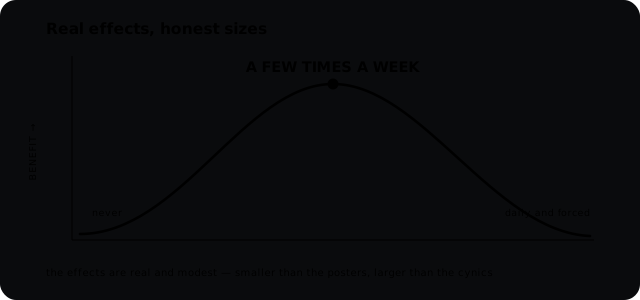
Here's the finding that explains every abandoned gratitude journal: Sonja Lyubomirsky's lab compared practice frequencies and found once-weekly practitioners improved while three-times-weekly practitioners often didn't. The mechanism is hedonic adaptation — the brain's relentless renormalization of anything repeated. Daily lists converge on wallpaper ("family, health, coffee," typed on autopilot, felt as nothing), and an unfelt practice trains nothing.
The preservatives:
- Lower the frequency. Weekly, done with attention, beats daily done on autopilot. (A rare case where the lazier schedule is the evidence-based one.)
- Demand specificity. Not "my partner" — "the way she took over Tuesday's call when I was underwater, without being asked." Specific entries require the actual memory search, which is the actual exercise. Generic entries are reps with no weight on the bar.
- Rotate formats. Lists, then a letter, then a week of noticing-one-thing-in-the-moment, then mental subtraction (imagining a good thing having never happened — clunky name, strong effect). Novelty keeps the editor awake.
The champion: the letter
If the literature has a single best-performing exercise, it's this one. In Seligman's comparative trial of positive interventions, the gratitude visit — write a concrete, specific letter to someone who shaped your life and never got properly thanked, then read it to them aloud — produced the largest happiness gains of anything tested, with effects from a single performance lasting a month or more.
The active ingredients explain the margin: maximum specificity (a real letter can't be wallpaper), the saying of a genuinely unsaid thing (rare, potent, slightly terrifying), and — most of all — the relational channel. Gratitude is fundamentally social technology: its evolutionary job is bond-strengthening, and the relationship layer is where the deepest well-being effects live anyway. The letter works because it spends gratitude where gratitude was designed to be spent: on a person, out loud. If the visit is too much — it's a lot — the letter alone, even unsent, still measures well. But the trials are clear about which version people remember for the rest of their lives.
Stop treating gratitude as an emotion you should feel more of — that framing produces guilt, not practice. Treat it as a search skill: the trained ability to retrieve what's working, on demand, against an editor biased the other way. Skills don't require sunsets. They require reps with weight on the bar.
The honest boundaries
Three lines the posters skip. It's not a depression treatment — gratitude practice shows small effects on depressive symptoms and is no substitute for professional care; "have you tried a gratitude journal" offered to clinical depression is a category error wearing kindness. It's not an argument against legitimate feelings — gratitude deployed to suppress grief, anger at real mistreatment, or honest dissatisfaction curdles into toxic positivity, and the suppression bills later. The practice adds coverage of what's working; it doesn't prosecute what isn't. And it's not a substitute for fixing things — grateful framing of a structurally broken job, relationship, or schedule is anesthesia where surgery is indicated. The editor needed retraining. Sometimes the news itself needs changing — and a well-trained editor is precisely what lets you tell which is which.
Train the layer that predicts the most.
Seven questions, about a minute. See how your system is actually appraising your life — and which input to train first.
Take the Free Assessment →Frequently asked questions
Does gratitude practice actually work?
Yes — real, modest, replicated effects on mood and well-being (Emmons trials, confirming meta-analyses). Not a depression treatment or a cosmic mechanism: attention training with a measurable dividend.
How does gratitude change the brain?
It counter-trains the negativity bias: repeated retrieval of what went right becomes an automatic search, shifting what gets noticed in real time. The editor of your inner newsfeed gets retrained.
Why doesn't my gratitude journal work anymore?
Dosing: daily lists become wallpaper and adaptation eats the effect — weekly with real specificity beat thrice-weekly in trials. Lower frequency, demand detail, rotate formats.
What is the most effective gratitude exercise?
The letter-and-visit: a concrete letter to someone never properly thanked, read aloud to them — the largest single-intervention effect in the comparative trials. Even unsent, the letter measures well.