Between the panic and the shrug
Parents currently choose between two stories. Story one: screens are rewiring a generation — attention destroyed, childhood stolen, the device as developmental poison. Story two: relax — they said this about television, comics, and the novel; the kids are alright. Both stories are doing the same thing: substituting a verdict for a mechanism — and a parent armed with a verdict can only ration or surrender.
The evidence supports neither camp comfortably. The huge datasets find small average associations between moderate screen use and wellbeing — genuinely smaller than the panic implies, a finding the dismissal camp loves to quote. But averages launder mechanisms: the harms that are real concentrate in specific, identifiable pathways — and those pathways are designable around, which is the entire point of knowing them. A decade of working with families taught me the useful question was never how many minutes. It's what are the minutes replacing — and what's running on the screen, next to whom?
The displacement model: what minutes actually measure
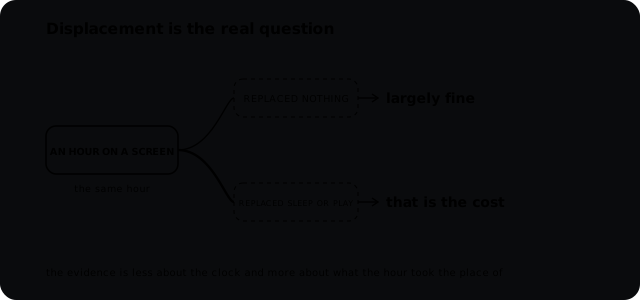
Here's the model that organizes the whole literature: a child's day is a fixed container, and development has non-negotiable line items — sleep, physical play, face-to-face conversation, boredom (yes, boredom: it's where self-directed thought gets built — the AI-age curriculum runs on it). Screen time correlates with harm mostly to the degree it displaces these — which explains the data's apparent contradictions in one stroke: the hour of cartoons after an active, social, well-slept day measures as roughly nothing; the same hour carved out of sleep or replacing the day's only conversation measures as cost. The minutes were never the unit. The trade is.
Screen time is a purchase, and the currency is whatever the screen replaced. The same hour costs nothing or costs development — depending entirely on what it was traded for.
The mechanisms with real evidence
- Sleep — the headline pathway. Screens in bedrooms predict worse and shorter sleep with depressing consistency, via every mechanism at once: displacement of the bedtime, arousal from engineered content, and the 6am availability of the device. Sleep is developmental infrastructure — and protecting it is the single highest-yield screen rule that exists.
- Conversation — the quiet one. Background TV measurably reduces parent-child talk; technoference (below) reduces it further — and conversational turns are the engine of language development. The screen's cost here isn't what the child watches; it's the sentences that never happened around it.
- Attention tempo — real, with nuance. Fast-cut, high-stimulation content can shape young children's pacing expectations — the experimental work on rapid-tempo shows found short-term executive-function dips, and a brain calibrating to algorithmic shorts is calibrating to something. The nuance: effects are content-specific (slow, narrative programming doesn't show them), which is an argument for curation rather than abolition.
- What the evidence doesn't support: wholesale "rewiring" claims and screen-caused epidemics. The famous imaging studies show correlations marinated in confounders — household stress, income, sleep, everything. The honest summary stays boring: displacement of essentials, plus content effects in the young, plus the sleep pathway. Boring is buildable.
The variable in your pocket
Now the section the screen-time wars never feature, and the one with the strongest leverage. The research on technoference — parental device use interrupting interactions — keeps finding the same things: phone-absorbed parents respond less, talk less, and miss more bids for attention; infants read an absorbed face with something like the distress of the still-face experiments, because for them your face is the co-regulation channel. And the modeling layer compounds it: a child's relationship with devices is learned almost entirely by demonstration — the house where adults scroll at dinner is teaching scrolling at dinner, and no rule survives contradiction by its lawmaker.
This reframe is uncomfortable and liberating in equal measure: the most effective screen intervention for your child is, repeatedly and measurably, changing the adults' habits first — which also happens to be entirely within your control tonight. (The adult repair kit already exists: the feed mechanics, the evening protocol. Your child is the second beneficiary of both.)
A brief honest age guide
Under ~2: minimal value, real displacement risk — the official no-screens-except-video-chat guidance is reasonable (video calls with grandparents are genuinely fine; they're conversation, the thing itself). 2–5: about an hour of slow, age-fit, ideally co-viewed content — co-viewing converts intake into conversation, which flips the trade. School age: fixed caps matter less than structure (zones, times, curation) plus the entry of a new question: what kind — creative and social use differs from passive algorithmic intake. Adolescence: the social-media question, which is its own storm — the honest current reading is that effects are real but modest on average and concentrated in vulnerable kids and in sleep displacement; the bedroom-and-bedtime rules carry most of the protective load here too.
Stop counting minutes and start auditing trades: is sleep intact? Did the body move? Did real conversation happen today? Was there any boredom left in the schedule? If those four line items are funded, the remaining screen time is mostly noise. If they're not, zero minutes won't fix what the schedule already broke.
Structure beats rationing: the house rules
- Bedrooms are screen-free — for everyone. The sleep pathway alone justifies it, it removes the nightly negotiation entirely (zones don't renegotiate; allowances do), and "for everyone" is the clause that makes it enforceable. The family charging station in the kitchen is the single best purchase in this topic, and it costs nothing.
- The table and the hour before bed are device-free. The two highest-density conversation-and-downshift windows of the day, protected by time rather than policed by minutes. (The device-free meal is developmental infrastructure wearing dinner's clothes.)
- Curate before you count. Slow beats fast, narrative beats algorithmic, finite beats infinite — and autoplay off, everywhere, restores the stopping cues. An hour of the good kind costs less than twenty minutes of the slot-machine kind.
- Co-view when young; stay curious when older. Watching together converts passive intake into conversation; for older kids, interest beats surveillance — the parent who knows what their kid actually does online got there by asking, not monitoring.
- Replace what you remove. The screen filled a vacuum — boredom, company, downtime. Remove it without funding the alternatives (materials, other kids, your attention, permission to be bored) and the vacuum wins the rematch. The goal was never less screen. It was more childhood — the screen just had the best lobbyist.
It starts with your own patterns.
Children learn most from what we model. The free Life Audit shows the pattern running your own days in three minutes, with one first move you can start this week.
Take the free Life Audit →Frequently asked questions
How much screen time is actually okay for kids?
Minutes are a weak predictor; the trades are strong ones. Anchors: none before ~18–24 months (video chat excepted), ~an hour of quality co-viewed content at 2–5, structure over caps after. The real audit: sleep, movement, conversation, boredom — funded or not?
What does screen time actually do to children's brains?
The evidenced pathways: sleep displacement (the big one), reduced conversation around background screens, and tempo effects from fast-cut content in young children. Wholesale-rewiring claims outrun the data.
Does my own phone use really affect my child?
It's the strongest unaudited variable: technoference measurably cuts responsiveness and talk, and children learn their device relationship by watching yours. Change the adults' habits first — it works and it's available tonight.
How do I set screen rules that actually work?
Zones (bedrooms, table) and times (hour before bed) for everyone, curation over counting, co-viewing young, autoplay off — and fund the alternatives, because vacuums refill themselves.