The loan everyone takes
The arrangement feels so reasonable. The week demands more hours than it contains, sleep is the only budget line without a boss, so you borrow: six hours Tuesday, six-and-a-half Wednesday, five-something Thursday. Then Saturday arrives as the scheduled repayment — eleven glorious hours — and Monday you start the cycle again, books balanced.
Sleep science has spent two decades auditing this arrangement, and the verdict reads like a credit report: the borrowing is fully real, the repayment is partial, the interest is charged in currencies you don't monitor, and — the clause that should worry you most — the borrower progressively loses the ability to read their own statement. Let's go through the audit.
How the debt compounds (the landmark data)
The definitive experiment is Van Dongen and Dinges (2003): participants restricted to 4, 6, or 8 hours in bed for two weeks, with attention and reaction time measured daily. The 8-hour group held steady. The 6-hour group — the "realistic" group, the schedule half your colleagues run — declined steadily, week over week, with no plateau. By day fourteen their performance matched people who had been awake for 24 to 48 hours straight. Functionally drunk, by accumulation, on a schedule that felt sustainable.
The mechanism is simple bookkeeping: each short night leaves a residue of unmet sleep need, and residues stack. There's no biological amnesty at midnight — the system carries the balance forward, and the balance expresses itself as exactly the deficits you'd expect from someone mildly sleep-deprived at all times: slower reactions, leakier attention, an amygdala on a hair trigger, and decisions that age poorly.
The broken gauge: why you can't feel it
Now the finding that makes this article necessary, because it explains why none of this feels true from inside. In the same restriction studies, participants rated their own sleepiness daily — and the ratings plateaued after the first few days. "I've adjusted," said the self-reports, while the performance curves underneath them kept falling. The feeling adapted. The function didn't.
This is the trap in its full shape: chronic sleep restriction disables the instrument you'd use to detect it. The person three weeks into six-hour nights isn't lying when they say they feel fine — their gauge has genuinely recalibrated around the deficit. What they've lost is the memory of what their actual baseline felt like, and with it, the ability to price what the schedule is costing. (Genetic short-sleepers — true mutations like DEC2 — exist at a fraction of a percent of the population. The other 99-plus percent of "I'm fine on six" is the broken gauge talking.)
You don't adapt to short sleep. You adapt to the feeling of short sleep — while the impairment continues underneath, now with its alarm disconnected.
The weekend audit: what repays, what doesn't
So Saturday's eleven hours — what do they actually buy? The honest itemization:
- Repaid quickly: the feeling. Subjective alertness rebounds well after one or two extended nights. This is real, and it's also why the weekend plan feels like it works.
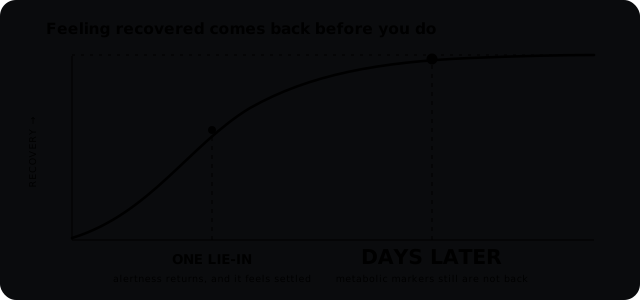
- Repaid slowly, partially: the performance. Attention and reaction-time deficits persist after recovery nights that have already normalized mood and sleepiness. The function lags the feeling by days — and most people re-borrow before the gap closes.
- Barely repaid: the metabolism. The sharpest modern data (Depner et al., 2019): a short-sleep week impaired insulin sensitivity; weekend recovery sleep failed to restore it; and the recovery group re-impaired immediately on returning to short nights — with some markers worse than the group that never "recovered" at all. The weekend lie-in, in metabolic terms, is closer to a cosmetic payment than a principal payment.
- Actively damaged: the clock. The Sunday 11am wake-up is a self-administered dose of social jet lag — Monday's grog isn't the week starting badly; it's the repayment plan's exit fee.
The silent ledger
Where the interest actually accrues, none of it labeled: glucose regulation moves within days of restriction (healthy young people pushed toward pre-diabetic handling in under a week of short sleep); immune function drops (in the famous viral-challenge studies, people sleeping under six hours caught colds at several times the rate of eight-hour sleepers when dosed with the same virus); hunger hormones tilt toward overeating (less leptin, more ghrelin — the diet that keeps failing often has a sleep schedule underneath it); and the emotional tax everyone around you pays first: more reactive, less generous, a personality you'd apologize for if you could see it from outside.
None of these file under "sleep." They file under stress, getting older, no willpower, a hard season. The debt is real; the billing is just misaddressed — which is why it goes unpaid for years.
Stop thinking of sleep as the flexible budget line and see it for what the data says it is: the credit limit on every other line. The hours you "gain" by borrowing are repaid out of the quality of all the hours that follow — at an exchange rate the broken gauge prevents you from ever quite seeing.
The honest repayment plan
- Repay gradually, not heroically. One marathon lie-in mostly buys clock disruption. The evidence-aligned version: extend sleep 30–90 minutes nightly for one to two weeks — earlier bedtime, same wake time, which repays principal while protecting the circadian anchor that everything else depends on.
- Use naps as instruments, not apologies. Twenty minutes, before mid-afternoon — real repayment without entering deep sleep or threatening the night. The 90-minute 5pm crash-nap is a different product: it's tomorrow's insomnia on layaway.
- Re-meet your real baseline once. A genuinely useful experiment for the broken gauge: a week (a holiday works) of no alarm, consistent bedtime, sleep until done. Where your sleep settles by day five or six is your actual need. Most people are quietly shocked — and recalibrated.
- Then fix the borrowing, not the repaying. The actual problem was never weekend technique — it's a weekly schedule that treats sleep as the only stakeholder that never pushes back. Give your real need its slot most nights, and the entire repayment apparatus becomes unnecessary, which was always the point.
- If two weeks of repayment changes nothing — look elsewhere. Fatigue that doesn't respond to genuinely extended sleep isn't sleep debt. It's one of the other six kinds of tired, and it deserves the right diagnosis instead of more weekends.
Which kind of tired are you, actually?
Seven questions, about a minute. Find out whether you're carrying sleep debt or something the weekend was never going to fix.
Take the Free Assessment →Frequently asked questions
Can you catch up on sleep on weekends?
Partially: alertness rebounds fast, performance lags days behind the feeling, and metabolic costs largely don't reverse (the Depner study found insulin sensitivity stayed impaired despite weekend recovery). Better than nothing, far worse than not borrowing.
What does sleep debt do to your body?
Cumulative attention and reaction deficits (two weeks of 6-hour nights ≈ 24–48 hours awake), heightened emotional reactivity, impaired glucose handling within days, weaker immunity, and hunger hormones tilted toward overeating — all misfiled as stress and age.
Do you adapt to less sleep over time?
You adapt to the feeling while the measured decline continues — the gauge recalibrates, the deficit doesn't. True genetic short-sleepers are a fraction of a percent. "Fine on six" is usually the impairment speaking.
How do I recover from sleep debt properly?
Extend sleep 30–90 minutes for one to two weeks via earlier bedtime (keep the wake anchor), use 20-minute pre-afternoon naps, re-meet your real baseline once — then fix the borrowing schedule itself.