The intervention nobody profits from
Try to imagine the launch event. No device, no subscription, no powder. The product is bipedal locomotion, the price is zero, and the customer already owns it. Walking is the worst business opportunity in wellness — which is exactly why you hear about cold plunges and continuous glucose monitors and almost never about the intervention that quietly outperforms most of what's sold around it.
So consider this article the marketing department walking never had. The claims that follow are the boring kind: measured, replicated, dose-mapped. Which, in this industry, is the most exotic thing a health claim can be.
The post-meal walk: ten minutes against the spike
Start with the most underused finding, because you can deploy it tonight. After you eat — especially a carbohydrate-heavy meal — blood glucose climbs for sixty to ninety minutes. Big, repeated spikes drive the energy crash that follows, and years of them pave the road toward insulin resistance.
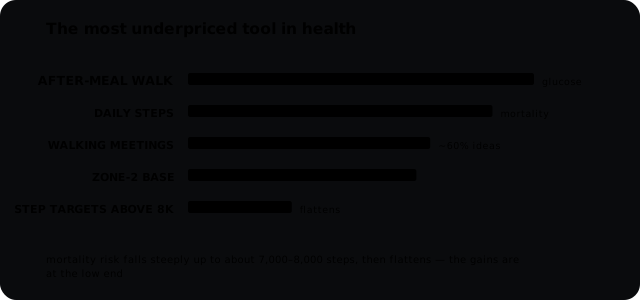
Now the mechanism that makes walking special: contracting muscle pulls glucose out of the blood without needing insulin. It's a separate door — the muscle, when working, takes its own sugar deliveries. Which means a modest 10–15 minute walk, started soon after eating, intercepts the spike at its source. The research bears it out: post-meal walking significantly blunts glucose excursions, the after-dinner walk shows particular benefit (dinner is typically the largest meal followed by the most sitting), and even two-to-five-minute walking breaks beat staying seated.
Every culture that walks after dinner — the Italian passeggiata, the subcontinental "hundred steps" — has been running this protocol for centuries without naming the hormone. (It pairs naturally with the 80% rule: less to clear, cleared faster.)
The cheapest glucose-control technology on earth is the walk you take while the dishwasher runs.
The 10,000-step audit
The most famous number in fitness is a marketing artifact. In 1965, a Japanese company launched a pedometer called manpo-kei — literally, "the 10,000-step meter" — and the catchy target outlived the product by sixty years. No physiology produced it. A naming meeting did.
The actual dose-response data is kinder than the slogan. Large meta-analyses tracking steps against mortality find the risk curve falling steeply from sedentary baselines up to roughly 7,000–8,000 steps a day, then flattening — more is mildly better, but the bargain ends. And the shape of the curve carries the real headline: the steepest gains sit at the bottom. Moving from 2,000 to 5,000 steps buys more risk reduction than moving from 8,000 to 11,000. The person who needs this article least is the one already counting; the person it would transform is the one at 2,500 who concluded that 10,000 was the entry fee and never started.
There is no entry fee. Every thousand steps is a real dose, and the first few thousand are the strongest medicine in the jar.
What walking does to the mind
The creativity effect — measured, not vibes
Stanford's Oppezzo and Schwartz ran the experiments creativity folklore was waiting for: participants did divergent-thinking tasks sitting, then walking. Walking lifted creative output by an average of around 60% — and, crucially, it worked on a treadmill facing a blank wall. The movement, not the scenery, carries most of the effect, and it lingered briefly after sitting back down. The nuance worth respecting: walking boosted generating ideas, not focused convergent execution. So the protocol writes itself — walk the problem, sit the solution. The history of thought agrees: Darwin's sandwalk, Dickens's night miles, every philosopher's peripatetic school.
Mood, in minutes
A brisk ten-minute walk produces measurable mood and energy lifts — in one well-known trial it beat a candy bar for sustained energy over the following hours. For an anxious system, it's a precision tool: anxiety is mobilization — fuel dumped for an emergency that never arrives — and a walk spends that mobilization as designed, while rhythmic motion and a moving horizon downshift the system further (the body-first logic). Add daylight, especially in the morning, and the same walk doubles as a circadian anchor. One behavior, four mechanisms, no receipt.
What walking can't do
Honesty clause. Walking does not meaningfully build or preserve muscle mass and strength — and from your thirties onward, those decline by default, with grip and leg strength among the stronger mortality predictors we have (the longevity rankings). It also rarely pushes the cardiovascular ceiling the way breathless intervals do.
So the honest architecture: walking is the base layer — the daily metabolic, mental, and circadian foundation — with two resistance sessions a week on top for the strength that keeps you autonomous at 80, and some genuinely hard breathing weekly for the engine. Foundation, not whole building. But buildings without foundations are the ones that actually fall.
Stop filing walking under "exercise" — that's why it loses to the gym you don't attend. File it under infrastructure: how you process meals, drain stress, generate ideas, and timestamp your clock. Exercise is an appointment. Infrastructure is just how the day works.
Placing the walks: a day that collects them
- Morning: 10 minutes outside. Light for the clock, movement for the mood — the double-duty walk.
- After the biggest meal: 10–15 minutes. The glucose interceptor. Dinner is usually the highest-leverage slot.
- The stuck-problem walk. When the work jams, don't push — loop the block with the question. Generate walking, capture sitting.
- Convert dead transitions. One call taken walking, the farther parking spot, the stop-early bus trick. Steps that cost no calendar time.
- Count nothing, or count gently. If a step count motivates you, aim near 7–8K and ignore the marketing slogan above it. If counting becomes another performance review, delete the app and keep the walks.
The 10-minute walk is one move in the protocol.
Longevity assembles the full evidence-ranked system — movement, sleep, food timing, energy. One action a day, for ninety days.
See Longevity →Frequently asked questions
Is walking 10 minutes a day actually beneficial?
Yes — especially timed after meals, where it blunts glucose spikes via insulin-independent muscle uptake. Ten brisk minutes also measurably lifts mood and energy, and short walks accumulate toward the mortality benefits.
Do I really need 10,000 steps a day?
No — that was a 1960s pedometer slogan. Risk falls steeply to about 7,000–8,000 steps, then flattens, and the biggest gains come at the low end: 2,000→5,000 beats 8,000→11,000.
Does walking really boost creativity?
Stanford measured ~60% more idea generation while walking — including on a treadmill facing a wall. It boosts divergent thinking, not focused execution: walk to generate, sit to finish.
Is walking enough exercise on its own?
It's the foundation, not the building: excellent for metabolic, mental, and cardiovascular base, but it doesn't preserve strength. Add two resistance sessions weekly and some genuinely breathless work.