Where I'm standing when I say this
Every article about AI coaching is written from a position, usually undisclosed. The tech founder's position: AI coaching is the future of everything. The human coach's position: nothing replaces the room. Both are defending their inventory.
Mine, disclosed: I spent a decade in behavioral science — a decade of work on what makes people thrive, from burnt-out executives to people rebuilding their health from zero — and then I spent years distilling that method into an AI coach. So I have inventory too; weigh what follows accordingly. But the decade taught me something the market hasn't priced in yet, and it's the honest foundation of everything below: the bottleneck in coaching was never the quality of the hour. It was the other 167 hours.
The layer where change actually fails
Here's the pattern from a decade of client work. The breakthrough happens in session — the insight, the plan, the genuine resolve. Then the client leaves, and change moves to where it actually lives: Tuesday, 14:00, the stress spike and the old pattern arriving together. The 11pm fridge negotiation. The Thursday where motivation has left exactly on schedule.
And in that moment — the only moment that counts — the coach is structurally absent. Next session is Thursday. The insight is a memory. The moment wins, the way moments do, and the week's session becomes a debrief of the loss. I watched this loop for years, with skilled colleagues and motivated clients, and concluded the problem wasn't anyone's skill: weekly support is architecturally mismatched to a daily problem. Behavior change is a daily-layer phenomenon being serviced by a weekly-layer industry.
That mismatch — not cost-cutting, not novelty — is the real case for AI coaching. It's the first technology that can be present at the moment of the pattern.
Change doesn't happen in the session. It happens at Tuesday, 14:00 — and for the entire history of coaching, nobody was there.
What AI coaching does genuinely well
- Presence at the moment. 11pm, Sunday, mid-spiral — the coach is there, in seconds, with full context. Not a meditation app's generic audio; a conversation about this moment and your pattern.
- Zero judgment, and what that unlocks. People tell an AI things in week one that took them months to tell me — the shame-coated stuff where the actual leverage lives. The absence of a watching human face is, for disclosure, a feature. The research on this goes back decades: people disclose more to computers when no human is felt to be judging.
- Perfect memory of your patterns. A human coach holds dozens of clients in one tired brain. A well-built AI holds your entire history — every Tuesday slump, every trigger, every thing that worked in March — and connects today's moment to it instantly.
- Infinite patience with repetition. The fourth relapse gets the same quality of attention as the first. No human, professional or spouse, fully achieves that — and the person mid-relapse can feel the difference.
- The economics of consistency. Human coaching at $100–500 a session means daily support was always an executive luxury. At subscription pricing, the daily layer is finally affordable to the people who need it most — which was, frankly, the point of building one. What was once reserved for a few belongs in millions of hands.
What it can't do — the honest list
Now the inventory I'd be richer for hiding:
- It can't read the room. A skilled human notices the pause before your answer, the joke deployed as armor, the thing you've not-said three sessions running. Text-based AI receives what you choose to type. That's a real ceiling, and it's why depth work belongs with humans.
- It defaults to comfort when you need challenge. The best coaching moments of my career were confrontations — "you've told me that story three times; what is it protecting?" AI systems are trained toward agreeableness, and a coach that always validates is a mirror, not a coach. (A well-designed one fights this default with method — see below — but the gravity is real.)
- It can't carry relationship accountability. Part of coaching's effect is not wanting to disappoint a person who believes in you. An AI is never disappointed in you — which is precisely why disclosure flows, and precisely why a certain kind of accountability doesn't.
- It is not clinical care — full stop. Depression, trauma, anxiety disorders, eating disorders: these need licensed humans. A responsible AI coach knows its boundary and says so out loud; an irresponsible one improvises in territory where improvising harms people. Ask any product you're considering what it does at that boundary. The answer is diagnostic.
The method test: how to spot a chatbot in a whistle
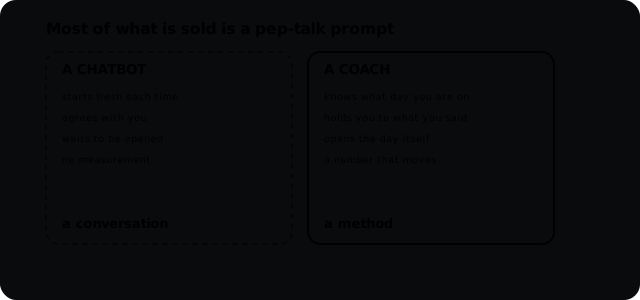
The market right now: a handful of seriously built coaching systems, and a long tail of generic chatbots with a system prompt that says be an encouraging life coach. From outside, the marketing pages look identical. One question separates them: "What method is this running?"
A real coaching system is the digitization of an actual framework — a named practitioner's tested protocol, a clinical methodology, a behavioral-science playbook with reasons behind it. It behaves consistently: what it asks when you're struggling, how it handles a relapse, when it pushes versus holds, what it refuses to do. A prompt-wrapper has none of that spine. The tells, visible within a week of use:
- Generic positivity — "You've got this! 💪" — where a method would ask a diagnostic question.
- No thread between conversations. Tuesday's coach doesn't remember Sunday's pattern; every chat starts from zero.
- Advice that drifts — contradicting itself week to week, because there's no framework underneath, only the model's mood.
- No stated boundaries about clinical territory. The serious products name the line; the wrappers don't know there is one.
The AI is a delivery mechanism. You are choosing the method it delivers — same as you would with a human, where you'd never hire on "friendly and available" alone.
Stop comparing AI coaching to human coaching — for most people that's not the live choice. The live choice is AI coaching versus nothing: versus facing the 11pm moment alone, again, with last Tuesday's insight fading. Against the room, AI loses on depth. Against nothing, it isn't close.
The division of labor that actually works
So the honest architecture, the one I'd recommend even if I sold neither half: humans for depth, AI for days. A human — coach or therapist — for the quarterly deep work, the confrontations, the clinical needs, the moments that require being seen. An AI coach for the layer no human was ever going to cover: the daily pattern-interrupts, the 11pm presence, the unglamorous repetition where change actually compounds.
That's the layer worth designing for: the moment the pattern fires, and the ordinary days in between.
Start with a clear picture of your days.
The Life Audit takes three minutes. It looks at ten areas of your life and hands you one first move, with a written specialist matched to the area that needs it most.
Take the free Life Audit →Frequently asked questions
Is an AI life coach actually effective?
For the daily layer — where most change actually fails — genuinely yes: 24/7 presence, no judgment, perfect pattern memory, accessible pricing. The quality variable is the method underneath, not the AI.
Can an AI coach replace a human coach or therapist?
No. Humans win on reading the unsaid, productive challenge, and relationship accountability — and clinical conditions require licensed care, always. The working model is division of labor: humans for depth, AI for days.
How much does an AI coach cost compared to a human coach?
Human: $400–2,000/month for weekly sessions. AI: typically $20–50/month, unlimited. Different products — less depth per exchange, presence at a frequency no human can offer. The honest comparison is AI versus nothing.
What should I look for in an AI coaching app?
Ask what method it runs. Credible products are built on a named, real framework, hold a thread across conversations, and state their clinical boundaries. Red flags: generic positivity, no memory, drifting advice, no boundaries.