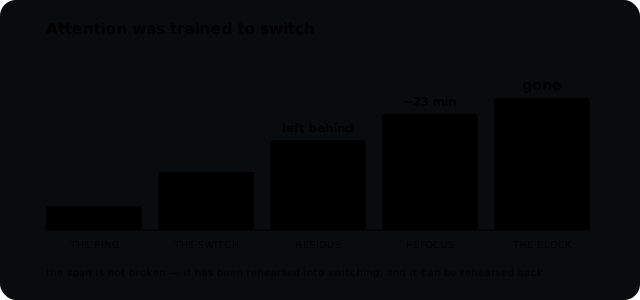
What actually happened to your attention
The popular story says human attention span collapsed to eight seconds — less than a goldfish. The study behind that claim doesn't hold up, and attention researchers have disowned it. But the thing it gestures at is real, and the real version is more useful:
Your attention didn't shrink. It was retrained.
The brain is plastic — it strengthens whatever pattern it repeats. For the past decade, the most-repeated attentional pattern in your life has been the switch: notification → glance → feed → refresh → new tab. Each switch delivers a micro-hit of novelty, which makes switching self-reinforcing. Thousands of repetitions a day, every day, for years. You haven't lost the capacity for sustained attention; you've built a superhighway in the other direction.
This is bad news with a built-in remedy: the same plasticity that trained the switching can retrain the sustaining. Attention responds to practice the way muscle responds to load.
How focus works in the brain
Sustained attention is a prefrontal cortex operation: holding a goal online, amplifying relevant signal, and — the expensive part — continuously suppressing everything else. Focus isn't one act; it's an ongoing veto of ten thousand competing pulls.
Three things govern how well that veto works:
- Arousal level. Focus follows an inverted U. Too sleepy and the system can't engage; too stressed and control shifts away from the prefrontal cortex toward reactive, vigilance-driven attention. Peak focus lives in the middle — alert and calm. (This is why regulation is upstream of focus; see nervous system regulation.)
- Dopamine. Motivation chemistry decides what feels worth attending to. A reward system recalibrated to fast spikes makes slow work feel unbearable — the mechanism covered in the dopamine piece.
- Fuel. Cognitive control degrades fast on poor sleep, and a sleep-deprived brain shows measurably reduced prefrontal activity. No technique survives a wrecked substrate.
The switching tax
The most expensive lie in modern work is that you can do two cognitive things at once. You can't — nobody can. What feels like multitasking is rapid task-switching, and the meter runs on every switch:
| What you do | What it costs |
|---|---|
| Glance at the inbox mid-task | Attention residue — part of your mind stays on the email for many minutes |
| Keep chat open "just in case" | Continuous partial attention; the deep-focus state never fully forms |
| Switch heavily all day | Up to ~40% of productive capacity lost to switch costs |
| Phone visible on the desk | Measurably reduced working memory — even when it's off and untouched |
That last row deserves a second look. In controlled studies, the mere presence of a phone on the desk reduced available cognitive capacity — the brain spends resources actively ignoring it. The phone doesn't have to win your attention to tax it.
Deep focus isn't a personality trait some people have. It's a state that forms under specific conditions — and dies under interruption. Build the conditions and the state shows up.
Step one: redesign the environment
Willpower is the most expensive way to focus; architecture is the cheapest. In a contest between your intentions and a thousand engineered interruptions, redesign the contest:
- Phone in another room. Not face-down, not in the bag — another room. This single move outperforms every focus technique on this page.
- One screen, one task, full screen. Close every tab that isn't the work. Each open tab is a standing invitation to switch.
- Kill notifications at the source. Not silent — off. Batch communication into two or three windows a day and tell people that's how you work. They adapt within a week.
- Give focus a place. Same desk, same hours, same ritual to start. Context cues the state — the brain learns "this chair means deep work" the same way it learned "this couch means scrolling."
Step two: work in biological blocks
Your brain doesn't produce flat output across eight hours. It runs ultradian rhythms — roughly 90-minute waves of higher and lower alertness all day. Fighting them produces the familiar grind; riding them is the free lunch:
- One block = 60–90 minutes of single-task deep work. Beginners: start at 25–30 and build. Capacity grows like training volume.
- Then a real break, 10–20 minutes. Walk, stretch, stare out a window. The phone is not a break — it's a different demand on the same attention system. Idle time is also when the brain consolidates what you just worked on.
- One to three blocks a day. That's not a compromise — that's what elite output actually looks like. Nobody does eight hours of deep work; the people who seem to are doing three good blocks and protecting them ferociously.
- Put the first block early, before the inbox, when the morning dopamine and cortisol peak make focus cheapest. The first hour of the day sets the attentional tone for the rest — spend it on the work, not on other people's requests.
Step three: train attention directly
Beyond removing obstacles, attention responds to direct training — and the best-documented method is embarrassingly old: focused-attention meditation.
Strip the incense off and it's a pure attention rep: hold focus on an anchor (usually breath), notice when the mind wanders, return it. The return is the rep — every time you notice the wandering and come back, you've done one repetition of exactly the skill that fails when you can't read three paragraphs. Studies show measurable improvements in sustained attention and reduced mind-wandering with regular practice, visible in attention-related brain networks.
Ten minutes a day is enough to register effects within weeks. If meditation isn't your word, the same rep hides in other work: reading physical books past the boredom threshold, single-tasking a hard problem without relief, even a walk where you keep returning attention to the surroundings instead of a podcast. The principle is identical — notice the drift, return, repeat.
Step four: fix the substrate
Techniques sit on top of biology. Three substrate factors move focus more than any app:
- Sleep — the prefrontal cortex is the first thing sleep deprivation degrades and the last to recover. If you're waking unrefreshed, start there: why am I always tired.
- Movement — exercise acutely sharpens attention for hours afterward and chronically improves cognitive control. A pre-block walk is a legitimate focus tool.
- Stimulation diet — if every idle moment gets filled with fast content, your reward system keeps pricing slow work at zero. Lower the spikes and deep work stops feeling like punishment within one to two weeks.
Stop treating distraction as a discipline failure. Treat it as a training outcome — the predictable result of ten thousand daily reps of switching. Then change what you're repping. The brain that learned to switch can learn to stay.
The daily focus protocol
- Night before: choose tomorrow's first deep-work task. Deciding in the morning burns the best focus on deciding.
- Morning: light outside, no phone for the first 30–60 minutes. Protect the morning chemistry.
- Block one (60–90 min): phone in another room, one screen, one task, full screen. Start with the same two-minute ritual daily.
- Real break (10–20 min): movement or nothing. No feeds.
- Communication window: now the inbox and messages — batched, on your schedule.
- Block two if the day allows. Afternoon blocks work best right after a walk.
- Daily rep: ten minutes of focused-attention practice — meditation or deliberate single-tasking past the boredom threshold.
- Evening: a hard stop on inputs before bed. Tomorrow's focus is being built tonight.
Expect the first week to feel like withdrawal — the urge to switch will be loud. By week two the blocks get quieter, and by week four most people are doing more before noon than they previously did all day. That's not a productivity hack. That's the plasticity working for you instead of against you.
Focus isn't a hack. It's a system property.
Find out what's actually fragmenting your attention — and which layer to rebuild first. Seven questions, about a minute.
Take the Free Assessment →Frequently asked questions
Why can't I focus anymore?
Your attention has been trained to switch — thousands of rewarded micro-switches a day, for years. Add poor sleep, stress, and an interruption-engineered environment, and sustained focus becomes expensive. The capacity isn't gone; it's undertrained, and it returns with practice and environmental redesign within weeks.
How long should a deep focus session be?
60–90 minutes for one demanding block, aligned with ultradian rhythms, followed by a real 10–20 minute break. Beginners should start at 25–30 minutes. One to three blocks a day is what sustained elite output actually looks like.
Does multitasking really reduce productivity?
Yes — because it's actually rapid switching. Every switch leaves attention residue, error rates rise, and heavy switching can cost up to 40% of productive capacity. Single-tasking in protected blocks is the fix.
Can meditation actually improve focus?
Yes — focused-attention meditation is literal attention training: notice the wander, return to the anchor, repeat. Ten minutes daily produces measurable improvements in sustained attention within weeks. The rep is the return, not the stillness.