The question no checkup asks
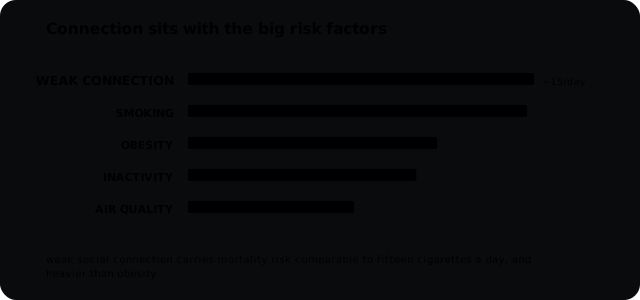
Your annual physical covers the canonical risks: smoking, weight, pressure, glucose, family history. It does not ask: who knows you? Who would notice within a day if something went wrong? When did you last have a conversation that wasn't logistics? — even though Julianne Holt-Lunstad's meta-analyses, pooling 300,000+ participants, put weak social connection in the same mortality-risk territory as smoking fifteen cigarettes a day, ahead of obesity and inactivity. The U.S. Surgeon General declared loneliness a public-health epidemic on this evidence in 2023.
The medical blind spot has a cultural twin: we treat loneliness as embarrassing — a personal failing to be hidden — rather than what the data describes: a mass-produced circumstance with a measurable body count. This article is the screening your checkup skipped. (The flip side of this coin appeared in the longevity rankings and the 85-year Harvard data — connection keeps surfacing as the variable that embarrasses the biohackers. This is the other direction: what its absence costs.)
The biology: isolation as threat state
Why would a feeling kill? Because for a social species, it was never just a feeling. Across evolutionary time, the isolated human was the unprotected one — and the body still runs that calculus. Chronic loneliness operates as a standing threat state:
- Inflammation rises. Steve Cole's gene-expression work found loneliness associated with upregulated inflammatory genes and downregulated antiviral ones — the body provisioning for wounds (the ancestral risk of isolation) at the expense of viral defense. Chronic inflammation then feeds every major disease pathway we have.
- Sleep goes vigilant. Lonely sleepers show lighter, more fragmented sleep — the unguarded-animal pattern, scanning all night. And degraded sleep bills everything downstream.
- The stress system never fully stands down. Other humans are the nervous system's primary safety signal — co-regulation is the original medicine — and in their absence the system idles high: allostatic load with a social cause.
- Cognition pays late: chronic loneliness tracks with measurably faster cognitive decline and elevated dementia risk in the cohort data.
The body never learned that you can be alone and safe in an apartment with a deadbolt. Alone still files as exposed — and the system bills for the guard duty, nightly.
The signal model: loneliness as social hunger
The reframe that removes the shame and enables the repair, from John Cacioppo's foundational work: loneliness is to connection what hunger is to food — an aversive signal evolved to drive corrective behavior. It isn't evidence you're defective; it's evidence your social intake has fallen below your need, exactly as hunger says nothing about your character and everything about your last meal.
Two implications. First, loneliness is about felt connection, not headcount — you can be lonely in a crowded office and complete with two real people; it's subjective sufficiency, which is why "just get out more" misses. Second, like hunger, the signal is information to act on, not an identity to inhabit. The trouble starts when acting on it gets blocked — which is precisely what chronic loneliness does, via the cruelest feature in this entire literature:
The spiral: how it compounds
Cacioppo documented the trap in detail: the lonely state changes social perception. Chronic loneliness heightens threat-detection toward social cues — the ambiguous reply reads as rejection, the unreturned greeting as verdict, the party as audit. Approach starts feeling dangerous, withdrawal follows, and the isolation deepens — which sharpens the bias further. The signal designed to drive reconnection ends up blocking it: hunger that makes food look poisonous.
Add the shame layer — loneliness misread as personal failure, therefore hidden, therefore never named even to friends who'd answer — and the spiral seals. Knowing this mechanism matters practically: it means the repair must treat perception alongside the calendar. The bias is real, it's a symptom rather than an insight, and it softens with safe repeated contact — but only if its forecasts ("they don't want you there") get treated as the symptom talking, not as data. (The same discipline as rumination's: read the state before believing the story.)
Why modern life mass-produces it
One honest structural paragraph, because the shame dissolves further when you see the machinery. The settings that produced human connection for millennia — fixed villages, multigenerational households, shared work, religious gathering, the errand web of pre-delivery life — have been optimized away one by one, each removal individually rational. Remote work deleted the ambient colleague; delivery deleted the shopkeeper; the feed replaced the visit with its pseudo-social substitute — parasocial intake that occupies the social appetite without nourishing it, the connection equivalent of ultra-processed food. Nobody chose loneliness. We chose convenience a hundred times, and loneliness was the bundled accessory. Which means feeling it isn't failure — it's noticing — and building connection now requires the deliberate structure that geography used to provide for free.
The repair
- Engineer repetition, not occasions. Friendship's documented formula is repeated, unplanned interaction in shared context — which is why school and first jobs produced friends effortlessly and adult life doesn't. Recreate the structure: the weekly class, club, team, volunteer shift — same faces, recurring schedule. Connection compounds on a cadence; one-off coffees don't.
- Choose depth over headcount. One conversation with real disclosure outperforms ten pleasantries — loneliness is felt understanding's absence, not company's. Practically: ask the second question (past the "fine"), disclose something true first (reciprocity is the mechanism), and convert one existing acquaintance toward depth rather than acquiring five new shallow ones.
- Contribute your way in. Volunteering reliably reduces loneliness in trials — being needed is a faster door than being welcomed, it bypasses the threat-reading (you have a role; the script is provided), and it runs on the purpose channel that the ikigai evidence keeps highlighting.
- Treat the bias as a symptom. Expect your forecasts to be miscalibrated toward rejection; let two awkward exchanges not cancel the project; score attendance, not vibes, for the first months — the perception softens after the contact accumulates, not before.
- Tend the existing garden first. The cheapest connection is the dormant one: the friend you haven't called in two years mostly didn't reject you — life happened. The reach-out is awkward for ninety seconds and works far more often than the bias predicts. Two texts tonight beats a networking strategy.
- Get help when the spiral is deep. Entrenched loneliness with depression attached responds best to professional support — notably CBT-style work targeting the threat-reading, which outperforms social-skills training in the meta-analyses (the skills were rarely the problem; the forecasts were).
Stop treating connection as a pleasant extra and file it where the mortality data puts it: infrastructure — as biological as sleep, as schedulable as exercise. The calendar's social column is a clinical document. Most people fund every other column first and wonder why the bloodwork of their life keeps coming back lonely.
Run the screening your checkup skipped.
Seven questions, about a minute. See which system — connection, recovery, regulation — your health is actually waiting on.
Take the Free Assessment →Frequently asked questions
Is loneliness really as bad as smoking?
The Holt-Lunstad meta-analyses (300K+ participants) put weak social connection's mortality risk in the range of 15 cigarettes a day — above obesity and inactivity. The Surgeon General declared it an epidemic on this evidence.
Why does loneliness affect physical health?
Isolation files as threat: inflammatory genes upregulate, antiviral defense tilts down, sleep goes vigilant, and the stress system never fully stands down — allostatic load with a social cause.
Why is loneliness so hard to fix?
It changes perception: ambiguous cues read as rejection, approach feels risky, withdrawal deepens the isolation. The repair treats the bias as a symptom while accumulating safe, repeated contact.
What actually helps with loneliness?
Repetition (same faces weekly), depth (the second question, real disclosure), contribution (volunteering — being needed beats being welcomed), reviving dormant ties, and professional support for entrenched spirals.