The metronome myth
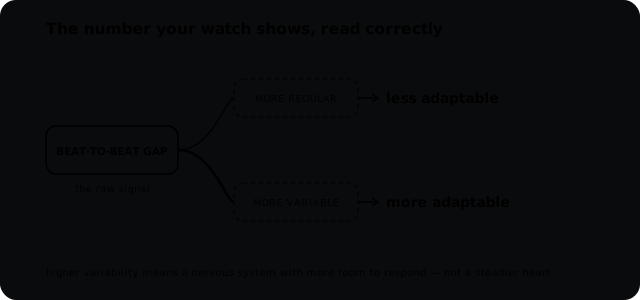
Intuition says a healthy heart should be steady — sixty clean, identical beats per minute, a metronome of wellness. Physiology says the opposite, and the opposite is the whole story: in a healthy system, the interval between beats varies continuously — 950 milliseconds, then 1,060, then 980 — and the variation isn't noise. It's steering.
Every breath, every postural shift, every flicker of demand gets answered by your autonomic nervous system adjusting the heart in real time — mostly through the vagus nerve's brake, easing on and off dozens of times a minute. A heart that varies richly is a heart under active, responsive management. A heart that beats rigidly — low variability — is a system that has stopped fine-tuning: stressed, depleted, inflamed, or locked in sustained mobilization. The metronome isn't health. The metronome is the brake worn out.
That's why low HRV shows up across the risk literature — predicting worse cardiovascular outcomes and tracking with depression, burnout, and chronic stress — and why high HRV tracks with stress resilience and faster recovery. The number is, in effect, a consumer-grade readout of your nervous system's headroom.
What the number actually reads
Mechanically: when you inhale, the vagal brake lifts and the heart speeds slightly; when you exhale, the brake reapplies and it slows — the respiratory rhythm covered in the sigh article. The size of those swings, plus the system's countless smaller adjustments, is what HRV metrics quantify (RMSSD is the one most wearables report, typically measured overnight when conditions are stable).
So when your watch reports HRV, it's effectively reporting how engaged and springy your parasympathetic brake was last night — which is why the number responds to exactly the things that load or unload your system: sleep debt, alcohol, stress, illness, training, recovery. It's the closest thing yet to a daily meter on the allostatic account — imperfect, indirect, but pointed at the right thing.
Your heart's irregularity is your nervous system's signature. The richer the variation, the more someone is home at the controls.
"What's a good HRV?" — the honest answer
The most-asked question has the least satisfying honest answer: there is no universal good number. Healthy people differ enormously — threefold, fourfold — by age (HRV declines naturally across decades), genetics, sex, fitness, and measurement method. A fit 25-year-old might run 100ms where a perfectly healthy 55-year-old runs 35ms; both fine. Comparing your number to a friend's, or to an app's population chart, produces mostly anxiety per unit of information — the wellness equivalent of comparing shoe sizes as a fitness metric.
What carries genuine signal is your trend against your own baseline. Two to three weeks of measurement establishes your normal range; from there, the readings that matter are deviations: HRV sitting meaningfully below your norm for several consecutive days is a credible flag that your system is under load — accumulating stress, fighting something pre-symptomatically (HRV often dips a day or two before you feel the cold), under-recovered from training, or paying for a stretch of short nights. One low morning means nothing. A low week means listen.
What moves it, both directions
Down, reliably: alcohol — the most visible single input; even a moderate evening measurably suppresses overnight HRV, making your wearable the most honest nightcap audit ever built. Short or broken sleep. Acute stress and sustained overwork. Illness and inflammation. Hard training without recovery days. Late heavy meals. Dehydration.
Up, over weeks: the recovery playbook, with no surprises and no shortcuts — consistent sufficient sleep (the heavyweight), regular aerobic exercise (the strongest long-term lever; fitness and vagal tone travel together), daily exhale-weighted breathing (the most direct input — long exhales literally exercise the brake), alcohol fenced, genuine stress-recovery, and calming company. Notice what the list is: the regulation toolkit, item for item. HRV never needed its own protocol. It's the meter on the protocols.
HRV is a gauge, not a dial. You don't raise it by wanting it higher — you raise it by changing what it measures: sleep, recovery, alcohol, fitness, stress. Chase the inputs; glance at the meter. People who invert this end up optimizing a number while the life it summarizes stays unchanged.
How to use it without serving it
- Establish your baseline first. Two to three weeks, same measurement conditions (overnight is best), before drawing any conclusions. The baseline is the instrument; without it you have decontextualized milliseconds.
- Read trends, ignore mornings. Single readings swing on trivia — a dream, a late dinner, sensor position. Three-to-seven-day trends against your baseline are the unit of meaning. Check weekly, not hourly.
- Use the flags for one decision: dosage. A genuinely low week is a credible argument for the easier training day, the earlier night, the deferred big push — exactly the modulation athletes use it for. That's the whole legitimate use-case: load management, informed by a trend.
- Run the experiments it's actually good at. Two weeks with alcohol versus without. Caffeine cutoff at 14:00 versus 17:00. The wearable turns these from arguments into data — the most genuinely useful thing the device will ever do for you.
- And keep the override rule: if the watch says you're recovered and your body says you're wrecked — or vice versa — the body wins. The gauge is a proxy; your interoception is the original instrument, and outsourcing it to a wristband is how people end up needing a notification to know they're tired. The device should be training your self-awareness, not replacing it. The day you can predict your HRV trend before looking is the day the gadget has done its actual job.
The meter is on your wrist. The system is the work.
Seven questions, about a minute. See what's actually loading your system — and which recovery lever moves your trend first.
Take the Free Assessment →Frequently asked questions
What is HRV in simple terms?
The variation between consecutive heartbeats — your nervous system steering in real time, mostly via the vagal brake. Higher variability means a responsive system with headroom; rigidity means stress, fatigue, or overload.
What is a good HRV score?
No universal one — healthy people differ 3–4x by age and genetics. The only meaningful reading is your trend against your own two-to-three-week baseline; several days below your norm is a credible load flag.
What lowers HRV the most?
Alcohol (the most visible), short sleep, unrecovered stress, brewing illness, overtraining, late meals. Chronically low HRV is the allostatic-load picture on a wristband.
How do I increase my HRV?
Indirectly: sleep, aerobic fitness, daily long-exhale breathing, fenced alcohol, real recovery, calming company. It's a gauge on the recovery playbook — chase the inputs, glance at the meter.