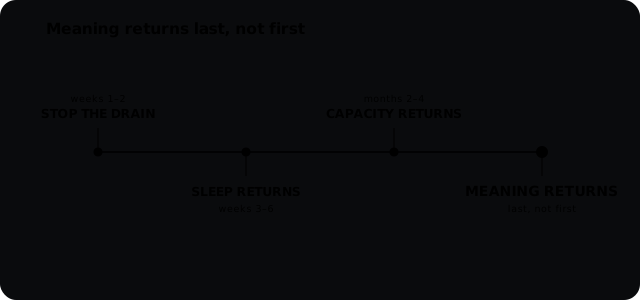
Why the vacation didn't work
You did the responsible thing: booked the week away, switched off the phone (mostly), slept long, came back tanned — and within four working days, every gauge had returned to exactly where it was. The conclusion most people draw is grim: even rest doesn't help me anymore. The actual conclusion is diagnostic, and it's better news: rest treats tiredness, and what you have isn't tiredness.
Burnout — per the WHO's occupational definition — is a syndrome with three dimensions, and a beach touches one of them, briefly. Worse, the vacation model carries a hidden relapse engine: you return at perhaps 40% capacity into a system still calibrated for 100%, fall behind immediately, sprint to catch up, and burn the vacation's gains in a fortnight — now with added evidence that "nothing works." Nothing was ever going to work at that dose. The dose was the problem, and so was the unchanged system waiting at the airport. (If you're a founder, the structural half of this story has its own article: burnout as systems failure. This one is the recovery manual — for anyone.)
The three dimensions (and what each needs)
- Exhaustion — depletion that rest doesn't fix. Needs: actual load reduction plus months of sleep-led physiological repair. This is the dimension people recognize, and the only one the vacation addressed.
- Cynicism / distance — the graying: work, and often life, drained of color; caring becomes physically unaffordable. This is the numb profile doing its conservation work — the system turning down the volume on everything because everything became too expensive. Needs: capacity returning first (you can't care your way out of a depleted state), then graduated re-engagement with things that matter.
- Eroded efficacy — more hours producing less, and competence itself feeling like it's leaving. Mostly downstream of the first two: a depleted, dampened brain genuinely performs worse, which feeds the hours, which feeds the depletion. Needs: the loop named for what it is — state, not ability — and workload shaped to current capacity so wins become possible again.
The exhaustion you can feel. The cynicism you can confess. The efficacy loss you'll fight to hide — and the hiding, at double effort for half output, is where the last reserves go.
The honest timeline
The studies of clinical burnout converge on a number nobody wants: recovery commonly runs one to three years for severe cases, and a few months for earlier stages caught honestly. The variables that compress it: catching it early, genuinely reducing load (not optimizing it — reducing it), sleep repair as the first project, and whether the structural causes change. The variable that extends it indefinitely: returning, recovered-ish, to the unchanged machine.
Why so long? Because burnout is physiological, not attitudinal: a stress system that spent years in the on position, an allostatic account deep in deficit, often with hormonal and sleep architecture costs attached. Tissue rebuilds on tissue timelines. The expectation reset is itself therapeutic — people who accept the real curve stop interpreting slow weeks as failure, which removes a layer of stress from the recovery itself. You didn't get here in a weekend. You won't leave in one. Both halves of that sentence are kindness.
The four stages of recovery
Stage 1: Stop the bleeding (weeks 1–6)
One goal: reduce actual load. Not productivity tips — fewer demands. Whatever combination is available: delegated work, deferred projects, medical leave where warranted, the honest conversation with the boss or the clients. Imperfect reductions count; pride is not a vital organ. And treat sleep as the entire first project — nothing rebuilds on a sleepless system, and burnout's wired-exhaustion usually needs the full protocol (anchored wake time, fenced caffeine, a real wind-down) rather than just opportunity.
Stage 2: Restore the body (months 1–3)
Gentle, daily, boring: walks, not bootcamps — intense training is another stressor on a system with no spare adaptation budget, and the fitness-as-recovery instinct relapses more people than it rescues. Daily downshift practice (the long exhale, five minutes), food at regular times, daylight in the mornings, and people who don't cost anything to be around — co-regulation is the cheapest medicine in this stage.
Stage 3: Rebuild capacity (months 2–6)
Load returns gradually and on purpose — slower than feels necessary, because feeling-recovered precedes being-recovered by months (the same gauge problem as sleep debt). Energy-first scheduling, hard boundaries treated as medical equipment, and wins deliberately sized to current capacity — efficacy rebuilds on completed things, and completion requires honest sizing. The signal you're ready for more: genuine boredom, not guilt. Guilt is the old system talking; boredom is capacity announcing itself.
Stage 4: Redesign the architecture (ongoing)
The stage that decides whether this was recovery or intermission. Burnout research (Maslach's work above all) is clear that the causes are substantially structural — workload, control, reward, community, fairness, values — and a recovered person returned to an unchanged structure re-burns on schedule. The redesign menu runs from boundaries and role reshaping to delegation and automation (the Tuesday audit exists for exactly this) to, sometimes, the exit. The honest question for the system you're returning to: what, specifically, is different now? If the answer is "me, trying harder to cope" — that's the sequel's opening scene.
Stop treating burnout as a personal failure to be quietly fixed, and treat it as data from a well-functioning alarm: the system you were running was unrunnable, and your body said so when you wouldn't. Recovery isn't getting back to who you were. It's building the version — of you and of the system — that doesn't require the alarm again.
The recovery mistakes that cause relapse
- The fitness offensive: attacking recovery with 6am HIIT. Intensity is load; the budget is empty. Walks first; the gym comes back in stage 3.
- The optimization detour: reorganizing the productivity system instead of reducing the demands it schedules. A better-organized unrunnable load is still unrunnable — now with dashboards.
- The premature comeback: first good fortnight → full load → crash. Feeling better is stage 2; being better is stage 4. Add load slower than the feeling suggests, every time.
- The solo run: severe burnout overlaps with depression often enough that professional eyes matter — and the cynicism dimension actively argues against asking. If the gray includes hopelessness, that's a clinician conversation, not a protocol article.
- The intermission ending: recovering diligently into the unchanged system. The most common mistake, and the only one that guarantees a sequel.
After: the recalibrated alarm
The honest epilogue: full recovery is real and common, and many people emerge structurally better — boundaries that exist, signals that get read at 20% instead of 90%, a life designed rather than accumulated. What usually remains is sensitivity: load registers earlier than it used to. The people who do best reframe that correctly — not as damage, but as an alarm that finally works, installed at considerable expense, worth honoring for the rest of a career. The burnout was the bill for years of unread signals. The sensitivity is the receipt — and the upgrade.
Find out which stage you're actually in.
Seven questions, about a minute. See whether your system needs rest, rebuilding, or redesign — and where to start this week.
Take the Free Assessment →Frequently asked questions
What does burnout actually feel like?
Three dimensions: exhaustion rest doesn't fix, cynicism (life graying; caring unaffordable), and eroded efficacy (more hours, less output). The tell versus tiredness: a good weekend fixes tired.
How long does it take to recover from burnout?
Months for early stages; commonly 1–3 years for severe clinical cases. The biggest variables: real load reduction, sleep repair, catching it early, and whether the structure that built it changes.
What is the fastest way to recover from burnout?
No fast way — an efficient order: reduce actual load + fix sleep, restore the body gently (walks, downshifts), rebuild capacity slower than feels necessary, then redesign the architecture. Skipping the last step schedules the relapse.
Can you fully recover from burnout?
Yes — most people recover fully, many emerge better-designed. What remains is earlier load sensitivity: not damage, but an alarm that finally works. Don't return to the baseline that produced the collapse.