The question behind the question
"Will AI take my job?" is rarely a question about employment statistics. It's a question about worth: if a machine can do what I do, what am I for?
That's why the panic headlines and the soothing LinkedIn posts both miss. The panic answers a question about economics with fear; the comfort answers a question about identity with denial. Neither gives you anything to do. This piece will — but it requires looking at the mechanics honestly first, because the mechanics are where the leverage hides.
AI takes tasks, not jobs — why that distinction matters
No job is a single activity. Every job is a bundle of tasks — some predictable, some not. A "marketing manager" writes copy, builds reports, sits in negotiations, reads a room, makes taste calls, takes responsibility when a campaign fails. An "accountant" processes entries, reconciles statements — and tells a terrified business owner the truth about their numbers in a way they can hear.
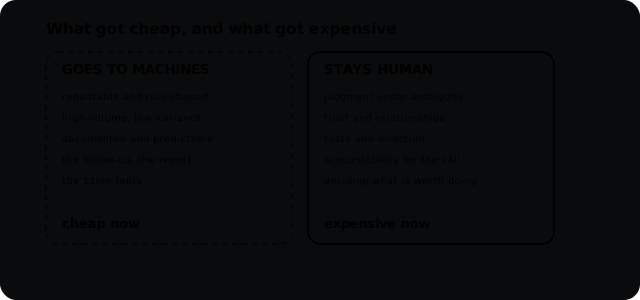
AI doesn't arrive and take the bundle. It takes the predictable tasks out of the bundle — the copy drafting, the report building, the entry processing. What happens next is the part that decides your future: the market reprices the remainder.
If your bundle was 80% predictable tasks, the remainder is thin, and the job consolidates — three people's residual work becomes one person's job. If your bundle was 80% judgment, relationships, and accountability, the predictable 20% disappearing makes you more valuable: same human, less drudgery, more of the work only you could do. Same technology, opposite outcomes — determined entirely by the composition of the bundle.
So the real question was never "is my job safe?" It's: what percentage of my week produces predictable outputs from digital inputs? Count it honestly. That number is your exposure.
Which work is genuinely exposed
| Exposure | Task shape | Examples |
|---|---|---|
| High | Predictable digital outputs from digital inputs | Routine content production, basic data analysis and reporting, standard document review, tier-one support, routine coding, administrative processing |
| Medium | Digital work with judgment mixed in | Design, marketing strategy, much of software engineering, financial advisory, teaching — the predictable parts go, the judgment parts concentrate |
| Low | Physical presence, accountability, trust, high-stakes human moments | Skilled trades, care work, surgery, leadership, negotiation, anything where someone must own the outcome |
Two things in that table offend people, so let's say them directly. First: exposure ignores prestige. A junior corporate lawyer doing document review is more exposed than an electrician. The degree doesn't protect you; the task shape does. Second: "medium" is most of us — and medium doesn't mean half-safe. It means your job will be transformed into a different job, and the transformation has a direction: the predictable parts leave, and what remains is judgment, relationships, and accountability. Whether that's a promotion or a layoff depends on which parts of the bundle you've been investing in.
The degree doesn't protect you. The title doesn't protect you. The shape of your Tuesday does.
What machines can't take
Not a comfort list — a strategy list. These are the capacities the market is already repricing upward:
- Accountability. An AI can draft the contract; it cannot be responsible for it. Someone must own decisions and their consequences, and that someone bills accordingly. Every automated system increases the value of the human who answers for it.
- Trust and relationships. People buy from, hire, follow, and confide in people. Trust is built over time, in person, through kept promises — it has no API.
- Taste and judgment. When anyone can generate a hundred options in a minute, the scarce skill is knowing which one is right — and which question was worth asking at all. Generation is now free; selection is the new expertise.
- Physical skill in unpredictable environments. The trades, care work, anything where the world refuses to be digital.
- Presence in the moments that matter. The negotiation, the diagnosis delivered kindly, the team rallied after a brutal quarter. In these moments humans don't just prefer humans — they require them.
The inversion nobody prices in
Here's the part of this story almost no one is acting on. When machine-generated output becomes free and infinite, the economics invert: what's scarce is no longer production. It's the human capacities underneath it — attention that can hold a hard problem, a nervous system that stays regulated under pressure, the energy to be fully present in the moments machines can't enter.
And look at the state of those capacities. The average knowledge worker is overstimulated, under-slept, fragmented across forty browser tabs, and running on stress hormones — degrading precisely the assets the new economy pays a premium for, while polishing skills the machines just absorbed. That's the strategic error of the decade, and it's almost universal.
The professionals who'll command a premium in five years aren't only the ones with better prompts. They're the ones who can focus when no one else can, stay calm when the room can't, and bring genuine presence to a meeting full of people checking their phones. We've written the full argument in how to stay relevant in the AI era — but the one-line version: being human just became a competitive advantage, and almost nobody is training for it.
The three moves, in order
1. Adopt the tools — seriously, not symbolically
The near-term threat is not AI taking your job. It's an AI-fluent human taking your job — doing your bundle at three times the speed because they delegated the predictable 60%. Use the tools on your real work until you know exactly what they do well and where they fail. This is weeks of deliberate effort, not a webinar. It's also table stakes — everyone will eventually do this, which is why it's first but not enough.
2. Rebalance your bundle
Audit your week against the table above. Then deliberately shift hours from exposed tasks to durable ones: volunteer for the client-facing work, take ownership of outcomes (not just outputs), develop the taste to evaluate what the machines produce, become the person who's accountable. In most organizations these are exactly the responsibilities others avoid — which makes the trade absurdly available right now.
3. Train the human baseline
The move almost everyone skips, because it doesn't look like career advice: fix your sleep, your attention, your stress regulation, your capacity to be present. These aren't wellness perks. In an economy where machine output is free, they're the production capital — the substrate every durable skill on this page runs on. They're also fully trainable, which is the best-kept secret in this entire conversation.
Stop asking "will AI take my job?" — it's a question you can't act on. Ask instead: "which of my tasks would I hand to a machine today, and what am I building with the time that frees?" The first question makes you a spectator of your own future. The second makes you its architect.
So — should you be worried?
Worry is the wrong instrument; it consumes the exact attention you need for the actual work. But its opposite — pretending this is overblown — is worse.
The realistic five-year picture for most fields is transformation, not deletion: your job becomes a different job that uses AI, with fewer people doing the predictable parts and a premium on those who own what's left. The people genuinely in trouble in five years will mostly be those who spent the transition window pretending nothing was changing — defending the old bundle instead of building the new one.
The window is open now. It will not be open indefinitely. And everything on the durable list — the tools fluency, the rebalanced bundle, the trained human underneath — compounds, which means the best time to start was last year, and the second-best time is the next hour.
The machines got smarter. Your move is to get more human.
Find out where you actually stand — and which capacity to build first. Seven questions, about a minute.
Take the Free Assessment →Frequently asked questions
Which jobs are most at risk from AI?
Work that produces predictable outputs from digital inputs — routine writing, basic analysis and reporting, standard document work, tier-one support, routine coding, administrative processing. Exposure follows task shape, not title prestige: parts of law and finance are more exposed than the trades.
What jobs will AI not replace?
Work anchored in what machines don't have: physical presence in unpredictable environments, accountability for outcomes, trust built over time, taste and judgment, and presence in high-stakes human moments. Most jobs are bundles — AI unbundles the predictable tasks and leaves the human ones.
How do I make myself irreplaceable in the AI era?
Three moves in order: adopt the tools seriously (the near-term risk is an AI-fluent human, not AI), shift your time toward judgment, relationships, and accountability, and train the human baseline — regulated nervous system, real attention, genuine presence. That last one is the scarce asset, and it's trainable.
Should I be worried about the next 5 years?
Urgency, not worry. The realistic picture is transformation: your job becomes a different job using AI, with a premium on those who handle what machines can't. The people in trouble are mostly those who spend the window pretending — and the window is open now.