Two problems that solve each other
Problem one predates AI by centuries: your business's operating knowledge lives nowhere reliable. The real refund policy (with its exceptions) lives in the founder's head. The answer to the question clients ask weekly lives in an email thread from 2024. The reason you always check X before Y lives in the memory of the person who was there for the incident — and leaves when they do. Every vacation test failure, every brutal onboarding quarter, every "ask Deniz, she knows" is this problem wearing a different costume.
Problem two is newer: the AI systems everyone's deploying answer questions by drawing on their general training — eloquent pattern-matching over the internet — which means questions about your specific business get answered by educated improvisation. Usually plausible. Sometimes wrong. Always confident. Every screenshot-worthy chatbot disaster — the invented policy, the hallucinated discount — is this problem in production.
The knowledge base solves both at once: capture the knowledge from problem one, and it becomes the grounding that fixes problem two. One project, two graves.
RAG: the open-book exam
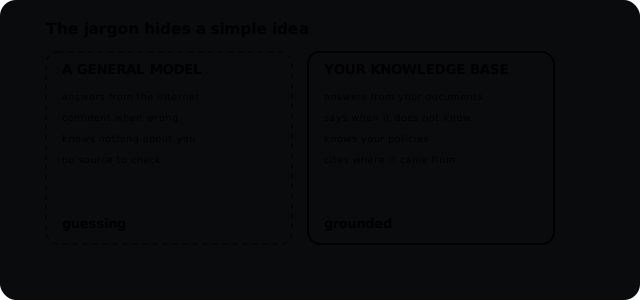
The jargon — RAG, embeddings, vector search — obscures an idea simple enough for one analogy. An ungrounded AI takes your question like a closed-book exam: answering from memory of everything it ever read, none of which was specifically your business. A RAG system (Retrieval-Augmented Generation) takes the same question as an open-book exam: first it retrieves the relevant passages from your document library — the actual pricing page, the actual policy, the actual SOP — then it generates the answer from those passages, often citing which document it used.
The technical plumbing (documents chunked and indexed so the right passages surface for any phrasing of the question) matters to builders; what matters to owners is the property it produces: the system's answers are bounded by your documents. Ask it something the library covers, and it answers accurately in seconds. Ask it something the library doesn't cover, and a well-built one says the most valuable sentence in applied AI: "I don't have that information — let me connect you with someone who does."
An ungrounded AI is an articulate stranger guessing about your business. A grounded one is an assistant who actually read the manual — because you finally wrote the manual, once.
Why grounding is the whole game
Everything this series has said about deployment quality routes through this one architectural choice. The customer-service disasters? Ungrounded improvisation. The vendor-demo magic that fell apart on your real questions? No grounding in your real answers. The difference between the agent that helps and the chatbot that embarrasses? Largely whether its mouth is connected to your documents or to the internet's vibes.
And there's a compounding second payoff: the knowledge base becomes the substrate for everything else you automate. The phone agent answers from it. The internal assistant that saves your team the "quick question" interruptions runs on it. New-hire onboarding queries it instead of interrupting seniors. Each SOP you wrote stops being a document someone must find and becomes an answer that finds them. This is why we treat the knowledge layer as infrastructure, not a feature — it's the foundation every agent in the building stands on.
What goes in (and what it's worth)
The capture list, in value order: the fifty most-asked questions (mine the inbox and the call notes — they're all there, asked monthly for years), pricing and policies with their real edge cases (the documented version, not the folklore version — writing it down will surface that three people believed three different policies, which is itself a finding), your SOPs and delivery processes, product and service specifics, and the tribal knowledge — the "we always check X because of March" layer that currently has a single point of failure with a notice period.
The discipline that decides quality: curate ruthlessly. The system answers from what's there — including the stale price list and the superseded policy — so fifty current documents beat five hundred archaeological ones. Garbage in, confident garbage out, at scale, in your brand voice.
Building it: the practical sequence
- Harvest the questions first. One week of logging every question asked by clients and team — plus a dig through sent mail. This list is the spec: build the library that answers it.
- Write or gather the source documents — short, single-topic, dated. The one-page discipline applies doubly here: retrieval works best on focused documents.
- Resolve the contradictions before indexing. Where two documents disagree (they will), the business just learned something. Decide, document, delete the loser.
- Deploy narrow first: internal use before customer-facing — your team catches the wrong answers cheaply for a few weeks (shadow mode, knowledge edition), and the gap list grows fast.
- Then point it outward — site chat, the phone agent, the client portal — with the escalation rules already proven and the boundary sentence rehearsed: not in the library → human, with context.
Keeping it true
A knowledge base is a garden, not a monument — and an unmaintained one becomes the worst of both problems: a confident liar with a search function. The three disciplines: one named owner (currency is a job, or it's nobody's); change-triggered updates — price change, policy change, repeated wrong answer → edit that week, never "quarterly review" (the calendar version dies; the trigger version lives); and harvest the misses weekly — every question the system couldn't answer is a document requesting to exist, delivered free, pre-prioritized by frequency. Twenty minutes a week of this and the asset compounds: each month it answers more, escalates less, and holds more of the business's brain outside any single head. Which was the original problem, solved — quietly, permanently, and for every future hire, agent, and absence at once.
Stop thinking of documentation as paperwork and see what it became this decade: executable knowledge. Every page you write now has hands — it answers the client at 2am, trains the new hire, staffs the phone agent. The businesses that documented are handing their knowledge to machines. The ones that didn't are still answering the same fifty questions, by hand, forever.
Your knowledge, captured once, working everywhere.
The audit maps what your business answers by hand, what's trapped in heads, and what a grounded knowledge layer would return. If the numbers don't show a clear return, we don't build.
Get your Agent Blueprint →Frequently asked questions
What is RAG in simple terms?
An open-book exam: the AI retrieves relevant passages from your documents first, then answers from them — instead of improvising from general internet training. Bounded answers, citable sources.
Why does my business need a knowledge base for AI?
Because ungrounded AI invents — policies, prices, promises — fluently and in your brand voice. Grounding bounds answers to what's written and escalates at the edges. Every viral chatbot disaster was an ungrounded system.
What should go into a business knowledge base?
The fifty most-asked questions, real policies with edge cases, SOPs, service details, and the tribal knowledge that leaves with departures. Fifty current documents beat five hundred stale ones.
How do I keep it accurate?
One named owner, change-triggered edits (never quarterly reviews), and weekly harvesting of unanswered questions as the gap list. Maintained, it compounds; unmaintained, it's a confident liar with search.