The cheapest diagnostic in business
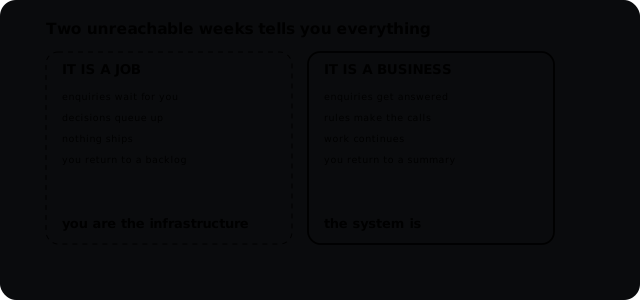
Consultants will sell you operational audits, maturity assessments, and dependency matrices. The same information is available for the price of a flight: leave, for two weeks, genuinely unreachable — and let the business write its own report. Every queue that forms, every decision that stalls, every customer who notices is a data point no interview could surface, because the org chart says one thing and the fortnight says the truth.
The test works because absence is unfakeable. Present, you patch a hundred small gaps daily without noticing — the quick approval, the only-you answer, the relationship that's personally yours — and the patching is the dependence, invisible precisely because it never gets to fail. Two unreachable weeks removes the patch. What's underneath was always underneath. (The founder who already knows their Tuesday Number can predict most of the report; the vacation test is the Tuesday audit's final exam.)
The refusal is the result
Here's the elegant, slightly cruel property of this diagnostic: most founders refuse to take it — and the refusal is the result. "I can't possibly be unreachable for two weeks" is not an objection to the test. It is the test, returned early, with the grade already filled in: the business cannot run without you, you know it, and the knowing has been managing your life for years — the never-fully-off holidays, the laptop that travels, the phone checked at the dinner you technically attended.
Worth saying as the behavioral scientist rather than the systems person: this isn't only architecture. For many founders, being needed is the identity, not the bug — every fire only you can fight confirms you matter, and a business that runs without you raises a question the inbox conveniently never leaves room to ask. The test threatens that arrangement, which is the honest reason it keeps not getting booked. Book it anyway. The question doesn't age well unasked.
"I can't be away two weeks" isn't a scheduling problem. It's the audit result, delivered free, years before the buyer's due-diligence team delivers it expensively.
What breaks, in order
Across the businesses we've audited, the failure sequence is remarkably consistent:
- Decisions queue (days 1–3). Approvals, exceptions, pricing calls, the "is this okay?" traffic — everywhere "ask the boss" is the de facto process, the process stops. The queue is a list of authority you never distributed.
- Customer-facing speed degrades (week 1). The leads only you answer age past the window; the accounts that are personally yours notice the silence. This is relationship and response architecture that lives in one phone — yours.
- Quality wobbles (week 2). Where standards live in your head instead of in documents, output drifts toward each person's private version of "good enough." Nobody did anything wrong; the spec was never published.
- Cash mechanics hiccup (week 2+). The invoices only you chase, the payments only you release — the unglamorous financial plumbing that routed through one set of hands.
Notice what's absent: people failing. The team mostly performs exactly as architected — the architecture just had you load-bearing in forty places. Every failure is an extraction failure: knowledge, authority, or relationship that never left the founder. Which is excellent news, because extraction is a project, not a personality change.
The valuation truth nobody tells founders
The test's stakes go beyond the fortnight. When a buyer eventually looks at your business — acquisition, investment, succession — owner-dependence is the first thing priced: a profitable company that needs its founder daily isn't an asset; it's a job with goodwill attached, and acquirers discount brutally or structure earn-outs that chain you to the desk for years. The same profit stream inside documented, transferable, founder-optional systems trades at multiples more — buyers pay for machines, not for marriages.
And the valuation logic applies even if you never sell: you are the buyer, every year, of your own freedom. The business that survives your absence is the one where your presence finally becomes a choice — the difference between owning a company and being owned by one, which was presumably the point of the whole adventure. (The systemization path is the same one: the four layers.)
The repair, by failure type
- Queued decisions → distribute authority with thresholds. Decision rules, written: "refunds under $200 — decide yourself. Schedule changes — decide yourself. New pricing — that's me." Every rule converts a recurring interruption into a standing capability, and the team grows exactly at the edge of the authority they're handed.
- Stalled knowledge → extract it to one-pagers. Record-then-document the recurring processes; stuck-test them on the least experienced person. The fortnight's quality wobbles are your prioritized SOP backlog, pre-sorted by pain.
- Machine-work bottlenecks → automate them out of human hands entirely. The reminders, follow-ups, data transfer, and routine answers that queued behind you needed no human at all — that layer is agent territory, and it doesn't take vacations either.
- Personal relationships → introduce seconds before you need them. Key accounts meet a capable colleague while you're still present — "I want you to have two people here" reads as service, not succession. Relationship transfer takes quarters; start before the test, not after the offer.
- The identity layer → do the honest hour. If the dependence keeps regrowing after every fix, the architecture isn't the regrower — the founder is, quietly re-absorbing decisions because being needed pays in a currency the systems don't. That pattern has its own article, and naming it is most of beating it.
The goal was never your irrelevance — it's that your presence becomes a choice. The founder of a self-running business still works, usually harder than ever, but on the things only founders can do: direction, relationships, the next thing. The vacation test doesn't measure whether you matter. It measures whether you're free.
Running the test properly
- Announce it with real notice — a month out. The announcement alone triggers useful panic-documentation; that's the test already working.
- Define the true-emergency line: one channel, one definition ("building on fire, legal service, key client cancellation") with one designated decider who isn't you. Once defined, it almost never fires — which is itself a finding.
- Go genuinely dark. No daily check-ins, no beach approvals — remote-working from a worse desk voids the diagnostic. The discomfort of day three is withdrawal, not emergency; it passes.
- Debrief in week one back: what queued, what broke, what surprised everyone by working. Write the failure map while it's fresh — it's your next two quarters' systemization roadmap, pre-prioritized.
- Re-run annually. The test should get more boring every year. Boring is the grade you're chasing — and the year it's finally uneventful, take a longer one. You'll have built the right to.
Want the failure map before the vacation?
The audit finds where you're load-bearing — decisions, processes, machine-work — and prices the dependence, before anything gets built. If the numbers don't show a clear return, we don't build.
Get your Agent Blueprint →Frequently asked questions
What is the vacation test for business owners?
Two genuinely unreachable weeks as a structural diagnostic: what queues, breaks, or stalls maps your owner-dependence precisely. Daily check-ins void the test — that's working from a worse desk.
Why does owner dependence matter if the business is profitable?
Single point of failure (you), brutal valuation discounts (buyers pay for machines, not marriages), and weekly opportunity cost — every infrastructure-hour is a growth-hour unspent.
What usually breaks first when the owner leaves?
Decisions queue, then customer speed degrades, then quality wobbles where standards live in your head, then cash mechanics hiccup. All extraction failures — knowledge and authority never moved out of the founder.
How do I make my business less dependent on me?
Distribute authority with thresholds, extract knowledge into one-page SOPs, automate the machine layer entirely, transfer relationships gradually — and re-run the test annually until it's boring.