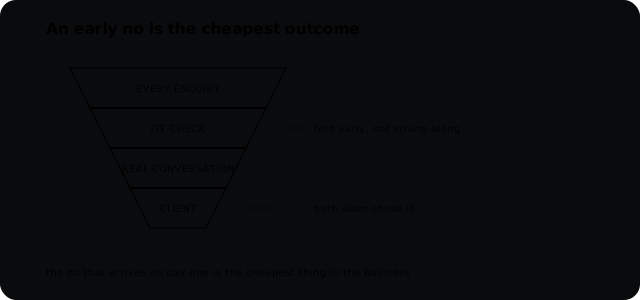
The every-lead tax
Here's a week I've watched play out in dozens of service businesses. Twelve inquiries arrive. All twelve get the founder's full treatment: the prompt reply, the call, the customized proposal, the follow-up sequence, the hope. Three were ever real buyers. Two of those three got slightly slower, slightly thinner attention — because the founder was busy writing a third proposal for someone who, it turns out, was "just getting quotes" for a project their brother-in-law was always going to do.
The every-lead instinct feels diligent and bills like negligence. The hours aren't conjured from nowhere — they're reallocated from your best prospects to your worst ones, and from the work itself to the courtship of people who were never going to fund any work. Add the emotional line item — the optimism invested in maybes that were always nos — and the policy of treating every lead as precious turns out to be precisely how none of them get treated that way.
Why qualification is kindness
The reframe that unlocks the whole discipline: qualification done honestly is kind in all three directions.
- Kind to right-fit prospects — who get faster responses, fuller attention, and a provider with the capacity to actually serve them, because that capacity wasn't spent elsewhere.
- Kind to wrong-fit prospects — genuinely. The person who can't afford you, doesn't need you, or needs something else deserves a respectful, fast no with a pointer to a better option — not three weeks of polite maybe that wastes their timeline too. Slow maybes feel gentler and are crueler.
- Kind to you and your team — who stop riding the emotional slot machine of pursuing everyone, and start working a pipeline where effort correlates with outcome. (There's also the positioning dividend: selectivity reads as demand. The provider who asks real questions before proposing signals worth; the one who chases signals hunger — and buyers price both signals, instantly, the same way they read your price as a story.)
A fast, respectful no is a gift. A slow maybe is a tax — collected from both sides, paid in the currency neither can mint more of.
The four questions
Skip the acronym frameworks; in real conversations, four questions surface everything BANT formalizes, without the interrogation flavor:
- "What's happening right now that made you reach out?" — the problem question. Listen for specific recent pain: "we missed two big jobs last month because nobody answered the phone" qualifies; "we're exploring options for the future" mostly doesn't. The trigger event is the single best predictor of real intent — people act when something happened, not when something might.
- "What is this costing you?" — the stakes question. A prospect who can name a cost — in money, hours, sleep, customers — has already half-built the business case. One who can't price the problem rarely funds the solution. (Helping them price it honestly is also the most useful free thing you'll do in the call — it's the audit instinct applied to sales.)
- "Who else is involved in deciding this?" — the authority question, asked without making anyone feel small. Surfaces the partner, the board, the spouse, the real buyer — in minute five instead of week three, which is when you'd otherwise discover your champion was a scout.
- "What happens if this isn't solved in three months?" — the timeline question, framed as consequence rather than calendar. "We lose the season" is a real timeline. "Nothing much, honestly" is a nurture entry, not a pursuit — file warmly and check back when something happens.
Reading the signals (it's the engagement, not the answers)
Here's the layer the frameworks miss: the answers matter less than how the prospect engages with the questions. Qualified buyers lean in — specifics pour out, numbers get named, the conversation deepens, because you're asking about a problem that genuinely hurts. Tourists deflect — vague answers, topic changes, "just send me a price." That deflection is the data: a person unwilling to discuss the problem in minute five will not become a great client in month five.
Watch also for the negative signals worth honoring early: budget questions answered with offense rather than information, urgency that's all yours ("can you start tomorrow?" from someone who took nine days to reply), and the prospect whose previous three providers were all incompetent — you will be the fourth. None of these is disqualifying alone. Two together usually are. The skill is letting the pattern speak before the proposal gets written, not after the invoice goes unpaid.
The fast no: scripts and courage
Disqualification fails not from ignorance but from discomfort — saying no feels like burning money you already spent on the lead. Scripts lower the cost:
- Wrong problem: "From what you've described, we're honestly not the right tool for this — what you need is [X], and [pointer] does that well. Wishing you a fast fix." (Thirty seconds, and they leave with a story about your honesty — which travels.)
- Wrong budget: "Our engagements start at [range], and I don't think the math works for the size of this problem yet. Here's the free version of what I'd do in your shoes: [one genuine tip]." (Generous, honest, occasionally returns a year later as a fit.)
- Wrong timing: "It sounds like this isn't urgent yet — and pushing it would serve me, not you. Can I check in when [the trigger they named] happens?" (Books the future, costs nothing now.)
Every one of these takes under a minute, leaves the relationship warm, and returns the hours to the pipeline that pays. The courage is required exactly once per script; after that it's procedure.
Stop measuring your pipeline by how many leads are in it and start measuring how fast the wrong ones leave. A pipeline's health isn't its volume — it's its honesty. The fastest-growing service businesses we audit are rarely the ones with the most leads. They're the ones whose hours go where the yes lives.
Automating the first pass
The practical failure of qualification was never the questions — it's that they don't get asked at speed. The inquiry arrives at 21:40; the qualifying conversation happens, at best, tomorrow afternoon — by which time the 5-minute window is long closed and the prospect has answered someone else's questions instead.
This is the cleanest agent use-case in the entire sales stack: an AI agent answers in seconds, asks the four questions conversationally (machines feel zero awkwardness about budget), books cleared prospects directly into your calendar, redirects misfits warmly with the scripts above, and queues the not-yets for scheduled nurture — every hour, every channel, in your voice. The human inherits exactly what humans are for: a discovery call with someone who has the problem, knows its cost, can decide, and chose a time. Qualification handled the gate; the relationship starts at the door.
How many of your hours go to leads that were never real?
The audit maps your inquiry flow — volume, speed, fit, where the hours leak — and shows what an automated first pass would recover. If the numbers don't justify it, we don't build.
Get your Agent Blueprint →Frequently asked questions
What does it mean to qualify a lead?
Finding out early whether you can genuinely help: real problem, named cost, decision authority, real timeline. A fast respectful no beats weeks of polite maybe — for both sides.
What questions should I ask to qualify a lead?
What happened that made you reach out; what's it costing you; who else decides; what happens if it's unsolved in three months. The prospect's engagement with the questions is itself the strongest signal.
Why is disqualifying leads important?
Bad-fit pursuits silently tax your best prospects' attention, and bad-fit clients cost more after closing — support, friction, churn. Selectivity also signals value; chasing signals hunger.
Can lead qualification be automated?
The first pass, yes: an agent asks the questions in seconds 24/7, books the fits, redirects misfits warmly, and nurtures the maybes — humans inherit warm, cleared, scheduled conversations.