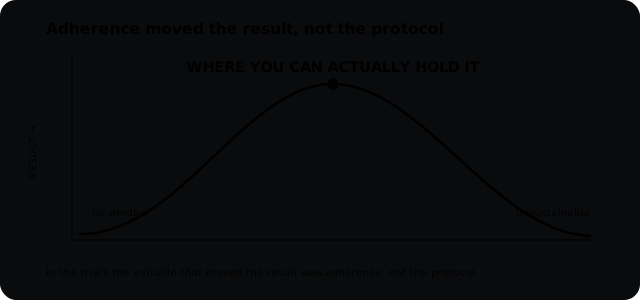
The prophet package
Every few years a dietary structure arrives wearing robes. Intermittent fasting's were particularly good: ancestral framing (your hunter-gatherer genes!), cellular mysticism (autophagy! the body eating its damaged parts!), a metabolic switch narrative (fat-burning mode!), and the implicit moral upgrade that fasting has carried in every religion that ever tried it. The package moved books, apps, and a billion skipped breakfasts.
Meanwhile, quietly, the trials ran. And as someone who sold health products for global brands long enough to know exactly how the robes get sewn — and then spent a decade watching clients live inside diets rather than read about them — I find the trial verdict more useful than the prophecy ever was: fasting is a legitimate, ordinary tool that works for the ordinary reason. The robes can go back to wardrobe. The tool can stay.
What the trials actually found
The question that matters is never "did fasters lose weight?" (any structure that cuts intake produces weight loss) but "did fasting beat matched calorie reduction?" The well-designed head-to-heads answer consistently:
- Year-long randomized trials comparing alternate-day fasting against continuous daily restriction: equivalent weight loss, equivalent cardiometabolic changes — with fasting groups often showing higher dropout, an adherence signal worth noticing.
- The rigorous 16:8 trials (including Ethan Weiss's TREAT study, run by a researcher who personally practiced 16:8 and stopped after his own results): time-restriction without calorie targets produced modest-to-minimal advantages over control, and one careful trial found a meaningful share of the small weight lost was lean mass.
- Calorie-matched comparisons across formats: when intake is equal, outcomes are equal. The window doesn't add metabolic magic on top of the deficit. The window is the deficit, delivered by schedule.
Read correctly, this isn't a debunk — it's a reassignment. Fasting moves from the metabolism aisle to the behavior-design aisle, alongside meal prep and smaller plates: structures whose entire job is making eat-less sustainable. And in that aisle, it's a genuinely strong product — for the right customer.
The window was never a metabolic switch. It's a fence — and fences work brilliantly for people who do better with fences than with negotiations.
The autophagy file
The claim deserves its own honest paragraph because it carries the robes. Autophagy — the cell's cleanup-and-recycling program — is real, important biology; its mechanisms earned the 2016 Nobel (Ohsumi's work, in yeast). Fasting upregulates it — robustly, in rodents and cells, on rodent timelines: a fasting mouse is metabolically deeper into deprivation in 18 hours than you are after a weekend.
What doesn't exist: human outcome data showing that daily 16-hour windows produce health-relevant autophagy gains. Measuring tissue autophagy in living humans is genuinely difficult, the human studies are sparse and indirect, and the dramatic claims are extrapolated across species and durations as if biology scaled like a recipe. Meanwhile exercise is a well-documented autophagy trigger — and nobody sells squats as cellular communion. The tell, as always in wellness: when the mechanism is real but the dose-claims are borrowed, you're holding marketing with a bibliography.
Who the structure fits (and who it bites)
Fits: rule-people — those for whom "no food before noon" is restful compared to all-day moderation negotiations (rules require one decision; moderation requires forty). Grazers and night-snackers, for whom the window mechanically deletes the grazing hours. People whose mornings genuinely run fine without breakfast — a real, stable chunk of the population. And schedule-compressors who like that fewer eating occasions means fewer food decisions per day.
Bites: anyone with an eating-disorder history — the most important and least-mentioned contraindication: a culturally-approved restriction structure is a reactivation risk for restriction-binge cycles, full stop. The pregnant, the adolescent, the underweight, and anyone on glucose-lowering medication (medical supervision territory). High-stress, under-slept systems — a fasting window on an already loaded system is one more stressor wearing a halo. And the rebound-prone: if the window produces ravenous 20:00 eating that erases the day's deficit plus interest, the structure is manufacturing the exact behavior it promised to control — for that pattern, the gentler fence of the 80% rule outperforms it on every horizon.
The timing nuance nobody markets
One genuinely interesting finding hides under the brand: when the window sits may matter more than that it exists. The circadian literature is clear that metabolic machinery runs on a daytime schedule — glucose handling is better earlier, and late eating tells peripheral clocks it's noon at midnight. Early-window trials (eating roughly 8:00–16:00) have shown better glucose and pressure results than the default skip-breakfast/late-dinner version most practitioners actually run — which may be the worst-aligned format: it deletes the meal your metabolism handles best and keeps the one it handles worst. If you fast, fast from the evening side first. The marketing never mentions this because "skip dinner" sells considerably worse than "skip breakfast."
Stop asking "does fasting work?" — wrong altitude. Ask: "do I do better with fences or with negotiations?" Fence-people thrive in windows. Negotiation-people thrive on the 80% rule. Both are running the same arithmetic underneath — and the structure you'll still be running in three years is the only one that was ever going to matter.
If you run it: the sane version
- Start at 12:12, drift to 14:10 or 16:8 only if it's easy. The aggressive windows buy little extra and cost adherence — and adherence was the entire product.
- Bias the window early when life allows. Finish eating 2–3 hours before bed regardless — that rule pays on every diet and no diet.
- Eat actual meals inside the window. Protein adequate, plants present. A window full of snacks is grazing with a deadline.
- Watch the rebound signal honestly. Ravenous evenings, food preoccupation, weekend blowouts: the structure is biting. Exit without ceremony — a structure that fights your regulation loses to one that fits it, always.
- Skip it entirely if you're in a contraindicated group — and if eating ever feels like a moral performance, step back: the goal was a sustainable deficit, not a purity practice. The robes were never load-bearing.
Fences, negotiations, or neither — find your structure.
Seven questions, about a minute. See what's actually driving your eating pattern — and which structure your system will keep.
Take the Free Assessment →Frequently asked questions
Does intermittent fasting work for weight loss?
About as well as matched calorie restriction — no better, no worse. The window works by reducing intake; it's a behavior structure, not a metabolic trick, and adherence is what separates outcomes.
Is the autophagy claim real?
The biology is real; the timeline is borrowed from rodents and long fasts. No human data shows 16:8 producing health-relevant autophagy gains — and exercise triggers autophagy without the robes.
Who should not do intermittent fasting?
Eating-disorder history (the big one), pregnancy, adolescence, underweight, glucose-lowering meds — plus caution for high-stress systems and anyone whose window produces evening rebounds.
Is 16:8 better than just eating less?
Metabolically no. Behaviorally — yes for fence-people who do better with rules than moderation; no if it wrecks evenings, social meals, or an already-stressed system. The early-window version aligns better with circadian biology than skip-breakfast.