The magic-words industry
It was inevitable: a technology arrives that responds to natural language, and within a year there's a priesthood selling the language. Courses in secret phrasings. Threads of "10 prompts that will change your business." The implicit promise underneath all of it: the model contains brilliance, locked, and the right incantation is the key.
As behavioral framing, it's seductive — it locates the gap in a learnable trick rather than in the unglamorous truth. And as a description of how these systems actually work, it has aged badly, fast. The honest version: early models were brittle, phrasing did matter disproportionately, and a real (small) craft existed. But every model generation since has gotten better at understanding plain, ordinary requests — that's much of what "better model" means — and each improvement quietly devalues the incantations. The course was teaching you to speak carefully to something that's learning to listen well. One side of that trade compounds. It isn't yours.
Why the tricks keep expiring
The pattern is structural, worth seeing once clearly: prompt tricks are workarounds for model weaknesses, and model weaknesses are precisely what model developers fix. The elaborate role-play framings, the chain-of-thought formulas, the formatting rituals — each was a patch for a limitation, and patches die with their limitation. (The hiring market told the same story in fast-forward: the famous prompt-engineer salaries made headlines; the postings faded within two years as the capability moved into the models and the systems around them.)
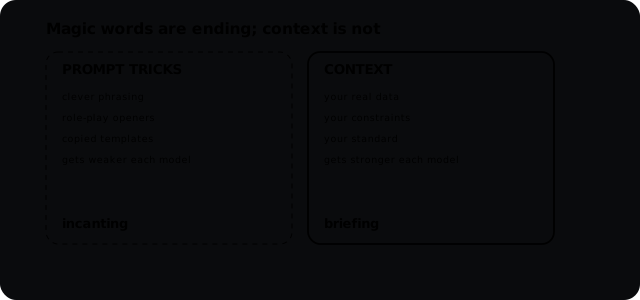
Meanwhile, notice what didn't expire across all those generations — what works better on every model, old and new, and will work on the next one: telling it what you actually need, with the information needed to deliver it. Context never expires, because context isn't a workaround. It's the actual input.
Prompt tricks are patches for model weaknesses — and weaknesses are what the labs fix. Context isn't a patch. It's the half of the conversation that was always yours to bring.
The real diagnosis: context deficit
Run the autopsy on your last disappointing AI output. "Write a post about productivity" → the average internet post about productivity. Of course: the model produces the statistically typical answer to the request as given — and the request, as given, was typical. It didn't know your audience, your contrarian position, your voice, your examples, what you'd be embarrassed to publish. No phrasing conjures information that was never provided; the deficiency was upstream of the wording entirely.
Now the same request, briefed: who it's for (service founders, skeptical of productivity content), what you believe that they don't expect (busyness is the disease, not the cure), two samples of your actual writing, three things to avoid (listicles, hustle tone, the word 'unlock'), the format and length, the bar ('would the sharpest founder I know forward this?') — and the output transforms. Not because better words unlocked the model. Because the model finally received the inputs the task always required — the same inputs a talented freelancer would have needed, and for the same reason. The instrument was never locked. It was uninformed.
The skill that compounds: briefing
Which surfaces the actual skill — the one that was always underneath good results and transfers to every model, tool, and human you'll ever work with. Three layers:
- Context provision. Assemble what the executor needs to know before asking: background, audience, constraints, and above all examples of good — nothing communicates a standard like an instance of it. (The discipline is identical to briefing a human, which is why people who delegate well got good at AI in a weekend, and people who delegate by vibes blame the model.)
- Outcome specification. Define done: format, length, tone, who judges it, what failure looks like. "Make it better" is not a spec for machines or people — the SOP rules apply to requests too: verifiable is executable.
- Editorial iteration. Treat every first output as a first draft and yourself as the editor: "more direct; cut section two; match the rhythm of this example." The request-revise loop is where the quality actually gets made — and the people disappointed by AI are overwhelmingly the ones who stopped at draft one, graded it as a verdict, and left.
Call the trio briefing, because that's what it is — and notice its strategic property: it compounds. Better briefing skills improve every output, on every model, forever — and they improve your human delegation as a side effect, which the prompt courses never mention because it can't be sold as a secret.
What this means for your business
Three practical conclusions. Don't hire the incantation specialist — teach your domain experts the briefing layer instead; they already own the context, which was always the scarce half. Institutionalize the context — the reason the same prompt produces gold for one business and mush for another is what each could feed it, and a knowledge base is context provision built once, serving every request after. And for recurring work, buy the engineered system, not the heroic prompt — in a well-built agent, the prompting is engineered: once, professionally, tested against your real cases, wired to your real context — which makes every individual user's phrasing skill pleasantly irrelevant. That's the mature shape of all this: prompting as infrastructure, not performance.
Stop asking "what's the right prompt?" and ask "what would a brilliant freelancer need from me to do this well?" — then provide exactly that. The question has never once changed its answer across any model release, which is how you know it was the real skill all along.
The prompt engineered once. The context built in.
We build agents where the briefing is infrastructure — grounded in your knowledge, tested on your cases, independent of anyone's phrasing. Audit first, always.
Get your Agent Blueprint →Frequently asked questions
Is prompt engineering still a valuable skill?
Its magic-words form decays with every model release — tricks are patches for weaknesses the labs keep fixing. The durable layer is briefing: context, outcome specs, iteration. That compounds.
Why are my AI outputs generic and mediocre?
Context deficit: a typical request produces the statistically typical answer. Add audience, position, examples of your actual standard, and constraints — the fix is upstream of the wording.
What should I learn instead of prompt tricks?
The briefing trio: context provision (backgrounds, examples of good), outcome specification (define done), and editorial iteration (first outputs are first drafts). All three transfer to every model — and to humans.
Do businesses need a prompt engineer?
Rarely: teach domain experts to brief, institutionalize context in a knowledge base, and for recurring work use systems where the prompting is engineered once — making individual phrasing skill irrelevant.