The productivity paradox
Run the honest audit on someone a year into heavy AI use and the typical finding is uncomfortable: dramatically more output, roughly the same outcomes. More documents, more drafts, more options, more content — same revenue, same progress on the thing that actually matters, same Sunday-night feeling of being behind.
The reason is structural. For most knowledge workers, output was never the bottleneck. The bottleneck was upstream — deciding what's worth doing, focusing long enough to do it well, and saying no to everything else. AI multiplies the production step while leaving the real constraints untouched. Multiply production against an unchanged decision bottleneck and you don't get progress; you get a bigger pile in front of the same narrow gate.
So the question that decides whether AI makes you productive isn't "which tools?" It's: what is my actual constraint — and does this delegation relieve it or feed it?
The delegation framework: hand off, keep, kill
Take your recurring work and sort it into three buckets:
| Bucket | Task shape | Examples |
|---|---|---|
| Hand off | Structured, high-volume, low-judgment | First drafts, summaries, meeting notes, research synthesis, formatting, data cleanup, routine replies, scheduling |
| Keep | Judgment, taste, relationships, accountability | Final decisions, anything a client will associate with you personally, hard conversations, strategy, what-to-do-next |
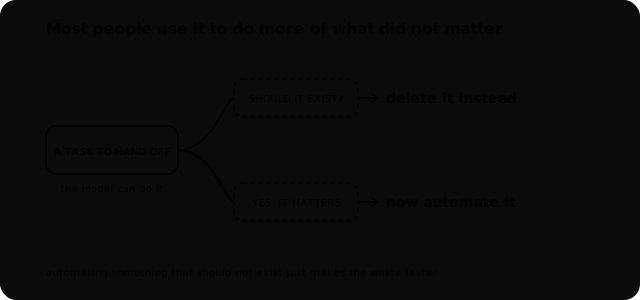
| Kill | Wouldn't survive the question "why does this exist?" | Reports nobody reads, meetings that are status theater, content produced because the calendar says so |
The third bucket is the one everyone skips, and it's where the paradox hides. The worst use of AI is doing efficiently what shouldn't be done at all. Before automating the weekly report, ask who reads it. The most productive thing AI can do for that report is nothing — you just couldn't see that while you were too busy writing it.
Two rules for the hand-off bucket. First, AI drafts, you decide — anything leaving your hands under your name passes through your judgment, which is both quality control and the moat. Second, delegate the whole task shape, not one instance: build a reusable prompt with your context, voice, and format once, and the hand-off compounds with every use instead of starting over.
AI is the cheapest employee you'll ever hire and the worst CEO you could ever appoint. Hand it the production. Never hand it the priorities.
Building your stack: one tool, used deeply
The tool-collecting instinct feels productive and works against you. Every new tool is a context switch, a login, a subscription, and another place your information fragments. The professionals getting real leverage run embarrassingly small stacks:
- One general assistant, used deeply. Claude, ChatGPT, or Gemini — pick one and run your actual work through it for two weeks: every draft, every summary, every thinking-out-loud session. The goal is calibration: knowing precisely where it's excellent, where it's mediocre, and where it confidently fails. That calibration — not the tool — is the skill.
- Specialists only at proven ceilings. Meeting transcription, code assistance, design generation — added when you hit a real limit, not when a launch video is good.
- Automation when tasks repeat without you. When the same multi-step process runs weekly regardless of your involvement — lead follow-up, reporting, invoice chasing — that's no longer assistant territory; that's agent territory, where the work happens whether or not you showed up.
The workflow that compounds
The daily shape that separates the compounding users from the busy ones:
- Start with the decision, not the chat. Each morning, decide the one thing that must move today — before opening any AI tool. Otherwise the tool's suggestions become your priorities, which is delegation in the wrong direction.
- Batch the delegation. Queue your hand-off work and run it in one or two sessions instead of pinging the assistant forty times a day. Each ping feels free; each is a context switch — and switching is the most expensive thing you do.
- Protect a daily deep block for the kept work. AI compressed your shallow work; the entire payoff is what you do with the reclaimed attention. Spend it on the judgment work in a protected 60–90 minute block, or watch it dissolve into email.
- Review the delegation weekly. What did AI handle well? What did you redo? What new task crossed into hand-off territory? Ten minutes a week keeps the system improving instead of fossilizing.
The bottleneck moves downstream — to you
Here's the second-order effect nobody warns you about: delegate production successfully, and the bottleneck doesn't disappear — it moves downstream into your judgment. More drafts to evaluate, more options to choose between, more ideas that are now cheap to explore. Your inbox of decisions grows precisely because your output capacity exploded.
This is why heavy AI users often report feeling more overwhelmed, not less — and why the decisive skills of the next decade are evaluative, not generative: knowing what good looks like, killing options fast, and saying no to work that's now trivially easy to start. Generation became free. Selection became the job.
The human half of the equation
Which leads to the conclusion most productivity content can't say, because it isn't a tool you can affiliate-link: the binding constraint on an AI-augmented professional is the state of the human.
Selection runs on judgment. Judgment runs on attention. Attention runs on sleep, a regulated nervous system, and a reward system that hasn't been recalibrated by the scroll. An exhausted, overstimulated person with the world's best AI stack produces noise at unprecedented speed — we've all met them, and some of us have been them.
So the highest-ROI productivity investment in the AI era is, slightly absurdly, the oldest one: your energy, your focus, your recovery. The machines scaled. The question is whether the human did.
Stop measuring AI by output produced — measure it by attention reclaimed and reinvested. If your freed hours aren't landing on the work only you can do, you haven't automated your job. You've automated your busyness.
The machines are handled. How's the human?
Find out where your real constraint is — energy, focus, or the system underneath. Seven questions, about a minute.
Take the Free Assessment →Frequently asked questions
What is the best way to use AI for productivity?
Delegate by task shape: hand AI structured, high-volume work — drafts, summaries, research synthesis, formatting, routine replies. Keep judgment, taste, relationships, and accountability. And reinvest the freed hours deliberately, or the gains evaporate into email.
Which AI tools should I start with?
One general assistant — Claude, ChatGPT, or Gemini — used deeply on your real work for two weeks until you know exactly where it's strong and where it fails. Add specialists only at proven ceilings. Tool sprawl is the productivity killer dressed as productivity.
Why am I not more productive even though I use AI?
Usually one of three: you're delegating the wrong tasks while your real bottleneck is decisions or focus; the saved time is leaking back into email and scrolling; or AI output has flooded your pipeline beyond what your judgment can process. Gains materialize when the human side scales with the machine side.
Can AI replace deep work?
No — it raises its value. AI compresses shallow work; what remains is exactly the work requiring sustained human attention: original thinking, hard decisions, taste. The users who compound pair AI with a protected deep-work practice.