The strangest business model in the economy
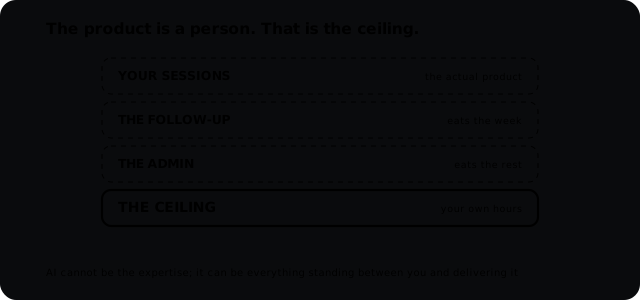
Every other business sells something separable from its maker — the bakery sells bread, not the baker. Expertise businesses sell the maker: your judgment on their situation, your presence in the hard conversation, your particular lens built from a decade of reps that no competitor can shortcut. It's the purest version of what this site calls the human side of the inversion — judgment, trust, and presence as the entire product line.
The model's moat and its ceiling are the same fact. Nobody can copy you — and nothing can multiply you. Revenue = your hours × your rate, and both terms have hard limits: the calendar fills, the energy depletes, and the rate rises only as far as positioning allows. Which is why every expertise business eventually meets the same wall, usually around the moment it succeeds: fully booked, fully exhausted, and earning less per hour than the invoices suggest — because half the hours were never billable at all.
The back office on fire
Audit an established coach's or consultant's real week — we have, many times — and the composition is remarkably stable: 40–60% of working hours are operations, none of them the product. The inquiry answered at 21:40 (because there's no one else to answer). The scheduling tennis, four emails per appointment. The intake forms chased, the session notes written, the no-show absorbed (an hour of inventory, expired unsold), the invoice nudged with the awkwardness of nagging someone you personally counsel. The content that should market the practice, perpetually deferred because client work eats the week.
Here's the detail that makes it worse than ordinary solo-business ops load: in an expertise business, every operational hour is taken from the product itself — your energy and presence are the inventory, and the inbox is consuming them before the clients do. The tired expert delivering at 70% because the morning went to admin isn't saving money on staff. They're discounting the only product they sell.
Clients pay premium rates for your full attention — and the back office has been skimming it for years. The fire wasn't burning your time. It was burning the product.
The division of labor, drawn honestly
What stays yours — permanently: the session itself, the judgment on a specific human's specific situation, the challenge delivered at the right moment, the trust built across months, the program design that encodes your method. This is the work clients buy, the work machines genuinely can't hold, and — not incidentally — the work you became an expert to do.
What goes to the machines — now: the entire rule-shaped orbit. Inquiry response and qualification. Booking, reminders, rescheduling. Onboarding sequences. Routine client questions (your policies, logistics, program details — grounded in your actual documents). Invoice issuing and chasing. Content repurposing — the talk becoming the posts becoming the newsletter, mechanical work on thinking you already did. This is the standard three-pile sort with an unusually clean result, because expertise businesses have an unusually sharp line between the person-work and the orbit.
The expertise-business stack
- The front door, staffed in seconds. Your structural disadvantage: inquiries arrive while you're in session — always, that's the job — and the 5-minute window doesn't pause for it. An agent answering instantly, qualifying in your voice, and booking discovery calls into your real calendar converts the leak with the clearest math in the whole stack. For most practices, this layer alone funds everything else.
- Scheduling without the tennis. Booking links, reminder sequences (no-shows are pure expired inventory for hourly businesses — reminders cut them 30–50%), self-service rescheduling. The four-email appointment becomes zero emails.
- Onboarding on rails. Welcome, intake, expectations, first booking — identical and immediate, whatever week you're having. First impressions are retention infrastructure, and yours currently fluctuate with your load.
- The knowledge layer. Your method, policies, and program details documented once — answering client logistics questions at 23:00, training future collaborators, and (the quiet payoff) becoming the grounded brain every other agent in the stack answers from.
- The content engine — repurposing, not generating. The honest version: AI shouldn't write your thinking (generic thinking is the one thing your market punishes), but it excels at re-forming it — the workshop transcript into posts, the session insight (anonymized) into the newsletter. Your lens, multiplied; never replaced.
The between-sessions question
The frontier question for coaches specifically: should AI touch the client work itself? The honest map has a bright line down the middle.
Legitimate and genuinely powerful: the between-sessions layer. Your client's change happens on Tuesday at 23:00, not in Thursday's session — the 167-hours problem is the oldest limitation of the craft — and a well-built companion (running your protocols, tracking patterns, present at the moment of the pattern) extends your method into hours you were never going to staff. Disclosed, branded as the tool it is, it makes your human sessions more valuable: the client arrives with two weeks of data instead of two weeks of fog.
The line: impersonation. AI answering as-if-you in client conversations, undisclosed, converts the moment of discovery into a trust collapse — and trust is the entire balance sheet of an expertise business. The rule is one sentence: machines may extend your method openly; they may never wear your face quietly.
Scaling a person, properly
With the orbit automated, the recovered 15–25 weekly hours fund the actual scaling sequence — in order: productize (defined programs at defined prices; custom-everything is why the ops were burning — the standardize-first logic applies doubly when the product is you), raise prices to match the now-undiluted product (full-attention delivery justifies the number the exhausted version couldn't), add one-to-many layers (the group program, the digital product — your method reaching people your calendar never could), and only then consider humans, usually fractional, for the judgment-adjacent work. The destination isn't an agency. It's a practice where 80% of your hours are the work only you can do — which is what the clients were paying for all along, finally delivered at full strength.
You don't have a scaling problem — you have a protection problem: the product (your attention, judgment, presence) has been unguarded against the operational fire for years. AI's job in an expertise business was never to be you. It's to be the staff you couldn't afford — so the clients finally get the version of you they were always paying for.
Your back office, audited and priced.
The audit maps where your week actually goes — the front-door leak, the orbit hours, the expired inventory — before anything is built. If the numbers don't show a clear return, we don't build.
Get your Agent Blueprint →Frequently asked questions
Can AI replace coaches and consultants?
The judgment-and-presence core, no — clients buy the human reading of their situation. The 40–60% operational orbit around it, yes — and that orbit was limiting how much product existed to sell.
What should a coach or consultant automate first?
Inquiry response: you're always in session, inquiries age into someone else's client, and an agent answering in seconds with your qualifying questions typically pays for the entire stack. Then scheduling, onboarding, follow-up, invoicing.
Should coaches use AI in their actual coaching?
Between sessions, disclosed — yes: presence at the 11pm moment, pattern tracking, your protocols extended into the 167 hours. Impersonating you in client conversations, undisclosed — never; discovery converts to trust collapse.
How do solo experts scale without hiring or burning out?
Productize the offer, automate the orbit (15–25 weekly hours back), add one-to-many layers on the recovered time, then fractional help. Target: 80% of your hours on work only you can do.