When growth arrives as punishment
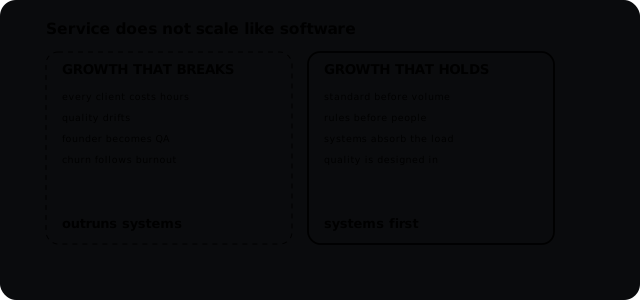
The pattern repeats in almost every service business we audit. The good year arrives — referrals compound, the pipeline fills — and growth, the thing everyone wanted, starts collecting: delivery quality wobbles because the method lived in two people's heads and now six people are improvising it; the founder re-absorbs work they'd delegated because "it's faster"; the best employee — the one carrying the standard — quietly starts interviewing; and the clients who built the business feel the difference first, because they knew what it was like when it was small. Revenue up, everything else down. More turned out to be a multiplier, and it multiplied what was there — including the chaos.
The diagnosis is structural, not moral: a service business's unit of production is human hours, and humans don't copy. Software scales by duplication; services scale only by changing the architecture around the humans — and the order of those changes is nearly everything. The sequence that works has three stages, and the expensive mistake is always the same one: running them backwards.
Stage 1: Standardize — make excellence reproducible
Productize the offer. Custom-everything can't scale, because every sale creates a novel delivery problem — new scope, new process, new ways to overrun. The move: define the two or three offers that produce most of your results (who they're for, exactly what's delivered, at what price), and let the bespoke work become the exception with exception pricing, not the default. Constraint here is a feature — clients buy confidence, and a defined offer delivered excellently beats infinite flexibility delivered variably. (Your qualification gets sharper for free: a defined offer defines its fit.)
Extract the method. The quality clients pay for currently lives in your head and your senior people's habits — which means growth dilutes it by exactly the ratio of new hands to old. The extraction toolkit already exists on this site: record-then-document SOPs, checklists at the failure points, the stuck-test on the least experienced person. The stage-1 exit exam: a competent new person delivers 80% of your quality in their first month, from your documentation. Until that's true, every growth dollar buys dilution.
Fix the unit economics before multiplying them. Price-per-engagement minus fully-loaded delivery cost, per offer, honestly. Thin or negative margins scale faster than revenue does — and the fix is usually pricing courage, not cost-cutting: the documented, productized offer you just built justifies the number the old chaos couldn't.
What you scale is whatever exists when you hit the accelerator. Standardization isn't bureaucracy — it's deciding that the thing being multiplied is the excellence, not the improvisation.
Stage 2: Leverage — clear the rules-work first
Here's the audit finding that surprises every service founder: 30–50% of the hours in a typical service operation aren't the service. They're the rules-work orbiting it — scheduling and rescheduling, reminders, lead first-response, onboarding sequences, status updates, report assembly, invoice chasing. Skilled, expensive humans spending a third of their week as workflow engines, while the actual delivery — the thing clients pay for — competes for what's left.
Stage 2 hands that orbit to machines: the automation layer, built workflow by workflow, highest payback first — exactly the three-pile sort applied at company scale. The result reads like arithmetic because it is: each human hour redirects to billable, quality-bearing work, and many service businesses grow revenue 50–100% on the same headcount before any multiplication happens. Stage 2 is also why stage 3 gets cheaper: the role you eventually hire for has been stripped to its human core, which changes both who you need and how long they take to pay back.
Stage 3: Multiply — hire onto systems
Now — and only now — headcount. The difference between hiring at stage 3 versus stage 0 is the difference between multiplication and dilution: the new person arrives to documented methods (ramp-up in weeks, not quarters), automated rails (no inherited chaos to fight), and a job description that's honestly human — delivery, judgment, client care — because the rules-work already has a home. Delegation works here because there's something coherent to delegate.
The stage-3 disciplines: hire against documented demand (a pipeline your conversion data supports, not optimism); expect each delivery hire to be margin-positive by month two or three (your stage-1 economics make this checkable); and protect the standard as you grow — the weekly quality review of real work against the documented bar, because entropy never stops applying and the vacation test should get more boring every year, not less.
The human gauge: scaling's real constraint
The closing layer, from the behavioral side of the house, because it's the one the operations advice always skips: service businesses run on nervous systems. The delivery quality, the client warmth, the judgment in the hard moments — all of it is produced by humans whose capacity is biological, and scaling pressure lands on exactly that biology: the team's load accumulates, the founder's burnout becomes a company-level event, and "we'll rest after this push" becomes the permanent weather.
So build the human gauge into the scaling dashboard: sustainable load as a tracked variable (the owner-hours KPI, team-wide), recovery treated as infrastructure rather than reward, and growth paced to what the humans can carry well — because the alternative isn't faster growth; it's the version where the turnover, the quality slips, and the founder's collapse arrive as surprise line items on the growth you thought you'd banked. The businesses that scale beautifully aren't the ones that pushed hardest. They're the ones where the machines took the machine-work, the humans kept the human work, and nobody had to become a system to survive their own success. That was the whole point — of the growth, and honestly, of everything we build.
Stop asking "how do we handle more clients?" and ask "what, exactly, would we be multiplying?" If the answer is documented excellence on automated rails — accelerate. If it's improvisation held together by heroics — every new client is a vote for the version of the company you already can't sustain. Standardize. Leverage. Then multiply.
Find your 30–50%.
The audit maps how much of your team's week is rules-work orbiting the service — and what clearing it would return before you hire anyone. If the numbers don't show a clear return, we don't build.
Get your Agent Blueprint →Frequently asked questions
Why is scaling a service business so hard?
The unit of production is human hours, and humans don't copy — growth without changed architecture means the same people doing more, billed later as quality slips, burnout, and turnover. The real problem: making excellence reproducible by people who aren't you.
What should I fix before trying to scale?
Productize the offer, document the delivery method (test: a new hire hits 80% of your quality in month one), and fix unit economics — margin problems scale faster than revenue.
How do I scale without hiring a huge team?
Automate the rules-orbit first (30–50% of most service operations' hours), redirect human hours to billable work, and raise prices to documented value. Many businesses grow 50–100% on the same headcount.
When is the right time to hire?
After standardization and leverage: onto systems, against documented demand, margin-positive by month two or three — for judgment-and-care roles, because the rules-work already has a home.